
- Status
- Public consultation draft · Version 1.0 · A research proposal for discussion
- Published
- 10 November 2026
- Comments close
- 15 January 2027
- DOI
- 10.5281/zenodo.24104750
- Licence
- CC BY 4.0
- Respond to
- contact@technologystewardship.org, quoting the section or question number
Abstract
An AI agent can retain valid access credentials after the conditions justifying its authority have changed. This paper proposes the Agent Authority Manifest (AAM), a governance architecture that connects permission to act with the conditions required for continued operation. A portable manifest records the agent's authority, while supporting arrangements define whose evidence is accepted, which actions are restricted when conditions fail, and how authority may be restored. AAM covers activity within an organization and across organizational boundaries, including oversight, delegation, challenge and operation with intermittent connectivity. Through illustrative cases and comparison with existing standards, the paper examines whether a shared agreement on continuing authority can help independently administered systems reach consistent, accountable decisions.
Keywords: AI agents; operational authority; authorization; evidence; recovery; Internet governance.
How to comment. Comments are open until 15 January 2027. Please email contact@technologystewardship.org, quoting the section or question number. Please say briefly who you are responding as (for example operator, developer, regulator or civil society) and whether your answer draws on direct experience. A comment log will accompany the next public paper. Individual responses and quotations will be published only with permission. Please state your attribution preference and identify confidential material. Critical comments are as welcome as supportive ones.
Section 8 lists the consultation questions. Operators may wish to start with questions 1, 5 and 7; standards participants with 2 and 6; and policy, legal and civil-society contributors with 3, 4 and 8.
1. The problem
Authorization settles what an agent may do, for whom and within which limits. But the facts behind that decision can change while the agent is working. AAM is about what happens next: how those changes affect the agent's authority, which actions should stop, and who may let them start again.
A company authorizes a customer-service agent to issue credits of up to USD 50 to eligible customers, using an approved model. A model update is deployed before the required assessment has been completed. The company's deployment record identifies the unassessed release. Although the agent's access credential remains valid, the company suspends automated credit issuance while staff handle customers' requests under separate authorization. Reinstating the approved model resolves the version mismatch. The agent may resume issuing credits only when the required eligibility evidence is available and the agreed recovery procedure has been completed. Credits issued between the update and the suspension fall inside an exposure window, which the company reviews (section 3). Section 2 gives a worked example of the manifest for this case.
Agent access to telecom capabilities across organizations has started to appear in trials and designs. In February 2026, Telefónica and Nokia reported laboratory testing of a bank fraud-prevention agent using network APIs, including SIM Swap and Device Swap, through Model Context Protocol (MCP) and Agent-to-Agent (A2A) integration [12]. CAMARA's January 2026 position paper describes network APIs exposed as tools for AI applications, including a video-streaming Quality on Demand (QoD) example [13].
Take an illustrative case: a video-service agent authorized to request an operator-offered Quality on Demand profile for specified customer sessions, within agreed cost and duration limits. Assume the agreement also requires an assessed agent configuration and current entitlement evidence. An unassessed model update or missing evidence restricts the dependent requests even if the access credential remains valid. Recovery follows the agreed route, and the operator retains control of its network. Existing sessions follow their own expiry and continuity rules.
A prospective extension involves Operator A's agent requesting agreed routing treatment through Operator B's contracted service interface, with B retaining admission and execution control. Inter-network routing already has precedents for requests that the receiving network decides whether to honor: action communities, blackholing and FlowSpec [14, 15]. Agentic-payment initiatives raise the same authority questions across consumers, agents, merchants and payment providers [16]. The AAM conditions in these examples are this paper's own proposal, applied to published trials and designs.
Inside one organization, a strong local policy engine can handle much of this. The harder case is several independently run services that must read the same evidence, restrictions and recovery decisions in the same way. AAM proposes a written, testable agreement for that. It works within a single organization too, but its cross-boundary profile is where it adds most: explicit receiver acceptance and a shared reading of authority. Whether that is worth the effort has to be judged against what existing standards and local policies already provide.
Why ITS is proposing this. In telecom network operations, automation acting on a stale view of the network is a familiar risk: the system is still authorized, but the facts it relied on have moved. A documented precedent from finance shows the configuration variant of the problem. In the 2012 Knight Capital incident, new code reached seven of eight order-routing servers; the eighth kept running obsolete code with valid market access, and the firm lost more than USD 460 million in about 45 minutes [17]. AI agents bring that problem to every sector, and across organizational boundaries, where no single operator can see it or fix it alone. This paper sets out one possible answer so that others can test it.
2. Scope and architecture
AAM covers how an AI agent is authorized to act, and how that authority is used, restricted or restored. The manifest names the principal the agent acts for, what it may do and to which resources, and the conditions and limits that apply. It travels inside existing authorization mechanisms, or is referenced from them, using agreed formats and established signing methods. Around it sits the governance arrangements: who decides, who supplies evidence, who enforces, and how decisions can be challenged. None of this works unless issuers and receivers mean the same thing by what they exchange.
The agreement answers these questions:
Which operating conditions must hold for the agent to act?
Who may provide evidence for each condition, and how recent must it be?
Which actions are restricted when a condition fails, and what service may continue?
How may authority resume, who decides, and how can the evidence or decision be challenged?
Authorization and operational evidence serve different purposes. Authorization evidence records who approved a grant and the basis for that decision. Operational evidence indicates whether the conditions attached to the grant still hold. Only a grant creates authority, and only current evidence shows that a condition holds.
In practice, the agreement records who the agent is and who answers for it, what it may do, the conditions it depends on, and whose evidence counts. It says how long authority is valid, what is restricted when a condition fails and what service continues. And it names the recovery route, who may restore operations, and the records and challenge procedures needed to examine a decision afterwards.
Five layers connect the common rules to their use in practice (Figure 1). The governance core establishes the duties, and a domain profile interprets them for a sector. The organization’s authority policy sets the actual thresholds, protected resources, assessors and recovery decisions. Existing standards and implementation mechanisms support authorization, policy decisions, access-change signals, attestation and records. The execution environment applies the agreed rules to each operation; existing infrastructure may require adaptation to fulfil those duties.
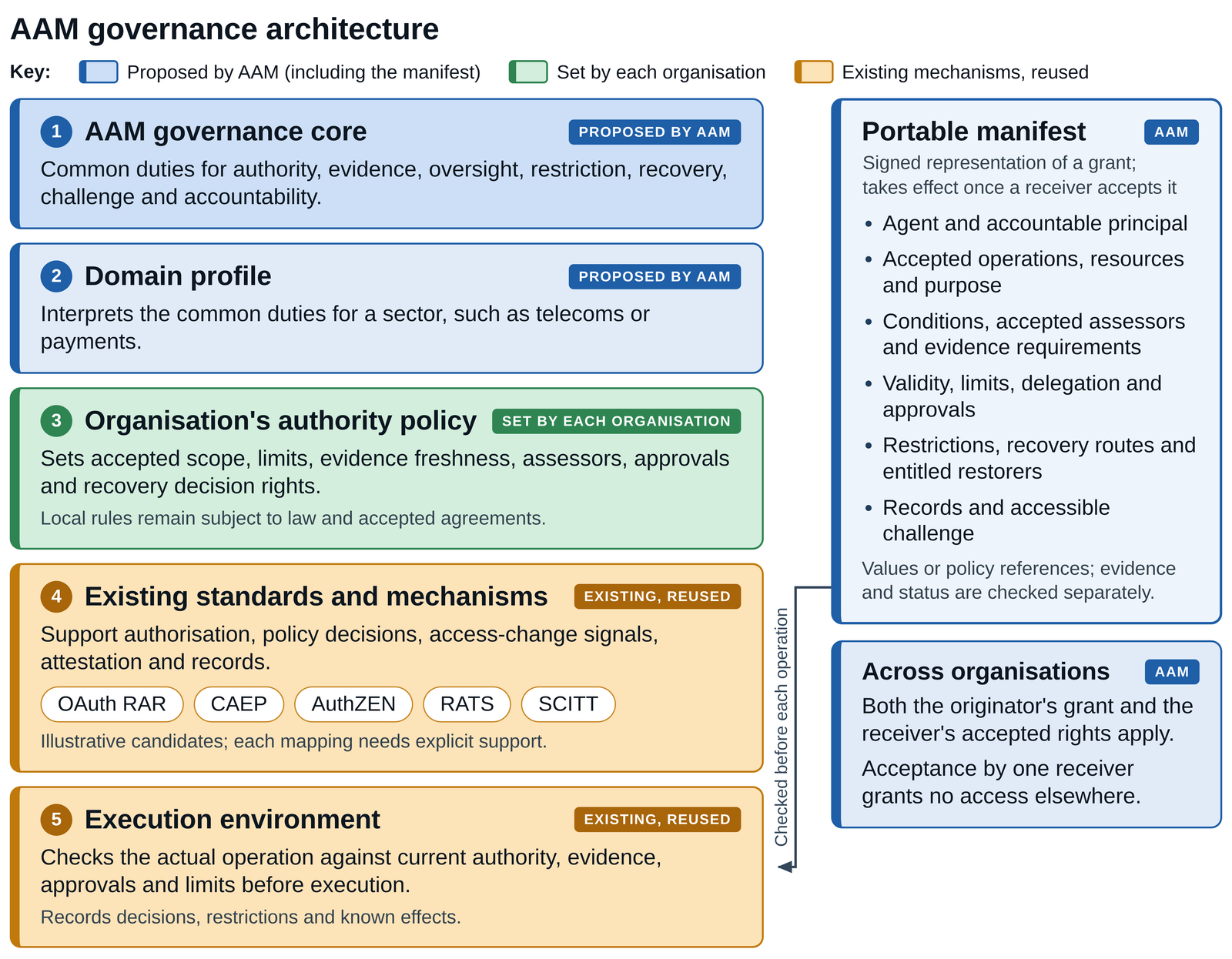
AAM can be adopted on its own, without a wider governance framework. It relies on existing identity and cryptographic mechanisms, and there is no global registry to join. Each receiver chooses its own trust arrangements and keeps control of its resources. A valid signature tells you who sent a report; whether the report is accurate is a separate question.
Lifecycle. The terms follow one sequence. An entitled authorizer issues a grant, and the manifest is its signed, portable form. The receiver records a decision on that manifest version: acceptance or refusal (XB02). Only an accepted manifest is in force on that receiver's resources. While in force it may be restricted and restored through the declared routes. It ends by expiry, or by supersession through a new grant that needs its own acceptance.
| State | Meaning | What moves it on |
|---|---|---|
| Proposed | The manifest has been issued and presented. It carries no authority on the receiver's resources. | The receiver accepts or refuses. |
| Refused | The receiver's recorded refusal of that manifest version. | The issuer may present a revised manifest. |
| Accepted, in force | Operations are admitted while their conditions hold. | A failed condition restricts the dependent operations. |
| Restricted | Affected operations run in the permitted mode or stop. Each cause is recorded. | An entitled restorer decides by the declared route; each receiver lifts its own refusal. |
| Ended | The manifest has expired or been superseded by a new accepted manifest. | Open restrictions carry over to the successor (section 3). |
Worked example of a manifest
For the customer-credit case, the manifest could record or reference the entries below. The values are illustrative and the format is open. Supporting evidence and role appointments are verified separately.
| Entry | Illustrative value or policy reference |
|---|---|
| Agent and principal | Agent CS-17 acts for the company's customer-operations unit. The credits service is the receiver and final executor. |
| Grant and scope | The company's entitled authorizer permits credits of up to USD 50 per eligible case, limited to one credit per case. |
| Validity | Eight hours from issue; current authority checked before each write. No offline credit writes. |
| Conditions and evidence | Approved release R3, supported by an accepted deployment report bound to CS-17. Eligibility evidence must be no more than five minutes old. |
| Accepted assessors | The appointed deployment-assurance team reports configuration. The appointed billing service supplies eligibility evidence, each within its recorded remit and validity. |
| Restriction and continuity | Suspend dependent credit writes when either condition is unmet or unestablished. Staff may act only through their separately authorized route. |
| Detection bounds and exposure review | One minute for configuration: deployment changes are reported within that time. Five minutes for eligibility: the limit on evidence age. Credits written after a condition failed and before suspension are listed for supervisor review within one working day. |
| Recovery and restorer | Targeted reassessment by an entitled customer-operations supervisor separate from the assessors. Resolve each restriction cause and recheck both conditions before resumption. |
| Records and challenge | Link the grant, operation, evidence, restriction causes and recovery decision. Affected customers may challenge through the declared customer-service route. |
3. Restricting and restoring authority
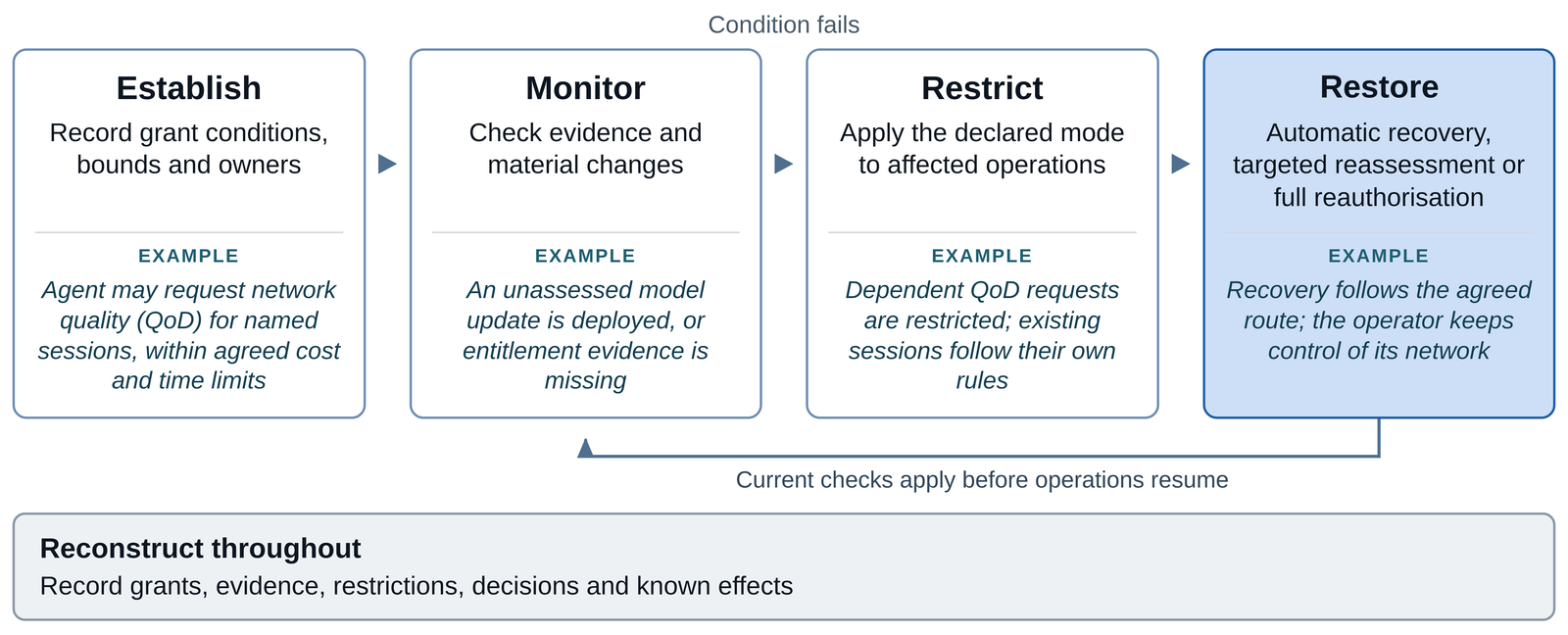
Each grant states the conditions attached to its operations, such as use of an approved model or the absence of protected traffic on a network path. It also says what evidence is needed, how old a report may be and how many assessors are required. The receiver decides which assessors it accepts and what independence they must demonstrate. A configuration condition requires an accepted deployment report, attestation or other agreed signal bound to the agent performing the operation. AAM specifies how such evidence affects authority; the deployment must supply a trustworthy means of obtaining it. A dependent operation is refused if a mandatory condition is false, cannot be interpreted, or lacks current accepted evidence. Conflicting reports on the same condition from accepted assessors, each within its remit and freshness limit, create a restriction on the affected operations.
Modes and continuity. When a condition fails, the affected operation moves to the mode permitted by the grant: limited (execution within enforceable limits), proposal only, read only or stopped. Full mode applies only while every mandatory condition for that operation holds. Other operations may continue under their own authority and conditions. The modes are not a safety ladder: reading can still expose sensitive information, and a proposal can still prompt someone to act. Each mode therefore requires explicit permission. Hard prohibitions, meaning actions the grant or the receiver's policy forbids in every mode and on every route, apply throughout.
Exposure window. A restriction cannot take effect before a failure is detected. Four moments matter: the fact changes; an assessor observes it; the report is issued and reaches the receiver; and the restriction takes effect where the operation can be prevented. Each mandatory condition has its own declared detection bound: the longest interval the parties accept from the first moment to the last. A freshness limit governs only the age of accepted evidence. It equals the detection bound only where every operation is checked at execution against evidence that carries a protected time of observation; otherwise, observation intervals, reporting and propagation delays add to it. Evidence without a reliable observation time is treated as unestablished.
Each bound is justified in the agreement and reviewed periodically, and actual detection latency is measured against it. If a bound cannot be kept, for example because an evidence source is unavailable, the condition counts as unestablished and the dependent operations are restricted. The bound concerns new admissions. Effects already admitted, such as a session running to its agreed expiry, continue under the declared continuity rule, and their remaining duration is recorded. Operations admitted inside the window are identified from the records and reviewed through a declared route that states who reviews them, by when, and what may be reversed or remedied.
Recovery follows one of three routes agreed in advance. A release applies only to the stated incident and operations; it leaves other unresolved restrictions in place.
| Recovery route | When it applies |
|---|---|
| Automatic recovery | A defined transient interruption, pre-authorized in the grant, with no material change and current conditions satisfied. |
| Targeted reassessment | A bounded material change, accepted dispute or incident requiring closure. An entitled restorer decides for the specified incident and operation subset. |
| Full reauthorization | The scope or basis of authority has changed. An entitled authorizer issues a new or revised grant through the applicable acceptance process. |
When reassessment or a new grant is required, fresh telemetry alone does not restore authority; the decision does. The governance agreement identifies roles that must be kept separate because of their consequences or conflicts of interest. By default, the party providing evidence for a condition may not authorize the restoration of operations that depend on it. Independence must be demonstrated on substance; separate names, keys or organizations are only a starting point.
Delegation, approvals and execution. A sub-agent inherits every applicable constraint on the authority delegated to it, including purpose, conditions, approvals, expiry and limits. Sub-agents share their parent's budget or receive explicit allocations from it, so delegation never enlarges the total. Where approval is required for each execution, it must identify the operation and material parameters, expire after a defined period and permit only one use; hard prohibitions still apply. Before a queued operation runs, the final executor checks its exact parameters against current authority and policy.
An emergency route must be agreed in advance. It must identify who may invoke it, the trigger, the conditions and actions it covers, its duration, and the required records and independent review. Required oversight and hard prohibitions still apply to it. Any separately authorized continuity service remains subject to its own conditions. Where refusing an operation could itself cause harm, the parties assess that impact when the condition is set and record which of a limited mode, a continuity service or the emergency route applies, who authorizes it and how its use is reviewed.
Disagreement and unavailable restorers. The parties must agree how conflicting evidence will be examined and who can decide whether an operation may resume. If the required restorer is unavailable, the restriction stays in place. Unresolved restrictions on an operation survive a replacement grant: they must be resolved or expressly superseded through an entitled decision and the receiver's acceptance process, with the decision recorded. A decision can supersede only those restrictions over which its maker holds authority, and it records their scope and the reasons. A new grant never lifts another party's refusal. Current mandatory conditions and hard prohibitions continue to apply. Replacement and escalation arrangements may be agreed in advance, subject to the same entitlement and conflict rules. Resumption always needs a positive decision, however long the wait; for automatic recovery, that decision is the pre-authorization recorded in the grant. In the end, whether this is safe depends on evidence quality, enforcement and the continuity arrangements.
Proportionate adoption. An organization or bilateral partnership may begin with one operation, one condition, an accepted assessor and an entitled restorer. Delegation, disconnected operation, emergency authority and approval for individual executions bring additional duties whenever they are used. A bounded application must still meet every obligation relevant to it. Writing responsibilities down is the easy part. The parties also need people with the competence and capacity to carry them out, a way to manage conflicts of interest, and cover when someone is unavailable.
Conformance rests on nine duties. D1 to D9 are the baseline proposed in this consultation. Each has a duty-holder, a manifest entry (section 2) and a starter test (Appendix A). Delegation, disconnected operation, emergency authority and approval for individual executions add requirements only when they are used. Items still open are listed in section 7.
| Duty | Requirement | Duty-holder | Manifest entry | Test |
|---|---|---|---|---|
| D1 | Identify the accountable principal and the permitted operation. | Issuer | Agent and principal; grant and scope | T1 |
| D2 | State the validity rules for mandatory conditions. | Issuer and receiver | Validity; conditions and evidence | T3 |
| D3 | Establish accepted evidence sources. | Receiver | Accepted assessors | T5 |
| D4 | Specify which authority is restricted when a condition fails and how service may continue. | Issuer and receiver; the final executor enforces | Restriction and continuity | T2, T3 |
| D5 | Declare the recovery route. | Issuer and receiver | Recovery and restorer | T13 |
| D6 | Attribute restoration to an entitled authority without extending prior bounds. | Restorer; the authorizer for a new grant | Recovery and restorer | T6, T7, T13 |
| D7 | Preserve the receiver's right to refuse. | Issuer, federation and adjudicator | Receiver's acceptance (section 4) | T5, T7 |
| D8 | Retain enough information to reconstruct the decision. | Each party for its own decisions; the final executor for execution | Records and challenge | T10 |
| D9 | Declare a detection bound for each mandatory condition, measure against it, and review operations admitted inside the exposure window. | Issuer and receiver declare; the assessor reports observation time; the receiver measures | Detection bounds and exposure review | T2, T4 |
The allocation of duty-holders is a first proposal, and comments on it are invited under question 2.
4. Authority across organizational boundaries
The ten clauses of AAM's cross-boundary profile, AAM-XB, address situations in which an agent's authority originates in one organization and is exercised on another's resources. The originator's permission and the receiver's control of its resources are both binding. The clauses are summarized below.
XB01 Accepted rights. The receiver records which principal and issuer it accepts, for which operations and resources, under which policy and for how long. Those rights come from the receiver's acceptance, over and above authentication or federation membership.
XB02 Explicit handoff. Before a consequential operation, the receiver records acceptance or refusal of the manifest version, purpose, operation and conditions. Each receiver's acceptance covers its own resources only.
XB03 Meaning through translation. Translation between formats preserves every mandatory condition, unit, limit, prohibition and release rule. If a necessary meaning cannot be represented or enforced, the dependent operation is refused.
XB04 Delegation and shared limits. The delegation and budget rules in section 3 apply across every organization involved.
XB05 Dependencies. The agreement records which operations depend on each grant, assessor, configuration or service. Restrictions follow those dependencies, including affected sub-agents and queued operations.
XB06 Disconnected operation. Authority-status age and evidence age have separate limits. Any offline allowance is agreed per operation, anchored to a trusted checkpoint and finite. Reconnection requires reconciliation before further admission.
XB07 Evidence acceptance and challenge. Receivers publish acceptance criteria and a route to propose equivalent assessment. Affected parties can raise concerns without prior registration.
XB08 Purpose and data handling. The agreement specifies purposes, data categories, locations, onward disclosure and retention. Model, tool or service substitutions are checked against these terms. Using data requires its own authority, separate from access.
XB09 Recovery and resumption. Each receiver can identify a restriction's cause, release requirements, entitled decision-maker and restored subset. Each party's valid refusal stands until that party lifts it, whatever others restore.
XB10 Execution and known effects. The final executor checks the actual operation, parameters, authority version, conditions, approvals and any budget reservation. Records distinguish acceptance, dispatch, completion, failure and unknown effects. Reconcile uncertain results before a potentially duplicating retry.
Worked example across a boundary
The Quality on Demand case from section 1 shows how the clauses work when two parties disagree. StreamCo, a video service, authorizes its agent VQ-3 to request an operator's QoD profile for premium subscribers' sessions. The operator controls the QoD interface and its network. Names, times and values are illustrative.
| Entry | Illustrative value or policy reference |
|---|---|
| Originator's grant | StreamCo's entitled authorizer permits VQ-3 to request the high-definition QoD profile for premium subscribers' sessions, for at most 30 minutes a session and within a daily budget. |
| Receiver's acceptance (XB01, XB02) | The operator accepts StreamCo as issuer for QoD requests on its own subscribers' sessions for 90 days, under its network policy, and may refuse any request. |
| Conditions and evidence | Assessed release R7 on every agent instance, attested no more than five minutes before the request. Entitlement evidence observed no more than ten minutes before the request. |
| Accepted evidence sources (XB07) | For configuration: reports from StreamCo's deployment-assurance team, and the attested release identifier each instance presents. For entitlement: StreamCo's subscription service. Every report carries its time of observation. |
| Restriction and continuity | New QoD requests stop when either condition is unmet or unestablished. Sessions already granted run to their agreed expiry without extension; playback continues at best-effort quality. |
| Recovery and restorers (XB09) | Targeted reassessment, requiring current attestation from every instance and a recheck of both conditions. StreamCo's delivery-operations lead, separate from the assurance team, restores on StreamCo's side. The operator's network-operations duty manager lifts the operator's refusal. |
| Detection bounds and exposure review | Five minutes for configuration and ten minutes for entitlement. Each equals the limit on evidence age, because every request is checked against evidence that carries its observation time. Both parties review requests admitted inside a window, and the sessions they started, within two working days. |
The incident runs as follows.
| Time | Event | Basis |
|---|---|---|
| 19:40 | StreamCo deploys release R8 before its assessment is complete. | Condition fails |
| 19:44 | A refreshed attestation shows R8. The operator finds no accepted assessment for R8 and refuses new QoD requests from VQ-3. Sessions already granted run to expiry. | Section 3; XB05, XB10 |
| 19:55 | StreamCo rolls back, and its assurance team reports R7 reinstated. StreamCo's restorer approves resumption on that report without waiting for current attestation from every instance, which the recovery route requires. This is a procedural failure on StreamCo's side. | Section 3 |
| 19:57 | Attestations still show R8 on two of five instances, so two accepted sources conflict and the restriction stays. The premature approval has no effect on the operator's resources: the operator's refusal stands, and each request is checked against current attestation before execution. | Section 3; XB09, XB10 |
| 20:20 | StreamCo finds the incomplete rollback and corrects it. A new report and current attestations from all five instances agree, entitlement evidence is rechecked, and no other restriction is open. StreamCo's restorer confirms, and the operator's duty manager lifts the operator's refusal for QoD requests. | XB09 |
| Next day | Both parties review the requests admitted between 19:40 and 19:44 and the sessions they started, the last of which ended by 20:14. StreamCo also reviews the 19:55 approval. The records link the grant, the evidence, both restriction causes and both release decisions. | Exposure window; XB10 |
The incomplete rollback is the instructive step. The 19:55 report was signed by an accepted assessor and was wrong, and StreamCo's restorer relied on it without the required recheck. A second accepted source exposed the error. The receiver's separate decision, and its check at execution, kept the restriction in place.
The same incident under an underspecified bilateral arrangement. Suppose instead that the parties use OAuth Rich Authorization Requests and a contract that requires an assessed configuration, but have not agreed which signal carries that requirement, which operations a failure restricts, or who decides on recovery [1]. Existing mechanisms permit this arrangement; they do not require it. The two versions diverge at the four points the agreement is meant to settle (section 2).
| Point | Underspecified bilateral arrangement | With AAM |
|---|---|---|
| What counts as a failed condition | The contract names the requirement, but no signal agreed between the parties carries it. The access token stays valid. | The condition, its evidence sources and its freshness limit are in the accepted manifest. |
| Which operations stop | None, until StreamCo tells the operator or the operator notices. The operator's readily available control is to revoke StreamCo's access, which stops every StreamCo operation. | Only new QoD requests stop. Existing sessions and other operations follow their own rules. |
| Who may restart | StreamCo resumes on its own decision after the rollback, and the incomplete rollback goes unseen. If access was revoked, restoring it is negotiated case by case. | Each side has a named decision-maker. The operator's refusal stands until the operator lifts it. |
| What is on record | Each party keeps its own logs. Nothing links cause, restriction and release across the two. | A linked record on both sides, including the exposure-window review. |
These outcomes follow from what the arrangement leaves out, and existing mechanisms can supply each missing piece: CAEP carries access-change signals [2], and the AuthZEN approval profile requires a fresh decision under current policy [7]. The table shows what is at stake; it does not show that AAM is better. A fair comparison gives both approaches equivalent evidence, enforcement capability and operational requirements, and then tests whether AAM reduces omissions, disputes over interpretation, integration effort and recovery errors (section 7). The claim to be tested is that a shared structure makes such arrangements easier to establish and to operate consistently.
5. Governance and participation
Appointments and gatekeeping. Each receiver accepts assessors for specified claims, resources and periods. It may appoint them directly or use voluntary federations; bilateral participation requires no common federation infrastructure. Appointments must provide for updates, withdrawal and substitution. No federation, issuer or adjudicator can compel access beyond the receiver's accepted rights. The safeguards include:
the assessed party cannot alone determine which assessors the receiver accepts;
eligibility and conflict rules are published, with a reasoned process for proposing equivalent assessment;
acceptance, refusal, reversal and concentration are measured and reported with proportionate disclosure.
A dominant receiver could still favor one assessor or federation. So, evaluation has to look at what participation costs, whether substitutes are really available, how concentrated appointments become and how heavy challenges are to bring. Judging competence and independence takes institutional scrutiny; distinct identifiers prove little.
Challenge and redress. An affected person may raise a concern without holding a signing key registered in advance. The parties must define who can bring a challenge, how it is authenticated and assessed, and how urgency, privacy and abuse are handled. At a minimum the procedure states standing, time limits, access to the evidence relied on, conflict rules, an urgent track and one route of appeal. Filing a concern starts a review; any change to authority follows the declared routes. An accepted adjudicator may rule on positive or negative evidence within an agreed remit, subject to conflict, recusal and appeal rules. Any increase in authority must still follow the declared recovery route. Funding and the operation of adjudication across jurisdictions are questions for further work.
Intermittent connectivity. Connectivity affects which operations a receiver can admit; permission still comes from the grant. Three participation levels describe the infrastructure available to support those decisions:
L0 bilateral. Local evidence and agreed trust arrangements support low-risk, reversible operations within finite grant validity and offline limits.
L1 cached lists. Periodic synchronization supports operations within the risk and staleness limits accepted by the operator.
L2 online. Live status and short-lived evidence support any granted operation, but every operation still requires valid authority and its own evidence, approval and enforcement conditions.
An offline allowance applies to specified operations and runs from a trusted authority checkpoint. The agreement must keep several clocks apart: grant expiry, the age of authority-status information, the age of operational evidence, assessor appointment validity and the offline deadline. Once an allowance is used up, new telemetry, retries and restarts leave it used up. Sensitive operations may have no offline allowance. On reconnection, the receiver reconciles current grants, restrictions and consumed budgets. Privacy rules must also account for what others could infer from reports that disclose only whether a condition holds.
Web certificate revocation is a cautionary precedent. Status mechanisms such as OCSP have long existed, yet a 2015 measurement study found that browsers often did not check whether certificates had been revoked, and that mobile browsers never did [18]. Where checking status costs speed or availability, relying parties are tempted to skip it. AAM therefore asks for explicit, finite allowances per operation, so that unchecked operation is a recorded decision and not a silent default.
Accountability and regulation. AAM records who authorized, assessed, restricted and restored an operation, together with the evidence and policy used. These records can support investigation and oversight. Liability is governed by applicable law and contract, while the operational agreement must address access to evidence, proportionate retention, privacy and remedies. The receiver's own discretion is subject to those duties too. Regulation is beginning to state related duties. Under the EU AI Act, high-risk systems must be designed for effective human oversight (Article 14), and deployers must monitor their operation and suspend use where the system may present a risk (Article 26(5)). After the 2026 amendment, these duties apply from 2 December 2027 for the high-risk uses listed in Annex III [19]. India's AI Governance Guidelines call for accountability to be assigned according to the function performed and the risk of harm [20]. AAM is not a compliance scheme for either. It offers a way to record who may suspend, on what evidence, and who may resume. Records do not allocate liability or settle their own evidentiary weight. The agreement should therefore also cover record integrity, each party's access to the other's records, legal privilege, cross-border transfer, key compromise and data minimization, all of which need legal examination in each jurisdiction (question 8).
Worked example of an appointment dispute
One bounded procedure shows how these safeguards could operate, using the parties from section 4. The terms are illustrative and are offered so that respondents can challenge them (questions 3 and 4).
| Step | Illustrative term |
|---|---|
| Proposal | StreamCo proposes AssureCo, an independent firm, as an equivalent assessor for the configuration condition, with evidence against the operator's published criteria (XB07). |
| Conflict review | The operator checks AssureCo's independence from StreamCo and from itself, and answers with reasons within 15 working days. |
| Refusal | The operator refuses, citing its criteria. AssureCo's reports are not accepted, and StreamCo's existing assessor continues. |
| Challenge | StreamCo files a challenge with the adjudicator named in the agreement and sees the evidence the operator relied on. Each side bears its own costs, and the filing fee is returned if the challenge succeeds. |
| Finding and appeal | Within 30 working days the adjudicator finds the refusal inconsistent with the published criteria. Either side may appeal once, on procedure. |
| Effect | The finding is recorded and counts in the operator's published refusal and reversal figures. The operator then accepts AssureCo or publishes revised criteria with reasons. The finding admits no operation by itself: the operator keeps control of admission, and any further remedy lies in contract and law. |
What should follow when a receiver neither accepts the assessor nor revises its criteria is left open (question 3).
Failure modes and misuse
AAM fails closed: an operation is refused when a mandatory condition is false, cannot be interpreted or lacks current accepted evidence (section 3). That choice moves risk from wrongful action to wrongful refusal, and it makes the evidence channel a target. The main failure modes are set out below. They should be tested, not assumed away, and Appendix A gives a starter case wherever the text fixes an outcome.
| Failure mode | Effect | Safeguards in AAM, and what remains |
|---|---|---|
| Evidence is suppressed, delayed or contradicted | Anyone able to block or dispute an assessor's reports can stop a service without touching the agent. | Only accepted assessors acting within their remit can create a conflict (section 3). Redundant evidence channels and a separately authorised continuity service limit the damage. The availability cost of failing closed remains; it is assessed when the condition is set and should be measured. |
| An assessor is wrong or compromised | A signed but inaccurate report keeps authority alive, or restores it. | Appointments are scoped, time-limited and can be withdrawn. A second independent source is advisable for high-impact conditions, as in the section 4 example. A signature still proves origin only. |
| Assessor and restorer share an interest | Separation of duties exists on paper only. | Independence must be shown on substance (section 3). Each receiver's own refusal stands (XB09). Concentration of appointments is measured and reported. |
| Assessor and receiver collude | A receiver and its preferred assessor restrict a competitor's agent, or keep rival assessors out. | Published criteria, a reasoned route to equivalent assessment and a challenge route, as set out above. The receiver keeps its right to refuse, so the remedy may lie in contract or competition law. |
| Restorers approve under pressure or coercion | With a service down, restoration becomes routine sign-off. | A release covers only the stated incident and operations, and is attributed and recorded (section 3). Restoration times and reversals should be measured (section 7). Capacity and cover for restorers remain an institutional question. |
| A signing key is compromised | Forged manifests or evidence reports are accepted as genuine. | AAM relies on the key management and revocation of the mechanisms that carry it (section 2), and finite validity limits the exposure. It sets no rule of its own for key compromise; this is open (section 7). |
| A manifest or approval is replayed | A superseded manifest version, or an approval already used, is presented again. | The receiver records the manifest version it accepted (XB02), the final executor checks the authority version (XB10), and each approval expires and permits one use (section 3). |
| A model, tool or service is substituted after acceptance | The agent that acts is no longer the one that was assessed. | Configuration evidence is bound to the agent performing the operation (section 3), and substitutions are checked against the data-handling terms (XB08). |
| Status is stale | A disconnected receiver acts on a superseded grant or withdrawn evidence. | Separate clocks, finite allowances anchored to a trusted checkpoint, and reconciliation before further admission (XB06). An offline receiver still acts on the last withdrawal it has received. |
| Meaning is lost in translation | A condition, unit or limit is dropped or weakened between formats. | The dependent operation is refused when a necessary meaning cannot be represented or enforced (XB03). Shared test cases help to detect silent loss (Appendix A). |
| Failure is detected late | Operations run after a condition has failed and before the restriction takes effect. | A declared detection bound for each condition, measured in operation, and review of the operations admitted inside it (section 3). |
| Challenges are filed in bulk | Reviews absorb capacity or are used to pressure a competitor. | Filing a concern starts a review and changes no authority, as stated above. Controls on abuse are left to the parties and need definition. |
| Status reports leak information | Observers infer facts about customers or a business from whether a condition holds and when restrictions occur. | Purposes, onward disclosure and retention are fixed in the agreement (XB08). No privacy threat model exists yet; this is open (section 7). |
| Conformance is claimed for a trivial scope, or a profile locks parties in | The label reassures without substance, or switching becomes costly. | A bounded application must still meet every relevant obligation (section 3), and a claim should state its scope. There is no global registry to join (section 2). Switching and participation costs should be measured (section 7). |
None of these safeguards is new to security practice, and none removes the dependence on truthful reports and competent institutions noted in section 7.
6. Relationship to existing standards
Much of what AAM needs already exists. Continuous authorization, constrained delegation, approvals and signed records all have substantial prior art. The comparison identifies mechanisms AAM could reuse and the governance questions its agreement addresses. Any mapping needs explicit support from the parties, and the Internet-Drafts cited are still work in progress. The problem is also on the public agenda: a February 2026 NIST concept paper on agent identity and authorization asks whether authorization policies can be updated dynamically when an agent's context changes [22].
| Existing work | Relevant provisions | Relationship to AAM |
|---|---|---|
| OAuth RAR [1] | Extensible authorization details. | Potential carrier for agreed semantics; issuer and receiver must support the mapping. |
| CAEP and status work; RATS [2, 3] | Access-change signals, status and attestation. | Reusable mechanisms for operation-specific conditions, freshness and recovery. |
| UCON, XACML and AuthZEN Obligations [4–6] | Usage conditions and policy obligations. | Foundations for an agreement on domain conditions, operating modes and accountable recovery. |
| AuthZEN Access Request and Approval [7] | Request-bound approval and a fresh decision preserving mandatory conditions. | Candidate approval mechanism governed by the receiver's domain conditions and decision rights. |
| AP2 [8] | Constrained mandates; unsupported constraints refused; potential for broader use. | Compatible mandate concepts; additional value in evidence, challenge and recovery governance requires evaluation. |
| Mission and Bounded Work drafts [9] | Approved task bounds, lifecycle control and durable approval evidence. | Related work on approved task bounds; see the provision-level comparison below. |
| SCITT RFC 9943 [10] | Signed-statement transparency and verifiable records. | Potential record infrastructure; records show provenance; truth and prudence need separate assessment. |
| Agent Passport System draft 04 [11] | Agent and principal separation, delegation, lifecycle candidate features and enforcement checks. | Closest related work; see the provision-level comparison below. |
AAM's proposed contribution is narrower than its scope. Much of the restriction and recovery mechanics already exists in the work above. What this paper adds is the institutional layer around those mechanics: who appoints assessors and restorers, how their independence is shown, how decisions are challenged, and which responsibilities the parties share. The claim that stating these together helps independent organizations make more consistent and accountable decisions, at an acceptable participation cost, is untested. Section 7 sets out the test.
Several mechanisms already have close counterparts. APS draft 04 specifies suspension with separately releasable causes, release by a party with standing over each cause, status freshness limits and a declared offline posture, much of it as candidate rather than core features [11]. AuthZEN's approval profile requires re-evaluation under current policy [7], and AP2 anticipates uses beyond payments [8]. AAM builds on them. Its comparison must examine who appoints assessors and restorers, how decisions can be challenged, which receiver decisions remain local, and what can operate with intermittent connectivity. The table below takes the closest drafts provision by provision. Comparative evaluation will show whether the combination brings a practical benefit.
| Work and status | What the cited revision provides | Relationship to AAM |
|---|---|---|
| Agent Passport System, draft 04 [11]. Individual Internet-Draft. | Suspension with separately releasable causes. Release by a source with standing over the cause. Per-source freshness limits, with unknown status never treated as active. A declared offline posture with a maximum snapshot age. Most lifecycle material is candidate rather than core, and release from suspension is listed among the open design questions. | The restriction mechanics largely coincide, and AAM should reuse them. APS leaves the choice of accepted status sources to the deploying profile. AAM's proposed additions are the rules for appointing assessors and restorers, keeping them separate, and hearing challenges. |
| Mission-Bound Authorization, draft 00 [9], with Status and Runtime companions [23]. Individual Internet-Draft; companions are author-hosted working drafts. | A durable, human-approved Mission that gates token issuance. Base states are active, revoked and expired; a token can outlive a state change by at most its lifetime. The Status and Lifecycle companion adds suspend, resume and complete operations, each needing explicit lifecycle authorization. The Runtime Enforcement companion requires a fresh permit for each consequential action against current Mission state and bound parameters, and produces execution evidence. | With its companions, close to AAM's restriction and recovery mechanics. AAM's proposed additions lie elsewhere: who appoints evidence sources, how independence is shown and how an affected party challenges a decision. Whether the Mission family addresses those is a question for its author. |
| Bounded Work Authorization, draft 00 [9]. Individual Internet-Draft. | A framework built on a bounded work proposal, a governing authorization and approval evidence. Two lifecycle states, active and ended; ending is terminal, and a realization may add a non-terminal suspension. A resource server denies when it cannot establish the lifecycle state within its acceptance window. | A compatible fail-closed stance. Per-operation approval and cumulative-use limits are outside that revision; AAM's approvals, shared budgets and recovery routes address them. |
| AI Identity Management System, draft 01 [21]. Working-group Internet-Draft. | Best practices that treat agents as workloads and compose existing identity and authorization standards. Any participant may subscribe to Shared Signals, including CAEP and RISC. On a relevant signal a recipient should reduce access and must not keep using revoked tokens or decisions. | The identity and signaling baseline AAM assumes. It covers reducing access on a signal; AAM addresses the step after: who may restore access, and on what evidence. |
Published standards, working-group drafts, individual drafts and author-hosted working drafts carry different weight, and the table marks which is which. The readings are of the revisions cited, which are changing quickly, and may be incomplete. Corrections from the drafts' authors are especially welcome under question 6.
7. Research approach and evaluation
Analytical approach. The paper sets out decision rights, evidence responsibilities, changes in authority and obligations across organizational boundaries. Illustrative scenarios show how these provisions interact when operating conditions change. Comparison with published standards identifies mechanisms that can be reused and questions needing further examination. This is a design study. Field trials, comparative results and independent review come next, and this consultation is the start of them.
Evaluation design. Independent teams should assess equivalent scenarios using AAM and a combination of existing standards and written policy. The comparator is given equivalent evidence, enforcement capability and operational requirements, so that any difference reflects the shared structure and not an incomplete baseline. Methods should include tabletop exercises, red-team tests and prototype implementations. Cases should include normal operation, stale or conflicting evidence, suppressed evidence, configuration changes including incomplete rollback, unavailable oversight, concurrent restrictions, delegated budgets, disconnection and recovery. Appendix A lists starter scenarios, and each failure mode in section 5 should have at least one case. Expected decisions should be established independently of the implementations being assessed, using the policy that applies to each receiver.
Hypotheses. Four hypotheses are proposed for pre-registration, each against the equivalent comparator. Scenario counts, thresholds and analysis rules are fixed before testing begins.
| Hypothesis | Primary measures | |
|---|---|---|
| H1 | AAM reduces inconsistent readings of shared facts and rules across organizations. | Divergent readings per scenario; severity-weighted incorrect admissions and refusals. |
| H2 | AAM shortens exposure windows without unacceptable loss of availability. | Detection latency against the declared bound; remaining duration of admitted effects; time lost to wrongful refusal. |
| H3 | Participation cost is acceptable for smaller operators and those with intermittent connectivity. | Integration effort; requests for clarification; feasibility at levels L0 and L1. |
| H4 | Challenge routes are accessible in practice. | Time to a decision; cost to the challenger; appeal and reversal rates. |
Measures. Evaluation should record incorrect admissions and refusals, agreement between receivers on shared facts and rules, delays in restriction and recovery, the length of exposure windows and the remaining duration of effects admitted inside them, integration effort and requests for clarification. Final decisions are scored separately, because two receivers can read the same manifest correctly and still decide differently under their own accepted rights and policies. Agreement alone is insufficient: several systems can reach the same incorrect decision. Evaluation rules should be set in advance, the order of implementation controlled to reduce learning effects, and adverse or equivalent results reported alongside favorable findings.
Institutional evaluation. The institutions matter as much as the mechanism. Practitioner exercises and multistakeholder review should test how assessors are appointed, how conflicts are handled, whether challenge is genuinely accessible, and whether restorers are available when needed. Participation costs, acceptance of equivalent assessors, the burden of appeals and concentration among trust providers should be measured directly. Candidate metrics include assessor acceptance rates and stated refusal reasons, time to a decision on equivalent assessment, active assessors for each claim and resource, appeal and reversal rates, and switching costs. Operators with intermittent connectivity should help design the evaluation.
Limits of the design. AAM relies on things it cannot supply itself: truthful reports, independent institutions, effective oversight and prudent authorization decisions. An offline receiver acts on the last withdrawal it has received. Assurance, operational safeguards and accountable institutions carry the rest. Each deployment still has to solve the hard engineering: concurrent state, propagation assumptions, key and trust lifecycles, data handling and uncertain effects after dispatch.
Research priorities. Evaluation should establish whether explicit conditions improve the interpretation of authority across organizations, whether restriction and recovery work under operational pressure, and whether the arrangements are affordable and open to challenge. The answers will shape the next version and any contribution to standards work.
Open design items. Several items are deliberately left open for the next version: whether separation of assessor and restorer should be mandatory for high-impact conditions unless an independent decision-maker records a reasoned waiver (question 2); further duties on privacy and purpose limitation, signing-key compromise, replay and clock skew, record integrity and evidence access for affected parties; a method for assessing availability impact; a privacy threat model for status reports; and the remedy when a receiver disregards an adjudicator's finding (questions 3 and 4).
8. Questions for multistakeholder discussion
The questions below invite contributions from operators, developers, standards participants, policy specialists, civil society and affected users. Responses should draw on practical examples, operational constraints or specific provisions in existing work.
Need. Have you seen AI agents or other automated systems keep acting after the conditions behind their permission changed, or different organizations reach different decisions about the same failure? Please describe what happened, anonymized if needed. (section 1)
Why we ask: the case for AAM rests on independent organizations reaching inconsistent decisions today. Real, anonymized cases show whether the problem exists in practice.
Design. Which obligations in sections 2–4 are unclear or unworkable in practice, and what wording would fix them? In particular, should the party that vouches for a condition always be barred from restoring authority that depends on it, or should that stay a default?
Why we ask: the obligations must be clear enough to implement and audit. Separation of duties is currently only a default.
Market power. How could a dominant organization or trust provider use its choice of assessors to shut others out, and what safeguards would prevent it? (section 5)
Why we ask: receivers choose which assessors they accept. A few dominant receivers or trust providers could shut smaller assessors out.
Fair challenge. Who could fairly hear a challenge to an agent's authority when the parties are in different organizations or countries? If you can, say how costs and appeals should work. (section 5)
Why we ask: affected people need a route to challenge decisions, but no single body hears disputes across every organization and country.
Inclusion. What would stop a smaller operator, or one with intermittent connectivity, from taking part, and what would make it feasible? (section 5)
Why we ask: AAM should not work only for well-resourced organizations with constant connectivity.
Prior art. Which existing standards or implementations already provide an equivalent arrangement, and which parts of AAM does that make unnecessary? Please cite the specific provisions. (section 6)
Why we ask: if existing standards already do this, AAM should reuse them rather than duplicate them.
Testing. What scenarios and measures would convincingly show whether AAM does better than existing standards and local policy, or not? (section 7)
Why we ask: AAM's value has to be demonstrated against a credible alternative.
Law and liability. If an agent acts on stale information, or a recovery decision causes harm, what should the parties have agreed in advance? If you can, say which questions need legal examination in your jurisdiction. (section 5)
Why we ask: AAM records decisions; liability and compensation depend on law and contract.
Anything else. Is there anything else the consultation should consider?
Comments on the governance model, practical applications and proposed evaluation are invited by 15 January 2027. Please identify the relevant section and send comments to contact@technologystewardship.org. Please state whether you consent to publication or quotation, your attribution preference, and any confidentiality requirements.
Key terms
| Term | Meaning in AAM |
|---|---|
| Agreement | The written arrangement between the parties that fixes conditions, accepted evidence, restrictions, recovery and challenge. The manifest records or references its terms for one grant. |
| Grant | A signed statement of bounded authority issued by an entitled authorizer on the principal's side. It takes effect on a receiver's resources only once its manifest is accepted. |
| Manifest | The signed, portable representation of a grant. It records or references the terms of the agreement that apply to it. |
| Acceptance | The receiver's recorded decision to honour a manifest for stated operations, resources and period (XB01, XB02). |
| Accepted manifest | A manifest version the receiver has recorded as accepted. It is the only form in force on that receiver's resources. |
| Receiver decision | The receiver's recorded acceptance or refusal of a manifest version, or its admission or refusal of an operation. |
| Condition | A defined operating fact required for an operation or mode, with applicable evidence and validity rules. |
| Assessor | A party accepted to report a defined fact within a scoped appointment. |
| Receiver | The organization controlling the requested resources; it retains local admission rights. |
| Final executor | The component that performs the operation on the receiver's resources and makes the last check before it runs. |
| Mode | The permitted effects of an operation: full while its conditions hold; otherwise limited, proposal only, read only or stopped, as the grant permits. |
| Hard prohibition | An action the grant or the receiver's policy forbids in every mode and on every route, including emergency use. |
| Step-down | A declared restriction on the affected operations and permitted effects. |
| Detection bound | The longest interval the parties accept, for one condition, between the underlying fact changing and the restriction taking effect. |
| Exposure window | The interval between a condition failing and the dependent operations being restricted. It is limited by the condition's detection bound and followed by review. |
| Incident | A recorded restriction cause with its affected scope and release requirements. |
| Material change | A change that the agreement identifies as affecting a condition or the basis of a grant. |
| Entitled | Holding authority, recorded under the agreement, to take the decision in question. |
| Restorer | An entitled decision-maker for a declared reassessment route, separate from the assessor by default. |
| Recovery route | Pre-authorised automatic recovery, targeted reassessment or full reauthorization. |
| Adjudicator | An accepted, conflict-managed reviewer of disputed evidence within a declared remit. |
| Participation level | Bilateral, cached-list or online arrangements; each operation still needs accepted authority. |
Appendix A: Illustrative manifest sketch and test scenarios (non-normative)
A.1 Manifest sketch
The customer-credit manifest from section 2 is shown below as one entry in an OAuth authorization details array [1]. RFC 9396 requires the type member and defines actions as a common data field. The other members are illustrative extensions and are not a proposed format. Durations use ISO 8601 notation; the review period is counted in working days under the company's calendar.
{
  "type": "aam_manifest_example",
  "actions": [
    "credit.write"
  ],
  "agent": "CS-17",
  "principal": "customer-operations",
  "receiver": "credits-service",
  "limits": {
    "max_amount": "50.00",
    "currency": "USD",
    "per_case": 1
  },
  "validity": {
    "duration": "PT8H",
    "status_check": "each_write",
    "offline_writes": false
  },
  "conditions": [
    {
      "id": "release",
      "requires": "R3",
      "evidence": "deployment_report",
      "assessor": "deployment-assurance",
      "detection_bound": "PT1M"
    },
    {
      "id": "eligibility",
      "evidence": "eligibility_record",
      "assessor": "billing-service",
      "max_age": "PT5M",
      "detection_bound": "PT5M"
    }
  ],
  "on_failure": {
    "mode": "stopped",
    "continuity": "separately_authorised_staff_route"
  },
  "recovery": {
    "route": "targeted_reassessment",
    "restorer": "customer-operations-supervisor"
  },
  "exposure_review": {
    "by": "customer-operations-supervisor",
    "within_working_days": 1
  },
  "records": [
    "grant",
    "operation",
    "evidence",
    "restriction_causes",
    "recovery_decision"
  ],
  "challenge": "customer-service-route"
}
A.2 Starter scenarios
Each case below follows from the text of this paper. The set includes normal operation and successful recovery, so that a system refusing everything does not score well. An evaluation would add expected decisions set independently of any implementation, under each receiver's own policy (section 7).
| Case | Scenario | What the text requires |
|---|---|---|
| T1 | Normal operation: every mandatory condition holds with current accepted evidence. | The operation is admitted within its limits and recorded (sections 2 and 3). |
| T2 | An unassessed release is deployed while the credential stays valid. | Dependent operations are refused once the condition lacks accepted evidence, within that condition's detection bound (section 3). |
| T3 | Evidence is older than its limit, or stops arriving. | The dependent operation is refused. Other operations continue under their own conditions (section 3). |
| T4 | An evidence source cannot keep its detection bound. | The condition counts as unestablished and the dependent operations are restricted (section 3). |
| T5 | Two accepted sources conflict after an incomplete rollback. | The restriction stays. One party's restoration does not lift another party's refusal (section 3, XB09). |
| T6 | The required restorer is unavailable. | The restriction stays in place until a positive decision is made (section 3). |
| T7 | A replacement grant is issued while a restriction is open. | The restriction survives unless it is resolved, or superseded by a decision-maker with authority over it (section 3). |
| T8 | A receiver stays offline beyond its allowance. | No further admission. Reconciliation comes before any new admission (XB06). |
| T9 | A translation cannot represent a limit. | The dependent operation is refused (XB03). |
| T10 | The result of a dispatched operation is unknown. | The result is reconciled before any retry that could duplicate it (XB10). |
| T11 | A superseded manifest version, or an approval already used, is presented again. | The operation is refused: the final executor checks the authority version against the receiver's recorded acceptance, and an approval permits one use (section 3, XB02, XB10). |
| T12 | A concern is filed against an agent's authority. | A review starts. Authority changes only through a declared route (section 5). |
| T13 | Successful recovery: the cause is resolved, every condition is rechecked and the entitled restorer decides. | Operations resume within the prior bounds once each receiver has lifted its own refusal (section 3, XB09). |
References
[1] IETF (2023). RFC 9396. OAuth 2.0 Rich Authorization Requests. Source
[2] OpenID Foundation (2025). Continuous Access Evaluation Profile 1.0. Source
[3] IETF. RATS Architecture, RFC 9334 (2023); Token Status List, draft-ietf-oauth-status-list-21 (2026), in the RFC Editor queue. RATS | Status List
[4] Park, J., and Sandhu, R. (2004). The UCON_ABC usage control model. ACM TISSEC, 7(1), 128–174. Source
[5] OASIS (2013). XACML Version 3.0. Source
[6] OpenID AuthZEN (2026). Profile for Obligations. Draft 1. Source
[7] OpenID AuthZEN (2026). Access Request and Approval Profile. Draft 1. Source
[8] AP2. Agent Authorization Framework. Source
[9] McGuinness, K. (2026). Mission-Bound Authorization for OAuth 2.0, draft 00, July (a later revision exists); Liu, D., and McGuinness, K. (2026). OAuth 2.0 Bounded Work Authorization, draft 00, October. Individual Internet-Drafts. Mission | Bounded Work
[10] IETF (2026). RFC 9943. An Architecture for Trustworthy and Transparent Digital Supply Chains. Source
[11] Pidlisnyi, T. (2026). Agent Passport System, draft-pidlisnyi-aps-04. Individual Internet-Draft. Source
[12] Telefónica (2026). Telefónica and Nokia Collaborate to Accelerate Network API Adoption with Agentic AI. Press release, 10 February. Source
[13] CAMARA (2026). In Concert: Bridging AI Systems & Network Infrastructure through MCP. Position paper, January, sections 2.3 and 3.1. Source
[14] IETF (2017). RFC 8195. Use of BGP Large Communities, section 2.2. Source
[15] IETF. BLACKHOLE Community, RFC 7999 (2016); Dissemination of Flow Specification Rules, RFC 8955 (2020). BLACKHOLE | FlowSpec
[16] Visa Intelligent Commerce and Mastercard Agent Pay. Programme announcements, April 2025. Visa | Mastercard
[17] U.S. Securities and Exchange Commission (2013). In the Matter of Knight Capital Americas LLC. Exchange Act Release No. 70694, 16 October. Source
[18] IETF (2013). RFC 6960. X.509 Internet Public Key Infrastructure Online Certificate Status Protocol - OCSP; Liu, Y., et al. (2015). An End-to-End Measurement of Certificate Revocation in the Web's PKI. ACM IMC 2015, 183–196. OCSP | Study
[19] European Union (2024). Regulation (EU) 2024/1689 (Artificial Intelligence Act), Articles 14 and 26, as amended by Regulation (EU) 2026/1744. Regulation | Amendment
[20] Ministry of Electronics and Information Technology, Government of India (2025). India AI Governance Guidelines: Enabling Safe and Trusted AI Innovation. 5 November. Source
[21] Kasselman, P., et al. (2026). AI Identity Management System, draft-ietf-wimse-aims-01. IETF WIMSE Working Group Internet-Draft, November. Source
[22] Booth, H., Fisher, B., Galluzzo, R., and Roberts, J. (2026). Accelerating the Adoption of Software and AI Agent Identity and Authorization. NIST NCCoE concept paper, February. Source
[23] McGuinness, K. (2026). Mission Status and Lifecycle for OAuth 2.0; Mission-Bound Runtime Enforcement. Author-hosted working drafts. Repository
How to cite: Arora, G. (2026). Agent Authority Manifest (AAM): Governing the continuing authority of AI agents. Public consultation draft, version 1.0. Institute for Technology Stewardship. DOI: 10.5281/zenodo.24104750
Version: 1.0, 10 November 2026. A revised version and a comment log will follow the consultation.
Correspondence: Gaurav Arora, Institute for Technology Stewardship, India. Email: contact@technologystewardship.org. Text licence: Creative Commons Attribution 4.0 International (CC BY 4.0).