
A note to the reader: read this as a framework, not as a compliance manual
This handbook is written for a person who may be seeing CI-AIGAF EU-TEL for the first time and who may then need to explain it to colleagues in operations, engineering, security, legal, privacy, assurance or management. The aim is not to make the reader memorize a catalogue of codes. The aim is to make the operating logic understandable: when AI is allowed to influence or control telecommunications, the authority given to that system should never exceed what the organization can justify with current evidence, appropriate human and technical controls, and the law that applies to the actual deployment.
Telecommunications organizations already know how to run controlled change, incident management, access management, resilience, audit, supplier governance and regulatory reporting. AI does not replace those disciplines. It introduces new uncertainty into them: model behaviour can change with context; agentic systems can chain actions through tools; human approval can become nominal when machines act faster than people can understand; supplier updates can invalidate earlier testing; and a system that is legally outside one high-risk category can still be operationally dangerous. CI-AIGAF EU-TEL is designed to connect these realities into one authorization and evidence model.
What this handbook is
A framework handbook that teaches the operating model first, then provides the detailed practitioner reference. It is intended to help teams decide what an AI system may do, what evidence must exist, what legal and operational conditions apply, how permission to operate is granted, and when that permission must be reduced, reopened or removed.
What this handbook is not
CI-AIGAF EU-TEL is not EU legislation, is not a substitute for legal advice, and does not make every telecom AI system a high-risk AI system under the EU AI Act. It is an Institute for Technology Stewardship operational framework that helps an organization apply law, engineering controls, resilience, evidence and decision rights consistently.
Why this document is useful
The document creates a common language between teams that normally see different parts of the same AI deployment. Network Operations may see a change mechanism. AI Engineering may see a model and tool chain. Security may see privileged identities. Legal may see provider/deployer roles and statutory obligations. Privacy may see personal or communications data. Internal Audit may see control effectiveness. Senior management may see service, regulatory and reputational exposure. CI-AIGAF EU-TEL gives those teams one shared object: the permission to operate a specific deployed AI system within a bounded authorization envelope.
It also prevents a common failure of governance programs: treating “compliant”, “tested”, “approved” or “human in the loop” as permanent labels. In this framework, authority is conditional. If evidence expires, supplier changes alter the system, monitoring stops, a critical assumption fails, or an incident reveals a new hazard, the system can lose authority even if a previous approval document still exists.
The handbook is therefore useful before procurement, during design, before production release, during daily operations, when a system changes, after an incident, during audit, and when an operator expands the same capability into another Member State. The same framework is used throughout the lifecycle so teams do not have to reinvent governance at each stage.
Who should use it
| Reader | What this handbook helps you do |
|---|---|
| Operational Head / Service Owner | Understand what AI is operating now, what authority it has, what evidence supports that authority, which systems are restricted, and what decisions require your action. |
| NOC / SOC / Network Engineering | Translate governance into production boundaries: allowed actions, change limits, rollback, safe state, alarms, monitoring, incident containment and evidence. |
| AI / ML / Platform Engineering | Design for bounded authority, versioned evidence, testability, monitoring, provenance, tool control and reauthorization triggers. |
| Cybersecurity / IAM / PAM | Ensure machine identities and agent tools cannot exceed the current authorization envelope and can be restricted or revoked when authority changes. |
| Legal / Compliance / DPO | Apply the EU AI Act and adjacent regimes to the actual deployment facts, preserve role and applicability reasoning, and distinguish law from framework controls. |
| Internal Audit / Assurance | Test design and operating effectiveness independently, challenge evidence sufficiency, preserve dissent and prevent self-closure of critical findings. |
| Executive / Management Body | Understand the residual operational and regulatory exposure being accepted, what is being attested, and why governance cannot be overridden by a generic business approval. |
| Supplier / Procurement / Vendor Management | Require the evidence, cooperation, change notices, incident support and exit rights needed to operate the system safely and lawfully. |
Why an organization would follow the framework
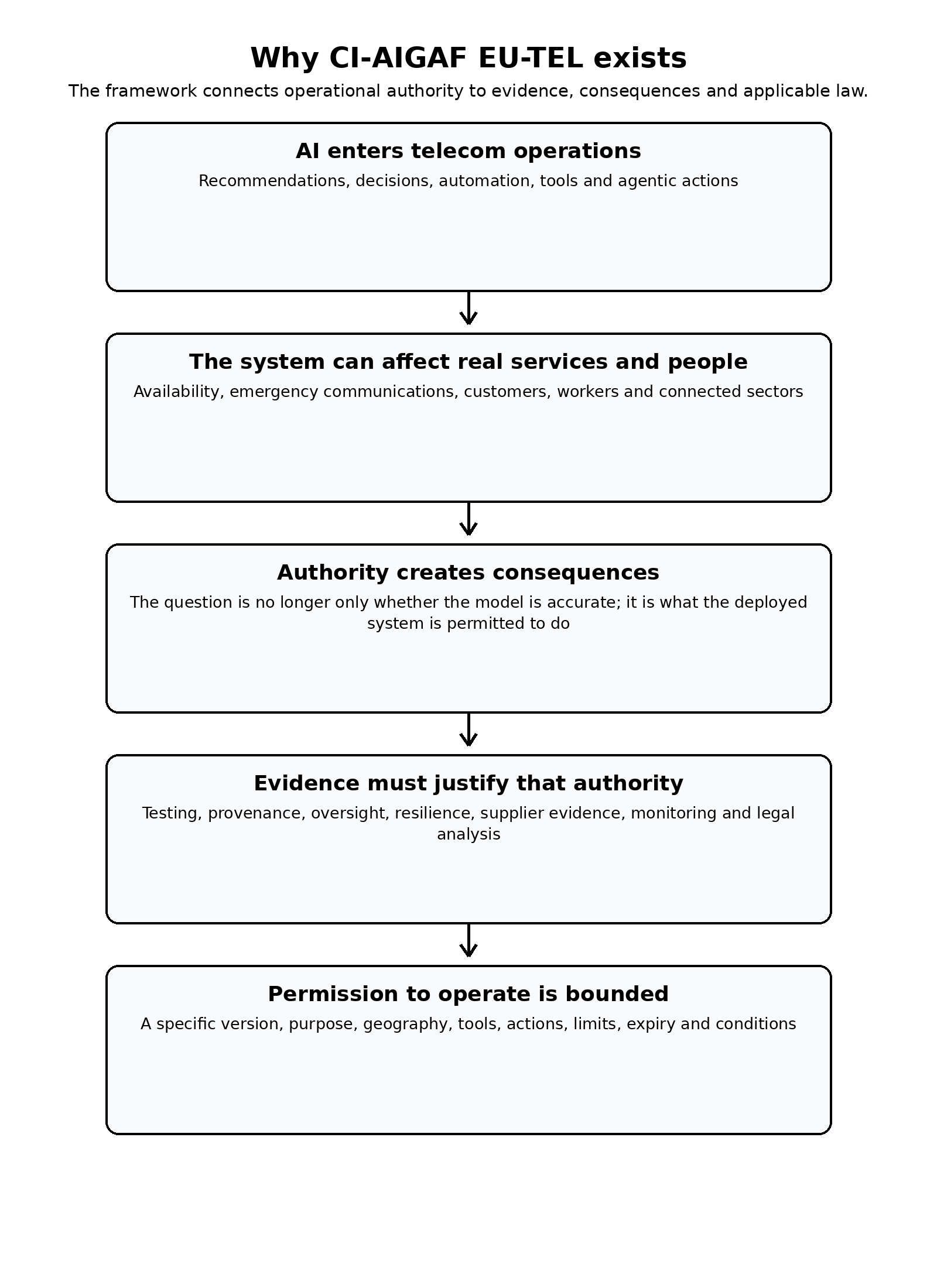
There is no legal rule that says a telecom operator must adopt a framework named CI-AIGAF EU-TEL. The reason to follow it is operational: applicable EU and national obligations arrive through different regimes, while the production system is one connected socio-technical system. Without a unifying method, classification, access, supplier evidence, testing, human oversight, incident handling, privacy, change control and authorization can become separate compliance workstreams that do not actually constrain production behaviour.
CI-AIGAF EU-TEL is designed to make those workstreams converge on operational permission. It asks a simple but demanding question: “Given what we know now, what is this exact AI deployment allowed to do?” The answer must be traceable to the system boundary, applicable law, operational authority, plausible consequence, evidence quality, human and technical controls, lifecycle gate decisions and the current authorization envelope.
How to read this handbook without getting lost
- Read the opening and Part I to understand the operational problem. Do not start with the codes.
- Use Part II to learn the five questions. The codes are simply shorthand for answers to those questions.
- Read Part III as a story. It follows one AI Network Change Agent from idea to production, change, incident and reauthorization.
- Use Part IV to understand what your function is expected to contribute and what it should not approve by itself.
- Use Parts V-VIII for the legal, evidence, runtime and enterprise operating model.
- Use Part IX only when you need the detailed reference: G0-G9, P1-P18, instruments, use-case catalogue and application/control-plane mapping.
the entire framework
- “We are not adding another approval layer. We are making sure that the authority given to AI is explicit, bounded and supported by current evidence.”
- “Legal classification and operational danger are different questions. A system can be legally non-high-risk and still require strong operational assurance.”
- “An approval is not permanent. Changes, incidents, expired evidence or lost monitoring can reduce authority.”
- “The framework is successful only when its decisions can change production reality: for example by removing credentials, reducing scope, requiring dual approval or suspending execution.”
Part I: The problem before the framework
1. Start with an operational story, not with a regulation
A telecom operator introduces an AI Network Change Agent. The first release is conservative: it reads alarms, topology and previous change records, then drafts a proposed configuration change. An engineer reviews the proposal and manually enters the approved commands. The pilot performs well, so the team connects the agent to a change API. It can now submit changes for approval. Later, the supplier offers an “autonomous mode” that can execute within defined thresholds. The product name did not change, but the operational system did.
Now imagine the agent recommends a change that destabilizes a cluster. One service is degraded and emergency-service traffic protection is affected. The engineer who approved the change relied on a generated explanation that omitted a dependency introduced the previous week. A supplier model update had also been installed three days earlier. The organization must now answer questions that a conventional model card cannot answer.
- What exact version, prompt/RAG configuration, tool set and permissions were operating?
- Was the system acting as a recommender, a submitter or an executor?
- What network domains and protected services were inside or outside its authorization?
- What evidence had been accepted, and did that evidence cover the current topology and supplier version?
- Could the human overseer realistically understand and intervene before the change became irreversible?
- Which legal roles and obligations applied to this deployment and to the organization?
- Which incident routes and reporting clocks might now be relevant?
- What evidence must be frozen so the decision can later be reconstructed?
- Who has authority to keep the system running, reduce it to advisory-only, suspend it, recommission it or retire it?
CI-AIGAF EU-TEL is designed so these answers are created before they are urgently needed. The framework makes the decision path explicit, binds evidence to the deployed system and version, and treats production authority as a controlled state rather than a one-time approval.
2. Why traditional AI governance can be too abstract for telecom operations
Many AI governance frameworks are good at defining principles, risk themes and management responsibilities. Telecom operations need an additional layer: a way to translate those principles into executable limits in environments where machine decisions can touch live network infrastructure, customer services, identity systems, routing, resilience and emergency communications.
The key shift is from model governance to authority governance. The relevant object is not just a model. It is a deployed socio-technical system: model, prompts, RAG sources, data, tools, agent logic, identities, network interfaces, users, human reviewers, supplier components, operating procedures, country and service context. Two deployments of the same commercial model can therefore need completely different legal and operational treatment.
This is also why a compliance percentage is a weak operating signal. A system can be “95% compliant” and still be unsafe to operate if its authorization expired, a blocking piece of evidence is missing, the human overseer is unavailable, or a supplier change invalidated earlier tests. CI-AIGAF EU-TEL gives blocking conditions priority over aggregate scores.
Same model, four different deployments
A general-purpose language model can be used as a NOC knowledge assistant with no write access; as a configuration generator whose output is manually validated; as an agent that submits changes through an API; or as a closed-loop optimizer that executes changes directly. Treating these four deployments as one “AI system” would hide the authority, consequence, evidence and legal differences that matter.
3. The operating principle in one sentence
Governing principle
No AI authority claim should exceed the realism, relevance, freshness and independence of the evidence supporting it.
This principle has practical consequences. If an AI system has only been tested as a recommender, the evidence does not justify autonomous execution. If testing covered one topology, it does not automatically justify operation across all network regions. If the human approval step cannot occur before an irreversible action, it should not be credited as effective human oversight. If a supplier model update changes behaviour, the previous evidence must be screened for continued validity. If the system is legally non-high-risk, that does not erase operational risk.
why the framework exists
- Ask your team to describe the AI system as a production capability, not as a product name.
- Ask what the system can actually influence or execute today: not what the pilot originally did.
- Ask what evidence supports that authority and under what conditions the evidence was generated.
- Ask what would automatically reduce or remove authority if those conditions stop being true.
Part II: Understand CI-AIGAF EU-TEL through five questions
The easiest way to learn the framework is to ignore the acronyms for a few pages. Every deployment must answer five questions. The formal codes are introduced only after the question is understood.
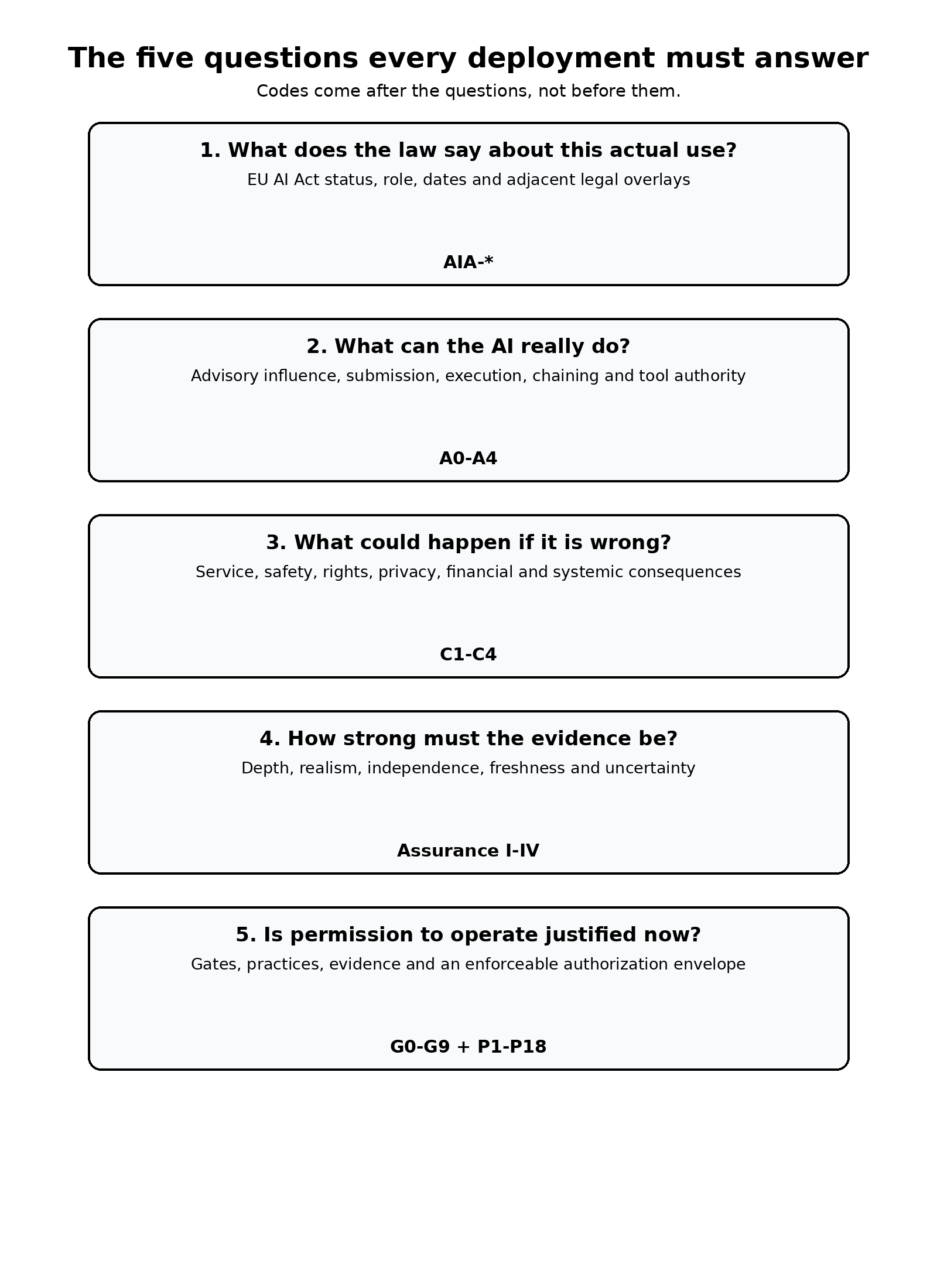
4. What does the law say about this actual use?
The legal route depends on what the system is, how it is used, the role held by the organization, the affected people or infrastructure, the country, and the date. The EU AI Act is central but not alone: telecom operations may also engage NIS2, GDPR, ePrivacy, the EECC, the Open Internet Regulation, accessibility, consumer, employment, resilience or product rules. CI-AIGAF EU-TEL records legal status separately because a legal label should not be asked to carry the whole operational risk decision.
Framework shorthand
The code family AIA-* is used only after the underlying decision has been explained and recorded. The code is a reference mechanism; the rationale and evidence are the real governance record.
5. What can the AI really do?
Authority is about deployed capability. Can the system only retrieve information? Can it recommend? Can it submit a change? Can it execute through a tool? Can it chain several tools? Can it act without a human approval? Does it hold privileged credentials? The framework represents this operational authority on A0-A4. The exact tier definitions are in the reference section; the important idea is that authority is determined from real capability, not marketing language.
Framework shorthand
The code family A0-A4 is used only after the underlying decision has been explained and recorded. The code is a reference mechanism; the rationale and evidence are the real governance record.
6. What could happen if it is wrong?
Consequence asks what a credible failure, misuse, compromise or unavailable system could do to service continuity, health and safety, rights, privacy, customers, workers, finances or connected sectors. This is deliberately independent of authority. A low-authority assistant can still influence a high-consequence human decision, while a highly automated tool can be tightly bounded to a low-consequence function. CI-AIGAF records consequence as C1-C4.
Framework shorthand
The code family C1-C4 is used only after the underlying decision has been explained and recorded. The code is a reference mechanism; the rationale and evidence are the real governance record.
7. How strong must the evidence be?
A system with greater authority, greater consequence, weak fallback, vulnerable affected groups, opaque supplier evidence or high uncertainty needs stronger assurance. The Assurance Class tells the organization how deep, realistic, independent and fresh the evidence must be. It is a framework decision, not an EU AI Act category.
Framework shorthand
The code family Assurance I-IV is used only after the underlying decision has been explained and recorded. The code is a reference mechanism; the rationale and evidence are the real governance record.
8. Is permission to operate justified now?
The previous four answers do not themselves authorize production. Permission is granted through lifecycle gates, the applicable practices, evidence sufficiency and a bounded authorization envelope. The organization must be able to say what the AI is allowed to do now, for this version and context, and what would cause that permission to expire, narrow, suspend or reopen.
Framework shorthand
The code family G0-G9 + P1-P18 is used only after the underlying decision has been explained and recorded. The code is a reference mechanism; the rationale and evidence are the real governance record.
9. The four classifications must not be collapsed into one risk label
A frequent governance error is to treat one label: for example “high-risk”: as if it answered every question. CI-AIGAF EU-TEL deliberately separates legal status, operational authority, consequence and assurance. The same deployment can have a legal status that remains stable while its operational authority changes; or it can have unchanged authority while consequence rises because the service context changes.
| Decision | Plain-language question | Why it is separate |
|---|---|---|
| EU legal status | Which statutory route applies to this use and role? | Legal scope and obligations depend on defined legal tests; they should not be inferred from operational concern alone. |
| Operational authority | What can the deployed system influence or execute? | Authority can expand through new tools, credentials or workflow integration without a model change. |
| Consequence | What could credibly happen if it fails or is misused? | Consequence depends on service and affected context, not only on autonomy. |
| Assurance Class | How strong must the evidence and independent challenge be? | Evidence needs depend on authority, consequence, uncertainty, fallback and other contextual factors. |
Why the distinction matters
A NOC assistant may be legally outside the Annex III critical-infrastructure route and have no write access, yet if engineers routinely copy its generated emergency-routing instructions without validation, the operational consequence can be high. Conversely, an automated optimizer may execute frequently but only within a tightly bounded sandboxed parameter range with strong rollback, making its operational envelope materially different from an unrestricted autonomous agent.
Part III: Follow one AI Network Change Agent from idea to retirement
This part teaches the lifecycle as a story. The purpose is not to suggest that every organization must implement the exact example. It shows how the framework thinks when real facts change.
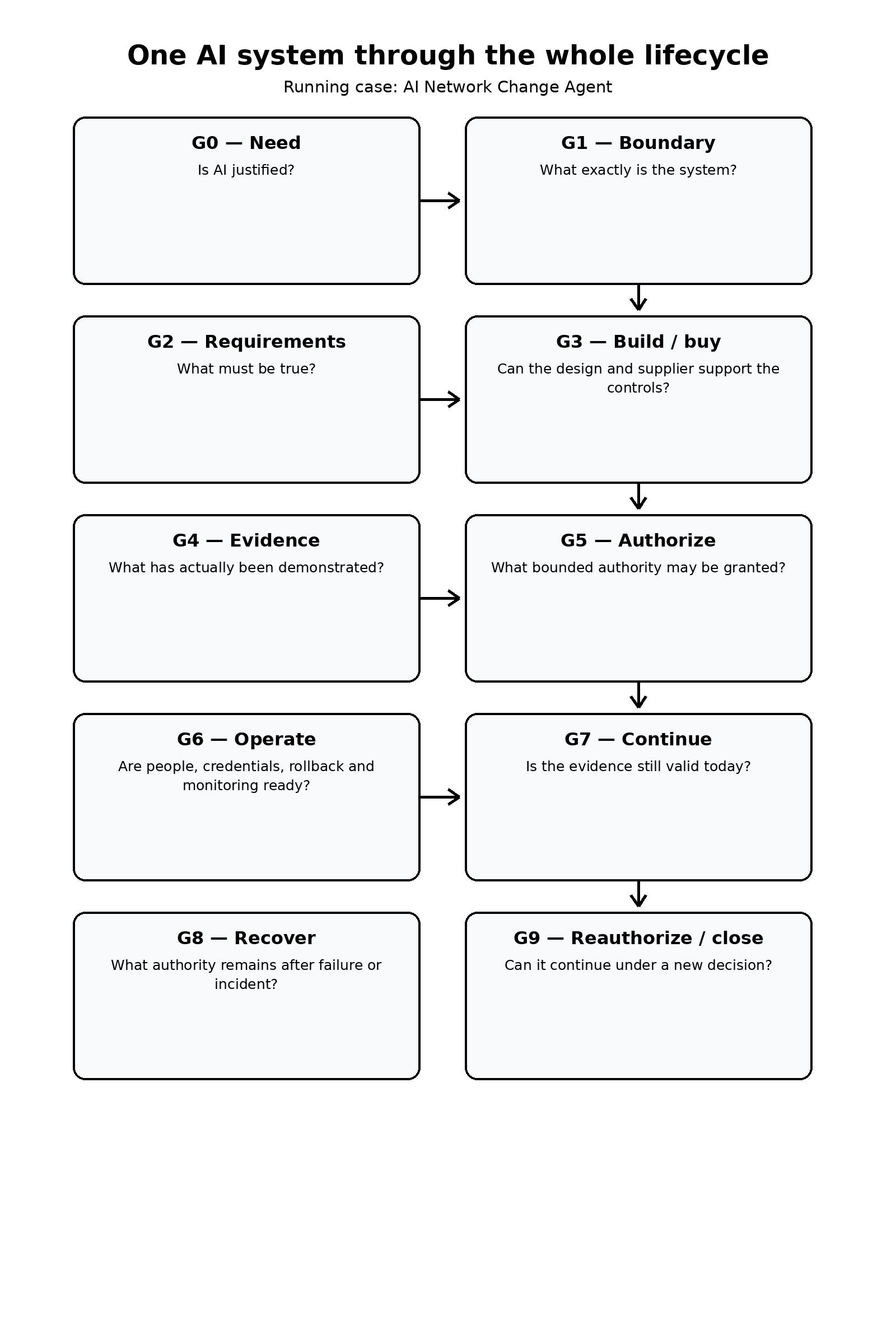
10. G0: The idea arrives
A network automation team proposes an AI Network Change Agent because engineers spend too much time correlating alarms, checking historical changes and drafting low-risk configuration updates. At G0 the organization does not ask “Which model should we buy?” It asks whether the service need is legitimate, whether AI is necessary, what outcomes must be protected, who is accountable and what the system must never be allowed to do.
Network Change Agent
The team might decide that the first release should remain advisory because the business need is faster diagnosis rather than autonomous change. That decision reduces later complexity. It also creates a clear prohibited outcome: the pilot must not obtain production write access merely because the underlying vendor product supports it.
11. G1: Define the thing being governed
The organization creates a canonical deployment boundary. The record includes the model and version; prompts and policies; RAG sources; historical change data; tool and API connections; NMS/EMS interfaces; service domains; machine identities; supplier components; users; countries; affected services; and the actions that can be proposed, submitted or executed.
Network Change Agent
This step prevents “the vendor product” from becoming the governance object. If the same product is used in three countries with different tools and network privileges, there are three controlled deployments even if the software package is identical.
12. G2: Translate goals and obligations into testable requirements
The service team, engineering, security, legal/privacy and assurance functions now state what must be true before production authority can be considered. Requirements might include a maximum permitted change magnitude, excluded emergency-service objects, rollback latency, logging fields, approval rules, data limitations, supplier change notice, scenario coverage, evidence freshness and a maximum human intervention time.
Network Change Agent
A requirement such as “the AI must be robust” is too vague to support authorization. A requirement such as “for this parameter class the system must detect an invalid target state and refuse execution in the defined failure scenarios” can be tested.
13. G3: Build or buy with evidence in mind
The procurement and engineering decision is tested against the requirements. The team asks whether the supplier will provide version information, known limitations, change notices, test artefacts, incident cooperation and exit support; whether APIs can enforce the intended authority; whether logs can reconstruct actions; and whether the system can be restricted if authorization changes.
Network Change Agent
A technically impressive product can fail G3 because the organization cannot obtain the evidence or contractual cooperation needed to operate it responsibly. The framework treats this as an operational readiness problem, not an administrative procurement detail.
14. G4: Ask what has actually been demonstrated
Testing is performed in representative environments. The team does not merely collect test reports; it builds an assurance argument. What claim does each test support? Which version and topology were used? What scenarios were not covered? How independent was the challenge? What failure modes were observed? What does the evidence not justify?
Network Change Agent
Suppose the agent achieves excellent results in a digital twin for two regions but has not been tested against a new slice configuration used in a third region. The correct conclusion is not “validated”. The evidence supports a bounded claim for the tested contexts.
15. G5: Grant a bounded authorization, not a generic approval
The authorization authority decides what the system may do. The decision might permit the agent to generate and submit specified change types, in named clusters, during maintenance windows, with engineer approval, while prohibiting direct execution and excluding emergency-service objects. The authorization has an expiry date and explicit reopening triggers.
Network Change Agent
This is the point where governance becomes an operational permission. If the organization later gives the same agent a new privileged API, the old approval cannot silently cover the expanded authority.
16. G6: Check whether production can enforce the decision
A valid authorization can still fail operational readiness. G6 confirms that the correct model and configuration are deployed; IAM/PAM permissions match the envelope; monitoring works; rollback is available; named humans are trained and available; incident procedures are ready; and the system cannot bypass the approval path.
Network Change Agent
If the authorization says “recommendation only” but the agent retains a credential that can execute changes, the production state contradicts the governance decision. G6 stays open until that is corrected.
17. G7: Treat continued operation as an active decision
The agent begins production use. Continued authorization depends on evidence remaining valid. The organization watches performance, drift, anomaly rates, overrides, change outcomes, supplier releases, data/RAG changes, privileges, service conditions, complaints and audit findings.
Network Change Agent
Three months later the supplier ships a model update. Performance appears improved, but the reasoning pattern changes and the update affects tool selection. G7 detects the change and routes it through material-change screening rather than assuming a supplier patch is automatically safe.
18. G8: Incident and recovery authority
A proposed change is approved and causes instability because the agent did not account for a dependency introduced by a recent network change. The first actions are operational: contain the service impact, restrict the AI, preserve the pre-incident state and relevant evidence, open potentially applicable incident routes, and assign owners.
Network Change Agent
The system may move to A0 or advisory-only while the incident is investigated. Recovery is staged. The organization does not restore full authority simply because the network itself is stable again.
19. G9: Reauthorize, materially change or close
Investigation finds that the new supplier model, new network dependency and insufficiently representative tests together invalidated part of the earlier assurance case. The organization updates the boundary and requirements, retests affected claims and decides whether to issue a new authorization envelope.
Network Change Agent
If the business benefit no longer justifies the assurance burden, retirement is a valid outcome. CI-AIGAF EU-TEL is not designed to force automation forward; it is designed to make the authority decision explicit and evidence-based.
20. What the running case teaches
- The model is only one component of the governed system.
- Authority can change without a model change, especially when tools, credentials or workflow integration change.
- Legal status and operational classification are separate decisions.
- Evidence supports claims only within the conditions that make it relevant.
- Human oversight must be feasible in time and supported by real authority to intervene.
- Authorization is bounded and temporary; it can be reduced, suspended or reopened.
- An incident is both an operational event and an evidence-preservation event.
- Recovery is not equivalent to reauthorization.
the lifecycle
- Use the Network Change Agent story when training teams. Ask them what would have to be different for the system to move from advisory to execution authority.
- Ask which changes would reopen classification even if the model version stayed the same.
- Ask what evidence they would want before signing an authorization, and what evidence would make them refuse.
- Ask how their current IAM, change and incident tools would actually enforce a downgrade or suspension.
Part IV: What each team contributes
CI-AIGAF EU-TEL is not owned by a single governance function. A central team can steward the method, but the evidence and decisions come from the people who understand the service, the network, the AI system, the law, the data, the security controls and the assurance process. The framework therefore separates contribution from decision right. A team can produce evidence without being allowed to approve its own evidence.
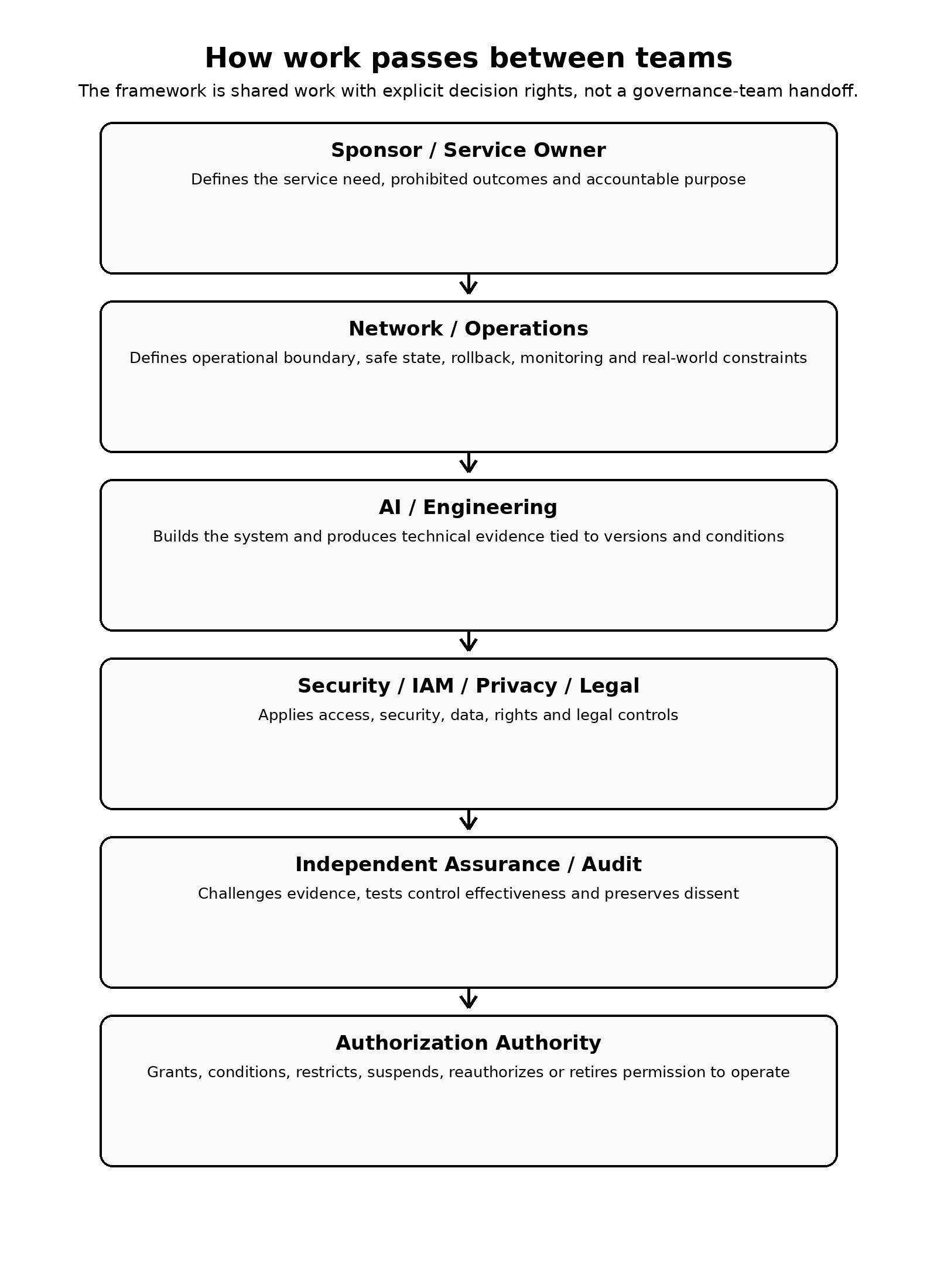
21. Operational Head / Service Owner
Own the service objective and acceptable operating boundary. Make sure the AI use case has a legitimate purpose, protected service outcomes, an accountable owner, defined failure constraints and a clear decision path when authority must be reduced. You should be able to see which AI systems are operating, their exact version, authority, authorization expiry, blocking conditions, open incidents and evidence exceptions.
Boundary of the role
Do not approve technical evidence simply because you are the senior business owner. Your role is to make accountable service decisions using evidence that has been produced and challenged by the appropriate functions.
22. Network Engineering / NOC / SOC
Define the real-world constraints: topology, protected objects, change limits, safe state, rollback, maintenance windows, alarm and monitoring coverage, service dependencies and emergency procedures. Validate AI-generated operational logic before it becomes production action.
Boundary of the role
Do not treat “AI approved” as permission to bypass change, access or incident disciplines. The authorization envelope should be implementable in the systems you already operate.
23. AI / ML / Platform Engineering
Maintain versioned system boundaries, training/evaluation records, model and prompt/RAG configuration, known limitations, test evidence, monitoring and change information. Design the system so its tools and identities can be restricted when authority changes.
Boundary of the role
Do not self-approve your own classification, evidence sufficiency or authorization. Technical ownership and independent assurance are intentionally separated.
24. Cybersecurity / IAM / PAM
Bind machine identity, privileged access and tool permissions to the authorization envelope. Monitor credential and privilege changes. Make suspension real by removing capability, not merely changing a dashboard label.
Boundary of the role
Do not assume that a human approval workflow compensates for an AI identity that can technically bypass it.
25. Legal / Compliance / DPO
Apply the law to the actual deployment facts, roles, affected people and country. Record applicability reasoning, dates, notices, rights, data restrictions, retention constraints and reporting routes. Distinguish statutory requirements from framework controls and recommendations.
Boundary of the role
Do not use a legal high-risk label as a proxy for all operational risk decisions, and do not allow a legally non-high-risk finding to be read as “low operational risk”.
26. Independent Assurance / Internal Audit
Test whether controls are well designed and whether they actually operate. Challenge the evidence chain, sampling, realism, independence and residual uncertainty. Preserve findings and dissent. Verify corrective action independently where required.
Boundary of the role
Do not allow a control owner to close a critical finding solely by asserting that it has been fixed. Evidence of effectiveness matters.
27. Executive / Management Body
Understand the operating exposure, legal role, significant incidents, audit findings, unresolved exceptions and regulatory commitments. Ensure accountability, training, challenge and resources exist.
Boundary of the role
Do not treat executive approval as a power to override a blocking legal or operational condition. The framework explicitly separates management accountability from technical authorization.
28. Procurement / Supplier Management
Obtain sufficient evidence, cooperation, change notification, security information, incident support, audit rights, concentration visibility and exit provisions for the intended authority.
Boundary of the role
Do not assume a supplier certificate, model card or contract warranty is deployment-specific evidence for your network context.
29. Role-based reading map
| Role | Read first | Then use |
|---|---|---|
| Operational Head | Parts I-III, VI-VII | G0-G9 reference, authorization and runtime sections |
| Network / NOC / SOC | Parts I-III, VI-VII | P2-P5, P8, P10-P12, incident and change references |
| AI / Platform | Parts II-III, VI | P3, P7, P10, P12-P14, evidence and change references |
| Security / IAM | Parts III-IV, VI-VII | P5, P6, P8, P10, authorization-envelope and incident references |
| Legal / DPO | Parts II, V, VII | Legal source register, P14-P17, incident and Member State references |
| Audit / Assurance | Parts II, VI, VIII | P10, P13, evidence quality, audit and adoption references |
| Executive | Opening, Parts I, IV, VIII | Accountability, exceptions, audit, commitments and authorization-state summaries |
Part V: Operating under the European legal environment
30. Law is an input to authorization, not a substitute for operational judgment
CI-AIGAF EU-TEL uses the EU AI Act as a central legal layer, but a telecom AI deployment can also engage cyber, communications, data-protection, resilience, accessibility, consumer, employment and product rules. The framework does not merge these regimes into one fictional “AI compliance” obligation. It keeps each legal source identifiable and turns applicable obligations into controlled requirements, evidence and decision points.
Legal requirement vs framework requirement
A paragraph marked LEGAL REQUIREMENT summarizes an identified obligation from a named legal source and should be verified against the controlled source register and current legal advice for the deployment. A paragraph marked FRAMEWORK REQUIREMENT is a CI-AIGAF EU-TEL control. The framework may deliberately go beyond statutory minimums where operational assurance requires it.
31. EU AI Act timing baseline used by this handbook
The handbook uses Regulation (EU) 2024/1689 as amended by Regulation (EU) 2026/1744. Regulation (EU) 2026/1744 was published on 24 July 2026 and changed the staged application of the high-risk provisions. As of this handbook’s verification date, Chapter III Sections 1-3 apply from 2 December 2027 for AI systems classified as high-risk pursuant to Article 6(2) and Annex III, and from 2 August 2028 for AI systems classified as high-risk pursuant to Article 6(1) and Annex I, subject to the detailed transitional provisions and exceptions in the Regulation.
Controlled source
Regulation (EU) 2026/1744, amending Regulation (EU) 2024/1689; Article 113 timetable as amended. Legal dates should be stored as controlled metadata rather than buried in static policy text.
32. Telecom criticality does not automatically create an Annex III high-risk finding
Annex III point 2 concerns AI systems intended to be used as safety components in the management and operation of critical digital infrastructure, road traffic, or specified utility supply. The classification therefore turns on the actual intended use and the safety-component test, not on the fact that a telecom organization is important or regulated. CI-AIGAF EU-TEL separately applies operational authority, consequence and assurance classification so that a legally non-high-risk system can still receive stringent operational controls where the deployment can affect essential services.
Do not infer legal status from the C-tier
A C4 operational consequence classification is not a legal conclusion that the AI system is Annex III high-risk. Conversely, a legal high-risk classification does not by itself determine the operational authority tier.
33. Core legal overlays used by EU-TEL
| Regime | Why telecom teams may need it in the operating model |
|---|---|
| EU AI Act | AI-system scope, prohibited practices, high-risk routes, provider/deployer and other roles, transparency, documentation, oversight, monitoring, incidents, registration and enforcement where applicable. |
| NIS2 + national transposition | Cyber risk management, management accountability, supply chain, continuity and significant-incident reporting for covered entities. |
| GDPR | Personal data, lawful basis, purpose limitation, minimization, DPIA, automated decision-making safeguards, rights, security and personal-data breach obligations. |
| ePrivacy + national law | Confidentiality of communications, traffic/location data and telecom-specific privacy rules. |
| EECC + national telecom law | Security and resilience of public communications networks/services, competent-authority powers, service and end-user obligations. |
| Open Internet Regulation | Traffic-management practices, non-discrimination and technical-necessity evidence where AI influences prioritization/throttling. |
| CER | Critical-entity and resilience context, with interaction rules intended to avoid duplication for digital infrastructure. |
| Cyber Resilience Act | Conditional route where products with digital elements and economic-operator obligations are relevant. |
| Data Act | Conditional route for connected-product data, data access/use and data-processing service requirements. |
| Accessibility / consumer / employment / equality rules | Conditional routes where AI affects customer interfaces, workers, pricing, eligibility, sales, service access or protected groups. |
34. Incident clocks should be opened in parallel, not sequentially
When an operational event could engage more than one regime, the initial response should contain the system and preserve evidence while the organization opens every potentially applicable route. NIS2 Article 23 uses a 24-hour early warning and 72-hour incident notification for significant incidents, followed by a final report normally within one month after the incident notification. The AI Act serious-incident route has different triggers and deadlines for high-risk AI systems. Privacy and national telecom rules can add further routes. CI-AIGAF EU-TEL therefore gives each potentially applicable clock a named owner rather than waiting for one team to decide which regime “owns” the incident.
Part VI: Evidence, human judgment and bounded authority
35. Evidence is a decision resource, not a document collection
Evidence answers a specific question for a specific system version and deployment context. A generic supplier white paper may help explain a technology, but it rarely proves that the deployed system will behave acceptably in a particular network state. A successful digital-twin test can be strong evidence for the scenarios actually represented; it is not proof for all topologies, traffic conditions or failure modes. CI-AIGAF EU-TEL therefore links every important claim to evidence, conditions, limitations, provenance and freshness.
The framework also preserves counterevidence and dissent. If a reviewer believes a test environment was unrepresentative, that concern belongs in the assurance record. A decision maker can still accept residual risk, but the record should not erase the uncertainty that was known when authority was granted.
Evidence ceiling
The Network Change Agent passes 1,000 simulated changes but all tests use normal traffic and exclude the maintenance scenario in which two monitoring feeds become delayed. The evidence may justify bounded use under normal conditions, but it does not justify a claim that the agent is safe under the delayed-telemetry scenario. The authorization envelope should reflect the evidence ceiling.
36. Human oversight is a timing, comprehension and authority problem
The phrase “human in the loop” is useful only when the human can actually perform the intended control. The person must receive the relevant information, understand the proposal and its limitations, have time to decide, possess the authority and technical means to intervene, and be able to stop or reverse the action before the harm becomes unavoidable. CI-AIGAF EU-TEL therefore treats human oversight as something that must be demonstrated rather than declared.
Approval that is too slow to matter
An AI remediation agent detects an event and can execute a network action two seconds later. The named engineer typically needs thirty seconds to interpret the alarms and understand the proposed action. Requiring the engineer to be “on shift” does not create effective oversight. The design must delay the action, reduce authority, use dual controls or rely on pre-authorized automated safety mechanisms that do not pretend the human is making the real-time decision.
37. Authorization should be enforceable
The framework’s most important operational construct is the authorization envelope. A decision such as “approved for production” is too broad. The authorization should specify the version, purpose, geography, network objects, tools, actions, thresholds, time windows, human approvals, rollback, monitoring, evidence, expiry and automatic suspension conditions that together define permission to operate.
Where technically feasible, the envelope should be reflected in IAM/PAM, API gateways, change controls, orchestration and network controllers. If the authorization expires or a critical blocking condition occurs, the system should be capable of losing credentials, tools or execution rights. Governance becomes credible when a decision can change the production state.
Part VII: Change, incidents, recovery and the loss of authority
38. A material change is any change that can invalidate a decision basis
A new model version is an obvious change, but it is not the only one that matters. A new tool, expanded credential, changed RAG corpus, new data source, different network topology, new intended purpose, supplier update, country expansion, revised threshold, unavailable human overseer or changed legal assumption can invalidate evidence or classification. CI-AIGAF EU-TEL therefore screens changes for their effect on authority, consequence, assurance, role, legal status and evidence validity.
Tool change without model change
The Network Change Agent keeps the same model version but receives access to a configuration API that can now execute a change rather than merely draft it. The system’s operational authority has changed materially even though the model hash is identical. The old tests and authorization must be screened against the new capability.
39. Incident response should preserve the decision state
After an incident, teams often focus on service restoration: correctly. The governance challenge is to restore service without destroying the ability to reconstruct what happened. Relevant model/configuration versions, prompts, retrieved sources, inputs, outputs, tool calls, identities, human decisions, network state, logs, authorization envelope and associated change/incident identifiers should be preserved according to the applicable evidence and privacy rules.
The framework does not recommend copying all telecom data into one central governance store. A federated evidence model can retain stable references and integrity metadata while preserving material snapshots where necessary. Sensitive payloads can remain separately controlled. The objective is reconstructability, not indiscriminate retention.
40. Recovery and reauthorization are different
A network can be technically stable while the AI system remains unauthorized. G8 supports staged recovery: suspended, advisory-only, bounded execution and then potentially restored authority. If the incident or change affects the original decision basis materially, G9 triggers reauthorization. The organization should be able to explain why each step of authority was restored and what evidence supported it.
Part VIII: Making the framework usable across an organization
41. Adoption is not the same as authorization
An organization can be mature at AI governance and still have an individual system that should not operate. Conversely, a specific low-authority system can be well controlled while the wider organization remains immature. CI-AIGAF EU-TEL therefore separates enterprise adoption maturity from individual system authorization. AD0-AD5 describes how reliably the organization can perform the framework; it does not grant permission to any system.
42. Start with a small controlled portfolio, not every AI idea at once
The most effective implementation begins with a small number of deployments that represent different kinds of authority and consequence. For example: a NOC knowledge assistant, an AI-generated configuration tool, a closed-loop optimizer and a customer/workforce decision system. These reveal different requirements and help the organization build reusable registers, evidence practices, legal source controls, authorization mechanisms and training before scaling.
| Pilot type | What it teaches the organization |
|---|---|
| NOC knowledge assistant | System boundary, RAG provenance, unsupported claims, low-authority operating controls and user training. |
| AI-generated configuration | Validation of operational logic, human oversight, change integration and authorization boundaries. |
| Closed-loop optimizer | A3/A4 authority, real-time oversight limits, rollback, monitoring and representative evidence. |
| Customer/workforce decision AI | Privacy, rights, fairness, transparency, contestability, worker/customer notices and human review. |
43. Give managers a way to pass the framework to their teams
A framework spreads successfully when the first reader can explain it without carrying a 150-page document into every meeting. Each team briefing should use the same four messages: what the framework protects, what changes for the team, what evidence the team must produce or consume, and which decisions the team is not allowed to approve by itself.
a 10-minute team briefing
- 1. “Our AI systems have explicit authority levels. Tool access and credentials must match the current authority.”
- 2. “Evidence is version- and context-bound. A successful test does not authorize uses that were not represented.”
- 3. “Legal status and operational consequence are separate. We record both.”
- 4. “Changes and incidents can reopen approval. We do not assume yesterday’s authorization is valid after a material change.”
- 5. “If a blocking condition exists, a percentage score or executive preference does not turn the system green.”
44. How to know the framework is becoming real
- Teams can name the actual AI systems and deployments operating in production, not just vendor products.
- Operations can show what each AI identity and tool is permitted to do and how authority can be revoked.
- Every material authorization can be traced to current evidence and an accountable decision.
- Supplier/model/tool changes trigger controlled screening rather than informal acceptance.
- Human oversight is tested for competence, timing and intervention capability.
- Incidents preserve evidence and start potentially applicable clocks without waiting for ownership arguments.
- Audit findings cannot be self-closed by the control owner where independent verification is required.
- Member State legal routes and authorities are controlled as country-specific metadata.
- Teams can explain the framework in plain language before they use the codes.
45. Reader checkpoint before the detailed reference
If the first eight parts have worked, the reader should now be able to explain CI-AIGAF EU-TEL without opening a reference table. The framework governs the authority of a deployed AI system. It separates legal status from operational authority and consequence. It asks for evidence proportionate to the uncertainty and impact. It moves the system through lifecycle gates. It grants a bounded permission to operate. It watches for changes that invalidate the decision basis. It preserves evidence during incidents. And it allows authority to decrease when confidence decreases.
The next part is intentionally more manual-like. It is a reference library for teams implementing the framework. It should be used after the operating model is understood, not as the first introduction.
Part IX: Detailed Practitioner Reference
This reference section retains the detailed framework material required by practitioners: lifecycle gates, P1-P18 practices, evidence and authorization mechanics, the 40 instruments, use-case playbooks, runtime operations, adoption and the Operational Assurance Control Plane. The wording below is intentionally more structured because its purpose is execution and auditability rather than first-time teaching.
- Reference A: Lifecycle gates G0-G9, explained gate by gate
- Reference B: The eighteen practices P1-P18, explained practice by practice
- Reference C: Evidence, assurance cases, human oversight and the authorization envelope
- Reference D: The 40 implementation instruments and how they fit together
- Reference E: Telecom use-case playbooks and classification patterns
- Reference F: Runtime operations, material change, incidents, recovery and reauthorization
- Reference G: Enterprise adoption, Member State localization and cross-border operation
- Reference H: Digital implementation: the Operational Assurance Control Plane
- Reference I: First implementation: a ten-step practitioner method and worked example
- Appendices: Traceability, glossary, legal source register and publication controls
Reference A: Lifecycle gates G0-G9: the decision path
This is the operational spine of CI-AIGAF EU-TEL. A gate is not a meeting, a sign-off email or a checklist. A gate is a decision that the available evidence is sufficient for the next level of commitment or authority. If the evidence basis later changes, the gate can reopen.
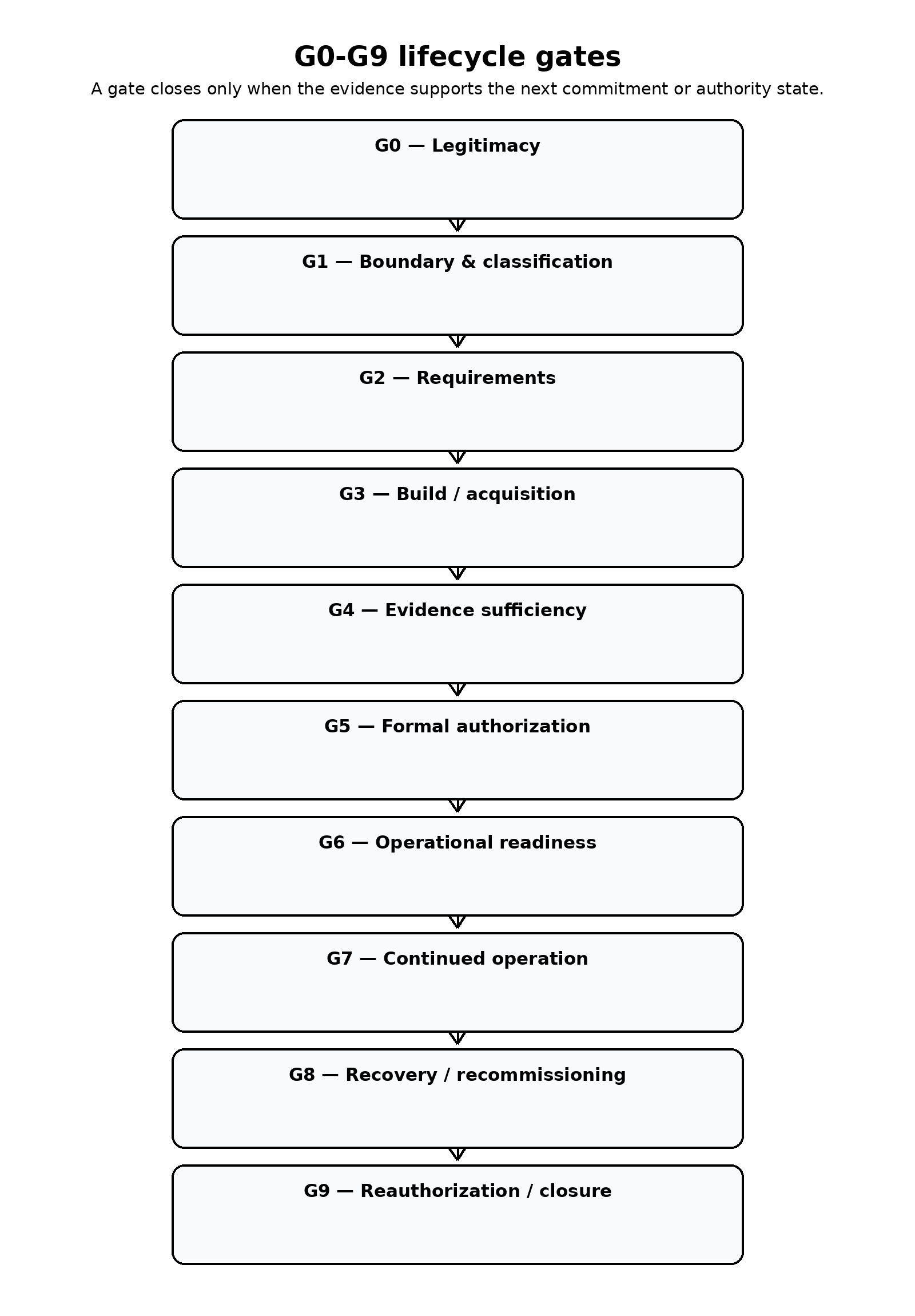
gates. The AI Network Change Agent cannot jump from a successful test directly into production. G4 asks whether evidence is sufficient; G5 decides whether bounded authority may be issued; G6 checks whether people, credentials, rollback, monitoring and production controls are ready. A “pass” at one gate does not silently close the next gate.
No gate should authorize more operational authority than the realism, independence, freshness and relevance of the supporting evidence can justify.
G0: Use-case legitimacy
Frame the need before committing to AI.
Should AI be used for this essential-service need?
The purpose of G0 is to stop the organization from treating “use AI” as the objective. The team first describes the service problem, affected people and minimum service that must be protected. It also considers whether a non-AI approach can meet the need with less uncertainty or operational coupling.
What the team is deciding
At this point the system should not need production authority. If the team cannot articulate a legitimate service need, accountable sponsor, affected parties and prohibited outcomes, the use case should not progress.
What must be true before the gate closes
| What must be true before the gate closes | Minimum evidence / records |
|---|---|
| Service problem and baseline are documented | F01 use-case intake |
| Affected customers/workers/emergency users and vulnerable groups are identified | R01 system register entry |
| Non-AI alternatives are considered | Alternatives analysis |
| Prohibited outcomes and minimum service are defined | Affected-party map |
| Article 5 prohibited-practice pre-screen is complete | G0 decision record |
What happens if the answer is “not yet”
Do not commit to AI or procurement; refine the service need, choose a non-AI alternative, or stop.
The Network Change Agent is proposed to reduce change-preparation time. At G0 the team compares it with better automation, templates and deterministic tooling before deciding that AI adds enough value to justify further work.
G1: Classification and ownership
Define exactly what is being governed and who is accountable.
Do we know the system, owner, legal status, authority and assurance need?
G1 creates the canonical system boundary. This is where the organization stops speaking about a product name and records the actual deployment: model, prompt/RAG, tools, identities, interfaces, suppliers, users, countries, intended purpose and executable actions. It also assigns the initial legal and operational classifications.
What the team is deciding
If the boundary is ambiguous, the wrong thing will be tested and the wrong evidence may be accepted. Shadow agents, inherited credentials and embedded automation are common reasons to hold the gate open.
What must be true before the gate closes
| What must be true before the gate closes | Minimum evidence / records |
|---|---|
| System boundary includes model/data/prompts/tools/identity/people/suppliers/interfaces | R01-R04 |
| EU AIA status is assigned or formally unresolved with restrictions | F01-F04 |
| Provider/deployer/value-chain roles are assigned | Boundary diagram |
| A0-A4, C1-C4 and Assurance Class are assigned | Role analysis |
| Countries and national-law owners are identified | AIA/A/C/Class decision |
What happens if the answer is “not yet”
Keep the system unowned/unclassified and therefore unauthorized; restrict experimentation until the boundary and accountability are stable.
For the Network Change Agent, G1 distinguishes a drafting model from the verifier, executor, privileged service identity, NMS/API and rollback service. Without these components, the authority tier would be understated.
G2: Requirements approval
Translate law, mission and risk into testable requirements before build/acquisition proceeds.
Are requirements complete, testable and connected to law and mission?
G2 is where broad obligations become engineering and operational requirements. “Be robust” is not enough. The team defines measurable service outcomes, failure constraints, human oversight requirements, safe state, rollback, logging, evidence acceptance criteria and the maximum authority the design may seek.
What the team is deciding
A weak G2 creates expensive problems later because teams procure technology before deciding what evidence, access and operational controls they will need. Requirements that cannot be tested should not support authorization.
What must be true before the gate closes
| What must be true before the gate closes | Minimum evidence / records |
|---|---|
| Operational/service requirements are measurable | F05-F07/F10 |
| Legal obligations are mapped to controls/evidence | R05 |
| Authorization envelope ceiling is drafted | Requirements traceability matrix |
| Human oversight and fallback requirements are specified | Draft A02 envelope |
| Evidence and acceptance strategy are defined | Evidence/validation plan |
What happens if the answer is “not yet”
Return requirements to design/legal/operations; do not allow procurement or build to silently set the requirements after the fact.
The Network Change Agent may be required to never execute protected command classes, to maintain a tested rollback path, to produce an attributable change record and to remain within defined network domains.
G3: Build/acquisition readiness
Confirm that control, evidence, continuity and exit can actually be obtained.
Can we obtain enough control, evidence, continuity and exit capability?
G3 tests the operating relationship with suppliers, platforms and internal architecture. A technically capable model can still be unsuitable if the organization cannot get system-level logs, change notice, evidence, incident cooperation, revocation control or a workable fallback.
What the team is deciding
This gate is where procurement, architecture, security and operations become part of AI assurance. Certification or vendor reputation does not replace deployment-specific evidence access.
What must be true before the gate closes
| What must be true before the gate closes | Minimum evidence / records |
|---|---|
| Supplier due diligence and contractual evidence access are adequate | R06-R08 |
| Identity/privilege architecture is bounded | F08 |
| Data/provenance and configuration controls exist | S01-S02 |
| Change notification and incident cooperation are defined | Contract clauses |
| Exit/fallback and concentration risks are understood | Architecture/IAM design |
What happens if the answer is “not yet”
Renegotiate supplier/architecture controls, introduce compensating controls, lower authority, or reject the dependency.
If the change-agent vendor will not expose action-level logs or provide notice of model/tool changes, the organization may have to lower the authority tier or reject the dependency.
G4: Evidence sufficiency
Decide whether realistic evidence supports the proposed authority.
Does realistic evidence justify the proposed authority?
G4 is the assurance gate. The question is not whether testing was performed; it is whether the testing was representative enough to support the claims that matter. Reviewers examine realism, failure modes, degraded conditions, human intervention, rollback, rights impacts, limitations and independent challenge.
What the team is deciding
Evidence should be tied to the exact version and environment. Generic vendor benchmarks, happy-path demonstrations and stale test results are not enough for high authority.
What must be true before the gate closes
| What must be true before the gate closes | Minimum evidence / records |
|---|---|
| Representative conditions and failure modes were tested | C01-C02 |
| Human oversight timing was demonstrated | A03 |
| Rollback/fallback and containment were exercised | Test reports |
| Rights/privacy/fairness/accessibility controls were tested as applicable | Evidence index |
| Independent challenge addressed material claims | Assurance-case draft |
What happens if the answer is “not yet”
Require stronger testing/evidence, reduce the proposed authority, add conditions, or reject authorization.
The Network Change Agent is tested against topology changes, stale telemetry, conflicting alarms, invalid proposed configuration, failed verifier, unavailable rollback and operator overload, not only successful change cases.
A failed or reopened gate must be capable of changing production authority in practice. A dashboard status is insufficient if the AI still retains credentials, tool access or execution paths.
G5: Formal authorization
Make the permission-to-operate decision.
What bounded authority, if any, may be granted?
G5 converts the assurance case into a formal authorization. The approver is not deciding whether the technology is “good.” The decision is whether this exact deployment may operate with a defined authority envelope for a defined period and context.
What the team is deciding
Conditions, expiry, evidence limits, residual risk, waivers and stop triggers are part of the authorization. A red blocking condition cannot be neutralized by an overall green score.
What must be true before the gate closes
| What must be true before the gate closes | Minimum evidence / records |
|---|---|
| Assurance case is complete | A01 authorization record |
| Residual risk and limitations are explicit | A02 envelope |
| Legal/conformity/registration route is addressed where applicable | A03 independent review |
| Authorized decision-maker has required competence/independence | A04 exception/waiver if used |
| A02 authorization envelope is ready | Conformity/registration artifacts as applicable |
What happens if the answer is “not yet”
Do not release authority. The system remains restricted, pilot-only, advisory-only, deferred or rejected.
The Network Change Agent may be authorized to execute only a defined set of reversible commands in two network domains, during staffed hours, with dual approval above a change threshold and automatic suspension if rollback health fails.
A failed or reopened gate must be capable of changing production authority in practice. A dashboard status is insufficient if the AI still retains credentials, tool access or execution paths.
G6: Operational readiness
Verify that the authorized design can actually be operated in production.
Can production start without exceeding the authorization envelope?
G6 separates design approval from production readiness. The organization confirms that production credentials, monitoring, trained people, runbooks, rollback, alerts, incident routes and exact deployed versions match what was authorized.
What the team is deciding
A system can pass validation and still fail G6 if production IAM is broader than the test environment, the alternate overseer is unavailable or the deployed build differs from the signed evidence.
What must be true before the gate closes
| What must be true before the gate closes | Minimum evidence / records |
|---|---|
| Named primary and alternate overseers are qualified | C04 |
| IAM/PAM matches the envelope | R08 |
| Monitoring/alerts/incidents/rollback are operational | M01-M02 |
| Operations understand limitations and stop conditions | Runbooks |
| Deployment version and geography match the authorization | Qualification tests |
What happens if the answer is “not yet”
Delay production or reduce production authority until people, credentials, monitoring, rollback and versions match the envelope.
Before release, the change agent’s service identity is checked against the envelope, the NOC verifies stop/rollback actions, and the production artifact digest is compared with the authorized version.
A failed or reopened gate must be capable of changing production authority in practice. A dashboard status is insufficient if the AI still retains credentials, tool access or execution paths.
G7: Continued operation
Continuously test whether the authorization basis remains true.
Do claims, assumptions and controls remain valid?
G7 is not passive monitoring. It continuously asks whether the facts that justified authorization remain true. Evidence freshness, performance, drift, complaints, supplier changes, privilege changes, legal changes, incidents and operational limitations can all reduce authority or reopen earlier gates.
What the team is deciding
The outcome is a decision: continue, continue with conditions, reduce authority, suspend, or reopen G8/G9. Monitoring without decision consequences is not assurance.
What must be true before the gate closes
| What must be true before the gate closes | Minimum evidence / records |
|---|---|
| Performance/drift/service/rights metrics remain inside thresholds | M01-M04 |
| Supplier/model/config changes are screened | R10 |
| Complaints/near misses/overrides are reviewed | F09 on change |
| Evidence remains fresh | Periodic assurance review |
| Legal/source changes are assessed | Current evidence manifest |
What happens if the answer is “not yet”
Continue only with explicit conditions or reduce/suspend authority; open G8 for incident recovery or G9 for reauthorization when required.
A supplier releases a new model version. Even if KPIs look normal, the unreviewed change triggers screening because the tested evidence belonged to the previous version.
A failed or reopened gate must be capable of changing production authority in practice. A dashboard status is insufficient if the AI still retains credentials, tool access or execution paths.
G8: Recovery / recommissioning
Control authority during incident, containment and staged restoration.
What authority can safely be restored after an incident or failure?
G8 exists because recovery creates pressure to restore service quickly. The framework therefore separates emergency containment authority from normal production authorization. Evidence is preserved, legal clocks are opened, safe state is established, root cause and corrective action are tracked, and restoration occurs in stages.
What the team is deciding
Recommissioning should not mean “the alarm cleared.” The organization must show that the causal condition is understood enough, controls are restored and the proposed authority is justified for the recovery stage.
What must be true before the gate closes
| What must be true before the gate closes | Minimum evidence / records |
|---|---|
| Evidence is frozen/preserved | I01-I05 |
| All potentially applicable legal clocks are opened | R10 |
| Containment/safe-state authority is clear | Incident evidence snapshot |
| Root cause and corrective action are recorded | Notification log |
| Restoration is staged and revalidated | Recovery authorization |
What happens if the answer is “not yet”
Keep the system suspended or at reduced authority until staged recommissioning evidence supports restoration.
After an unsafe configuration event, the change agent may remain suspended while deterministic rollback is used. It can later return in recommendation-only mode before any autonomous execution is reconsidered.
A failed or reopened gate must be capable of changing production authority in practice. A dashboard status is insufficient if the AI still retains credentials, tool access or execution paths.
G9: Reauthorization or closure
Decide what happens after material change, expiry, replacement or retirement.
Should authority continue, change, suspend or end?
G9 prevents an old authorization from living forever. Material change, provider-role change, expiry, major redesign, relocation or retirement requires a formal decision about the future state. If the system continues, a new envelope supersedes the old one. If it retires, credentials, data, evidence and retention duties are closed deliberately.
What the team is deciding
The key test is whether old evidence still supports the changed system. If not, affected gates must reopen and evidence must be regenerated rather than inherited by assumption.
What must be true before the gate closes
| What must be true before the gate closes | Minimum evidence / records |
|---|---|
| Material/substantial modification screen is complete | F09 |
| Role and legal classification are rechecked | R07 |
| Evidence and conformity are renewed where needed | A01-A04 |
| Data/credentials/evidence are closed appropriately if retired | I05 if recovering |
| New envelope supersedes the old one if continuing | Closure/retention record |
What happens if the answer is “not yet”
Reauthorize with a new envelope, change authority, replace, retire or close; never let the old authorization silently persist.
If the change agent is expanded from one domain to national core-network execution, the previous limited authorization cannot simply be extended. Classification, consequence and evidence must be reassessed.
A failed or reopened gate must be capable of changing production authority in practice. A dashboard status is insufficient if the AI still retains credentials, tool access or execution paths.
Reference B: The eighteen practices P1-P18: what each practice actually does
The practices are the work of the framework. They are not eighteen sequential phases. Several practices operate at the same gate, and the same practice can reopen later. For a first-time reader, the simplest way to understand a practice is to ask: what problem does it prevent, what work does the team actually perform, what evidence should exist, and where does it affect authorization?
P1: Establish Requirements for Success
Domain I: Define the service need, deployed boundary, intended purpose, legal and operational classifications, testable success conditions, authority ceiling and evidence plan before build or acquisition.
Why this practice exists
Without P1, teams can procure a capable AI system before knowing what it must prove or what authority it is allowed to seek.
What the practitioner actually does
- Define the service objective, affected parties and minimum service to protect.
- Draw the deployed system boundary, including tools, identities, suppliers and network interfaces.
- Assign AIA status, operator role, A0-A4 authority, C1-C4 consequence and Assurance Class.
- Translate legal/mission needs into testable acceptance criteria.
- Define the maximum authority and evidence plan before build/acquisition.
When it applies, what it produces and the telecom example
| Use this practice to answer | Guide |
|---|---|
| When does it apply? | G0-G2, then revalidation at G7-G9 |
| What must it produce? | Approved use-case brief; system boundary; AIA/A/C/Class decision; requirements traceability; draft envelope; evidence plan |
| Key legal overlays | AI Act Arts. 2-6, 8-15, 17, 25, 50, 113 as applicable; NIS2; GDPR; CER/EECC as triggered |
| Telecom example | CORE-05 network-configuration AI: define whether it only drafts configuration or can execute; identify protected commands and rollback before procurement/build. |
A system reaches procurement or production without a stable intended purpose, authority ceiling or testable acceptance criteria.
How this practice affects authorization
P1 sets the ceiling: later gates should not grant authority beyond the intended purpose, requirements and evidence plan defined here.
P2: Robustness, Resilience and Service Quality
Domain II: Connect AI/system performance to telecom service outcomes, realistic failure/degradation scenarios, thresholds, monitoring and recovery.
Why this practice exists
Average model accuracy can look acceptable while essential-service or protected traffic degrades.
What the practitioner actually does
- Identify telecom service outcomes and protected traffic/service classes.
- Model normal, degraded and failure conditions, including dependencies.
- Test representative load, topology, geography and failure scenarios.
- Set thresholds that trigger intervention, restriction or suspension.
- Exercise rollback, fallback and recovery.
When it applies, what it produces and the telecom example
| Use this practice to answer | Guide |
|---|---|
| When does it apply? | G2-G4, G6-G8 |
| What must it produce? | Service-impact model; failure-mode/dependency analysis; representative validation; thresholds; monitoring; recovery exercises |
| Key legal overlays | AI Act Arts. 9, 15, 20, 26, 72-73; NIS2 continuity/security; EECC availability; CER as applicable |
| Telecom example | Closed-loop RAN optimization must prove it does not preserve average KPI while degrading protected or emergency service classes. |
How this practice affects authorization
P2 can reduce or suspend authority when service/resilience evidence is weak or runtime thresholds are breached.
P3: Automated and Agentic Behaviour
Domain II: Map agents, tools, plans, memory and action paths; define enforceable allow/deny rules; require verification and containment; govern agent change.
Why this practice exists
An agent can accumulate effective authority through tool chaining even when no single prompt says it is autonomous.
What the practitioner actually does
- Map every agent, tool, API, memory store and action path.
- Specify what may be proposed, submitted, executed, chained or delegated.
- Use independent preconditions/verifiers for consequential actions.
- Test containment, credential revocation and tool disablement.
- Re-screen changes to planning, memory, tools, permissions or multi-agent coordination.
When it applies, what it produces and the telecom example
| Use this practice to answer | Guide |
|---|---|
| When does it apply? | G1-G9 |
| What must it produce? | Agent/tool graph; allow/deny rules; verifier tests; planning/memory limits; containment/revocation tests; change assessment |
| Key legal overlays | AI Act Arts. 9, 11-15, 17, 25, 72; NIS2 access and secure operations; GDPR/ePrivacy if memory contains personal/communications data |
| Telecom example | Autonomous incident agent: tool access and identities, not model wording, determine whether it is A2, A3 or A4. |
An agent can discover tools, escalate permissions, chain actions or keep acting when independent verification disappears.
How this practice affects authorization
P3 determines the enforceable action boundary and is central to whether the system is A1, A2, A3 or A4.
P4: Emergency Override, Recovery and Situation Awareness
Domain II: Design credible human command, independent telemetry, intervention-time budgets, stop/override/fallback and recovery authority.
Why this practice exists
A “human in the loop” can be nominal if the person cannot understand or intervene before the action is irreversible.
What the practitioner actually does
- Define who has command authority and what independent telemetry they see.
- Measure detection, comprehension, decision and intervention time.
- Test stop, override, rollback and safe-state actions.
- Provide alternate coverage and incident authority.
- Redesign authority when intervention cannot occur before irreversibility.
When it applies, what it produces and the telecom example
| Use this practice to answer | Guide |
|---|---|
| When does it apply? | G2-G8 |
| What must it produce? | Human-control concept; timing study; independent telemetry; override/kill tests; staffing/coverage; recovery exercises |
| Key legal overlays | AI Act Arts. 13-15, 26; NIS2 management/training/incident response; EECC availability |
| Telecom example | If an agent acts in two seconds but an engineer needs sixty seconds to understand it, the engineer is not exercising real-time oversight; the design must slow, constrain or automatically contain the action. |
A “human in the loop” exists on paper but cannot comprehend and intervene before irreversible action.
How this practice affects authorization
P4 limits authority when human command is not credible or independent recovery cannot be demonstrated.
P5: Identity and Access Management for AI Agents
Domain III: Give each AI/agent action an attributable identity, least privilege, scoped credentials, session attribution and independent revocation.
Why this practice exists
Shared human accounts and standing privileges make accountability and suspension unreliable.
What the practitioner actually does
- Create a unique machine/service identity for each consequential execution path.
- Bind credentials to deployment/version and least privilege.
- Prevent shared or borrowed human privileged accounts.
- Log sessions/actions with attributable identity.
- Test rapid independent revocation and expiry.
When it applies, what it produces and the telecom example
| Use this practice to answer | Guide |
|---|---|
| When does it apply? | G3-G9 |
| What must it produce? | Identity architecture; system-to-identity mapping; credential issuance; privilege tests; session logs; revocation evidence |
| Key legal overlays | AI Act Arts. 9, 12, 14-17 as applicable; NIS2 access control; cybersecurity requirements |
| Telecom example | An execution agent must not reuse a NOC engineer’s personal privileged account; its credentials should be bound to system/version and envelope. |
How this practice affects authorization
P5 turns authorization into actual technical privilege; loss of identity control can invalidate the envelope.
P6: External AI Supply Chain and Third-Party Risk
Domain III: Control supplier evidence, change notice, incident cooperation, continuity, exit, nth-party and concentration risk.
Why this practice exists
A reputable supplier can still make high authority unjustifiable if the deployer cannot access necessary evidence or control changes.
What the practitioner actually does
- Tier suppliers and critical nth parties by dependency and authority.
- Require evidence access, logs, change notice and incident cooperation.
- Assess concentration, substitutability, continuity and exit.
- Record supplier-controlled uncertainty.
- Lower authority when evidence/control cannot support the requested class.
When it applies, what it produces and the telecom example
| Use this practice to answer | Guide |
|---|---|
| When does it apply? | G1-G9 |
| What must it produce? | Supplier register; due diligence; contract clauses; evidence acceptance; concentration/exit analysis; change notices |
| Key legal overlays | AI Act provider/deployer/value-chain duties; NIS2 supply-chain security; CRA/Data Act/product law as applicable |
| Telecom example | A vendor refusing system-level logs may force a lower authority tier even if the vendor has a respected certification. |
How this practice affects authorization
P6 can cap authority when supplier evidence, change control, incident cooperation or exit is inadequate.
P7: Internal AI Supply Chain, Data and Provenance
Domain III: Control model, data, prompt, RAG, configuration and pipeline lineage so evidence remains tied to what is actually running.
Why this practice exists
A deployment can materially change without changing the base model version.
What the practitioner actually does
- Maintain lineage for model, prompt, RAG, data, policy and configuration.
- Use controlled repositories/pipelines and approved versions.
- Preserve provenance and integrity metadata.
- Detect internal changes that invalidate evidence.
- Tie evidence and authorization to exact component versions.
When it applies, what it produces and the telecom example
| Use this practice to answer | Guide |
|---|---|
| When does it apply? | G1-G9 |
| What must it produce? | Component/data lineage; configuration/version register; repository/pipeline controls; provenance manifests; change records |
| Key legal overlays | AI Act data/technical documentation/logging duties where applicable; GDPR/ePrivacy; NIS2 asset/change management |
| Telecom example | A new RAG corpus or prompt policy can invalidate a previously tested network assistant even when the base model version is unchanged. |
How this practice affects authorization
P7 preserves the link between evidence and the running configuration; uncontrolled change can force reauthorization.
P8: AI-Aware Incident Analysis and Response
Domain IV: Detect AI-specific failure patterns, preserve evidence, open multiple legal routes, contain authority, investigate and control recommissioning.
Why this practice exists
Incidents are mishandled when teams wait to decide whether the problem is “AI,” cyber, privacy or telecom before preserving evidence and opening clocks.
What the practitioner actually does
- Recognize AI-specific and combined failure signals.
- Freeze relevant evidence and preserve pre-incident state.
- Open all potentially applicable legal/reporting routes.
- Contain or reduce operational authority.
- Connect root cause and corrective action to staged recommissioning.
When it applies, what it produces and the telecom example
| Use this practice to answer | Guide |
|---|---|
| When does it apply? | G7-G9, especially G8 |
| What must it produce? | Incident triage; legal-clock matrix; containment/evidence record; notification log; root cause/CAPA; recommissioning decision |
| Key legal overlays | AI Act Arts. 26, 72-73 as applicable; NIS2 Art. 23; GDPR/ePrivacy breach rules; EECC/national telecom routes |
| Telecom example | A network incident must open AI Act, NIS2, privacy and national telecom screening in parallel rather than waiting for one team to “own” it. |
How this practice affects authorization
P8 can immediately reduce/suspend authority and governs the evidence needed to move through G8 recovery.
P9: Calibrated AI Risk Training and Workforce Readiness
Domain IV: Demonstrate system-specific competence, limitations knowledge, intervention ability, shift coverage and refresher readiness.
Why this practice exists
Training completion is not evidence that an operator can respond correctly under realistic pressure.
What the practitioner actually does
- Define role-specific competence for operators, approvers and responders.
- Teach system-specific limitations, not generic AI awareness only.
- Use scenario qualification under realistic failure/uncertainty.
- Verify actual IAM authority to intervene.
- Maintain shift coverage, alternates and refresher evidence.
When it applies, what it produces and the telecom example
| Use this practice to answer | Guide |
|---|---|
| When does it apply? | G3-G9 |
| What must it produce? | Role/competence register; training; scenario qualification; intervention tests; shift coverage; refresher evidence |
| Key legal overlays | AI Act Art. 4 literacy and Arts. 14/26 for high-risk oversight as applicable; NIS2 management/training |
| Telecom example | Training completion is not competence: an operator should demonstrate correct action in a realistic failed-telemetry or false-confidence scenario. |
How this practice affects authorization
P9 determines whether named humans can perform the oversight and response responsibilities assumed by the authorization.
P10: Multi-Tiered AI Logging and Audit
Domain IV: Make consequential AI actions reconstructable and preserve integrity, retention and independent audit evidence.
Why this practice exists
A bad outcome cannot be governed if nobody can reconstruct which version, prompt, tool, approval and network action produced it.
What the practitioner actually does
- Define event schemas for decisions, tool calls, approvals and executed actions.
- Preserve integrity, timestamps, versions and evidence references.
- Set record-specific retention rather than “keep everything.”
- Make consequential actions reconstructable end-to-end.
- Use independent audit and effectiveness testing for critical controls.
When it applies, what it produces and the telecom example
| Use this practice to answer | Guide |
|---|---|
| When does it apply? | G1-G9 |
| What must it produce? | Logging architecture; event schema; evidence integrity; retention matrix; audit trail; effectiveness testing |
| Key legal overlays | AI Act Arts. 12, 19, 26 and technical documentation where applicable; GDPR minimization/retention; NIS2 evidence/audit needs |
| Telecom example | For consequential actions, reconstruct model/config/prompt version, input references, tool call, approval, executed change, before/after state and envelope. |
The organization can see a bad outcome but cannot reconstruct which version, prompt, tool call, approval and network change produced it.
How this practice affects authorization
P10 provides the reconstruction and auditability needed to sustain, challenge or revoke authorization.
P11: AI-Aware Mission Continuity and Disaster Recovery
Domain IV: Maintain essential service when AI, cloud, supplier, identity, data or automation fails; test fallback and recovery sequencing.
Why this practice exists
AI can become a single point of failure when no workable non-AI or reduced-authority mode exists.
What the practitioner actually does
- Identify critical dependencies and acceptable degraded modes.
- Define non-AI/manual/reduced-authority fallback.
- Set recovery objectives and sequencing.
- Exercise dependency failure, failover and recommissioning.
- Ensure the AI itself is not required to recover from its own failure.
When it applies, what it produces and the telecom example
| Use this practice to answer | Guide |
|---|---|
| When does it apply? | G2-G9 |
| What must it produce? | Continuity strategy; fallback/manual mode; dependency map; exercises; RTO/RPO/service objectives; recommissioning evidence |
| Key legal overlays | NIS2 continuity; CER resilience; AI Act robustness/post-market duties where applicable; EECC availability |
| Telecom example | A restoration optimizer must not become a single point of failure: the organization needs a workable non-AI or reduced-authority restoration path. |
How this practice affects authorization
P11 limits authority where fallback and continuity are not credible for the consequence tier.
P12: Validate AI-Generated Operational Logic and Artifacts
Domain V: Treat generated configuration, code, scripts, policies, runbooks and incident analysis as controlled artifacts requiring semantic validation.
Why this practice exists
Syntactically valid AI-generated configuration can still be topologically or operationally unsafe.
What the practitioner actually does
- Identify AI-generated operational artifacts that can affect production.
- Apply deterministic/syntactic checks where useful but do not stop there.
- Perform semantic/service-effect validation and peer/independent review.
- Control repository, approval, rollback and provenance.
- Prevent execution of artifacts that have not passed required validation.
When it applies, what it produces and the telecom example
| Use this practice to answer | Guide |
|---|---|
| When does it apply? | G2-G9 |
| What must it produce? | Artifact provenance; validation policy; deterministic checks; peer/independent review; repository/change records; rollback proof |
| Key legal overlays | AI Act accuracy/robustness/human oversight as applicable; NIS2 secure change; software/product controls |
| Telecom example | Generated CLI may be syntactically valid but topologically unsafe; validation must test intended service effect, not only syntax. |
How this practice affects authorization
P12 blocks production use of AI-generated logic/artifacts until the required validation is complete.
P13: Integrated AI Assurance Case and Risk Acceptance
Domain I: Assemble claims, evidence, limitations, dissent, independent review and residual risk into the formal authorization case.
Why this practice exists
Scattered documents and vendor reputation do not prove that the current deployed configuration deserves the requested authority.
What the practitioner actually does
- State the claims that must be true for the requested authority.
- Link each material claim to current evidence and known limitations.
- Require independent challenge appropriate to Assurance Class.
- Record dissent, residual uncertainty and decision authority.
- Set validity, expiry and reopening triggers.
When it applies, what it produces and the telecom example
| Use this practice to answer | Guide |
|---|---|
| When does it apply? | G4-G9 |
| What must it produce? | Assurance-case charter; claim-evidence map; independent review; residual risk; decision authority; validity/expiry |
| Key legal overlays | AI Act high-risk documentation/QMS/conformity/post-market obligations as applicable; NIS2 management accountability; other triggered law |
| Telecom example | The assurance case states why this exact system/version may operate at A3 in this geography for this period, not why the vendor product is “good.” |
Authorization is based on scattered documents or reputation rather than a coherent claim-evidence-decision chain for the current configuration.
How this practice affects authorization
P13 is the formal claim-evidence-decision structure used at G5 and again for continued operation/change.
P14: Explainability, Interpretability and Operational Decision Transparency
Domain V: Define and test explanations for operators, approvers, affected persons, auditors, incident teams and authorities.
Why this practice exists
An explanation can be fluent yet useless for an operator or fabricated after the fact.
What the practitioner actually does
- Define which audiences need explanations and what decisions they must make.
- Test explanation fidelity and usefulness, not fluency only.
- Preserve inputs, outputs and action context for incident reconstruction.
- Avoid fabricated post-hoc rationale.
- Balance transparency with network/security confidentiality.
When it applies, what it produces and the telecom example
| Use this practice to answer | Guide |
|---|---|
| When does it apply? | G3-G9 |
| What must it produce? | Explainability policy; audience-specific outputs; fidelity tests; operator comprehension; incident reconstruction; disclosure controls |
| Key legal overlays | AI Act Arts. 13, 14, 26, 50, 86 where applicable; GDPR transparency/automated decisions; consumer/labour law |
| Telecom example | A NOC explanation must help an engineer decide whether to act; a customer explanation may require different detail and must not expose network security secrets. |
How this practice affects authorization
P14 supports safe operator action, contestability and incident reconstruction; poor explanations may require lower authority or stronger controls.
P15: AI Privacy, Sensitive Inference and Purpose Limitation
Domain V: Control personal/communications/location data, derived inference, purpose, lawful basis, retention, access and special-category workflows.
Why this practice exists
Data gathered for network operations can silently become profiling, model memory or sensitive inference.
What the practitioner actually does
- Inventory personal, traffic, location, communications and inferred data.
- Record purpose, lawful basis, minimization and retention decisions.
- Control memory, reuse, inference and access.
- Run DPIA/special-category workflows where required.
- Delete or restrict data when the authorized purpose ends.
When it applies, what it produces and the telecom example
| Use this practice to answer | Guide |
|---|---|
| When does it apply? | G1-G9 |
| What must it produce? | Purpose/lawful-basis record; DPIA decision; data/inference inventory; privacy envelope; retention/access evidence; Article 4a workflow where relevant |
| Key legal overlays | GDPR; ePrivacy; AI Act data governance and Article 4a as applicable; national telecom confidentiality law |
| Telecom example | Bias testing using special-category data requires the narrow Article 4a conditions and does not become a general permission to collect sensitive attributes. |
Data collected for one network purpose is silently reused for profiling, model memory or sensitive inference without a new legal/purpose decision.
How this practice affects authorization
P15 can restrict data use, memory, inference, retention and therefore the authorized operating envelope.
P16: Fair, Accessible and Equitable Essential Services
Domain VI: Define equitable service and accessibility outcomes, test distributional effects, investigate disparities and govern trade-offs.
Why this practice exists
Fleet-wide KPI improvement can hide consistent harm to rural, vulnerable or accessibility-dependent users.
What the practitioner actually does
- Define protected service/access outcomes before optimization.
- Select relevant groups/geographies/service classes for distributional testing.
- Monitor disparities, not only aggregate KPI.
- Investigate and remediate adverse patterns.
- Document justified trade-offs and exceptions.
When it applies, what it produces and the telecom example
| Use this practice to answer | Guide |
|---|---|
| When does it apply? | G1-G9 |
| What must it produce? | Fairness/equity objectives; accessibility tests; distributional metrics; disparity investigation; remediation/exception records |
| Key legal overlays | AI Act fundamental-rights and high-risk controls as applicable; GDPR/equality; European Accessibility Act; telecom/end-user law |
| Telecom example | An optimizer that improves aggregate throughput while consistently worsening rural or disability-related access can fail P16 even if the fleet-wide KPI rises. |
How this practice affects authorization
P16 can impose service protections, thresholds or remediation conditions even when aggregate performance is strong.
P17: Stakeholder Engagement, Contestability, Notification and Redress
Domain VI: Identify affected stakeholders, provide notices and effective human review, correction, complaint and remedy paths.
Why this practice exists
People can be trapped in automated processes with no meaningful route to challenge a consequential outcome.
What the practitioner actually does
- Map affected customers, workers, communities and representation gaps.
- Provide understandable notices where required.
- Create effective complaint, human review, correction and remedy routes.
- Track outcomes and recurring adverse patterns.
- Preserve accountability for the final decision.
When it applies, what it produces and the telecom example
| Use this practice to answer | Guide |
|---|---|
| When does it apply? | G0-G9 |
| What must it produce? | Stakeholder map; notice design; complaint/review workflow; correction/remedy records; outcome analysis |
| Key legal overlays | AI Act Arts. 26, 50, 85-87 where applicable; GDPR rights; labour/consumer/accessibility law |
| Telecom example | A customer-facing AI should not route users into an endless AI loop when a consequential billing or service restriction needs effective human review. |
How this practice affects authorization
P17 creates the notice, review and remedy conditions needed for accountable operation where people are affected.
P18: Cross-Sector Interdependencies and Cascading AI Risk
Domain VI: Map shared dependencies and concentration, test cross-sector/common-mode failure and coordinate recovery.
Why this practice exists
Each system can pass its local test while shared cloud, power, telecom or model dependencies create correlated failure.
What the practitioner actually does
- Map telecom dependencies on power, cloud, DNS, satellite, finance, emergency and other shared services.
- Identify shared models/platforms and concentration.
- Test common-mode and cascading scenarios.
- Coordinate cross-sector incident contacts and exercises.
- Sequence recovery so local optimization does not damage wider recovery.
When it applies, what it produces and the telecom example
| Use this practice to answer | Guide |
|---|---|
| When does it apply? | G1-G9 |
| What must it produce? | Dependency/concentration map; systemic-risk forum; cross-sector scenarios; joint exercises; coordination contacts; recovery sequencing |
| Key legal overlays | NIS2/CER cross-border and resilience duties; AI Act systemic/critical-infrastructure implications; sector rules |
| Telecom example | A regional restoration agent may optimize telecom recovery while starving power, emergency or cloud dependencies needed for broader recovery; local success is not enough. |
Each local system passes its own test while shared dependencies create correlated or cascading failure across services.
How this practice affects authorization
P18 can increase Assurance Class, constrain scope or require coordinated recovery when systemic dependencies are material.
Reference C: Evidence, assurance cases, human oversight and the authorization envelope
The framework grants authority only to the extent that evidence can justify it. Evidence therefore needs a clear chain from requirement to control to test to claim to decision. The strongest part of the model is that authority can decrease when evidence becomes stale, contradicted or inapplicable.
16. Evidence is not the same as documentation
A policy can state what the organization intends. Evidence shows what happened, under what version and conditions, and with what limitations. For high-authority telecom AI, assurance depends on deployment-specific evidence rather than a collection of generic documents.
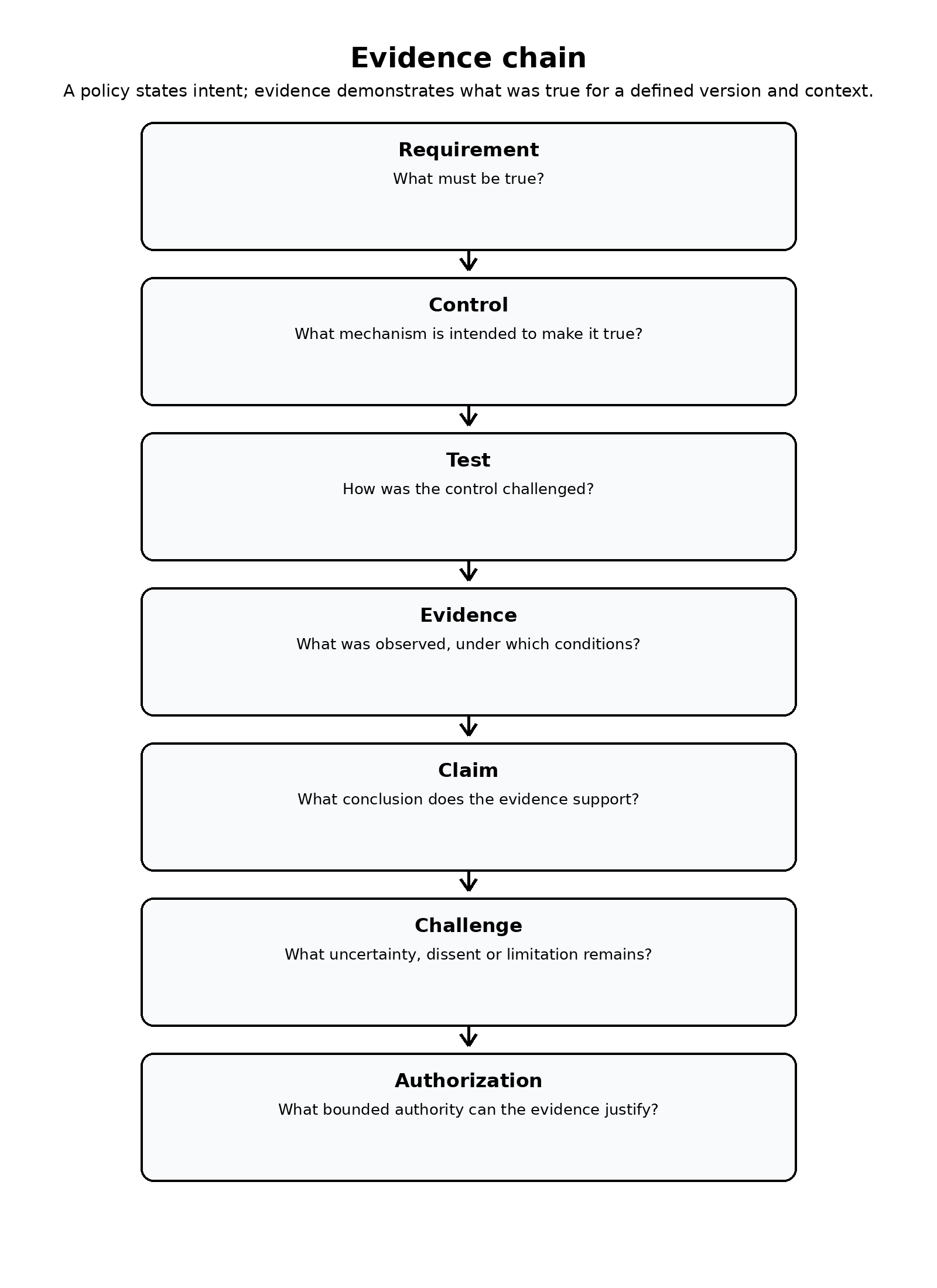
evidence. A digital-twin test showing that a generated network change succeeds under one topology is evidence, but it is not automatically enough to authorize all topologies. The claim must remain bounded by what was actually tested, the known limitations and the deployment conditions.
Evidence-quality questions
| Evidence quality dimension | Question the reviewer should ask |
|---|---|
| Relevance | Does the evidence directly support the requirement/claim for this deployment? |
| Representativeness | Does it cover realistic traffic, load, users, geography, failure, degraded and high-consequence conditions? |
| Reliability | Are methods, instrumentation, data quality, uncertainty and limitations credible? |
| Independence | Was consequential evidence challenged by a function not responsible for delivery success? |
| Traceability | Can the requirement and legal obligation be traced to implementation, test, result and decision? |
| Freshness | Does the evidence apply to the current model, data, prompt, tools, supplier and environment? |
| Integrity | Is provenance protected, access controlled and change detectable? |
| Actionability | Can operators/decision-makers use it under operational, incident, audit and regulatory time pressure? |
If supplier access, test realism, independence, freshness or observability is inadequate, the organization should reduce the authority claim rather than pretending the evidence is stronger than it is.
17. Federated evidence architecture
EU-TEL does not recommend copying all network telemetry and sensitive payloads into one governance repository. Source telemetry can remain in SIEM, OSS/BSS, MLOps, data and supplier systems. The assurance layer stores stable references, scope, provenance, hashes, manifests and protected snapshots for material authorization and incident evidence. This preserves reconstruction while limiting unnecessary duplication of sensitive data.
| Record type | Typical handling |
|---|---|
| Source telemetry | Remain in authoritative operational platform with stable reference and integrity metadata |
| Authorization evidence | Immutable/tamper-evident snapshot or sealed manifest tied to system/version |
| Incident evidence | Preserve pre-incident state, relevant logs, model/config/prompt/tool state, approvals and network before/after state |
| Sensitive personal/communications data | Minimize central copying; apply purpose/access/retention controls and legal holds where appropriate |
| Supplier evidence | Record exact version/scope, limitations, acceptance reviewer and retrieval/access guarantees |
| Dissent/counterevidence | Preserve alongside the decision; do not erase because authorization was granted |
18. The Operational Authorization Envelope
The authorization envelope is the bridge between governance and production. It tells operations and technical controls what the system is allowed to do. A signed approval that does not change credentials, tool permissions or deployment controls is weaker than an enforceable envelope integrated with IAM/PAM, API gateways, change control, orchestration and network controllers.
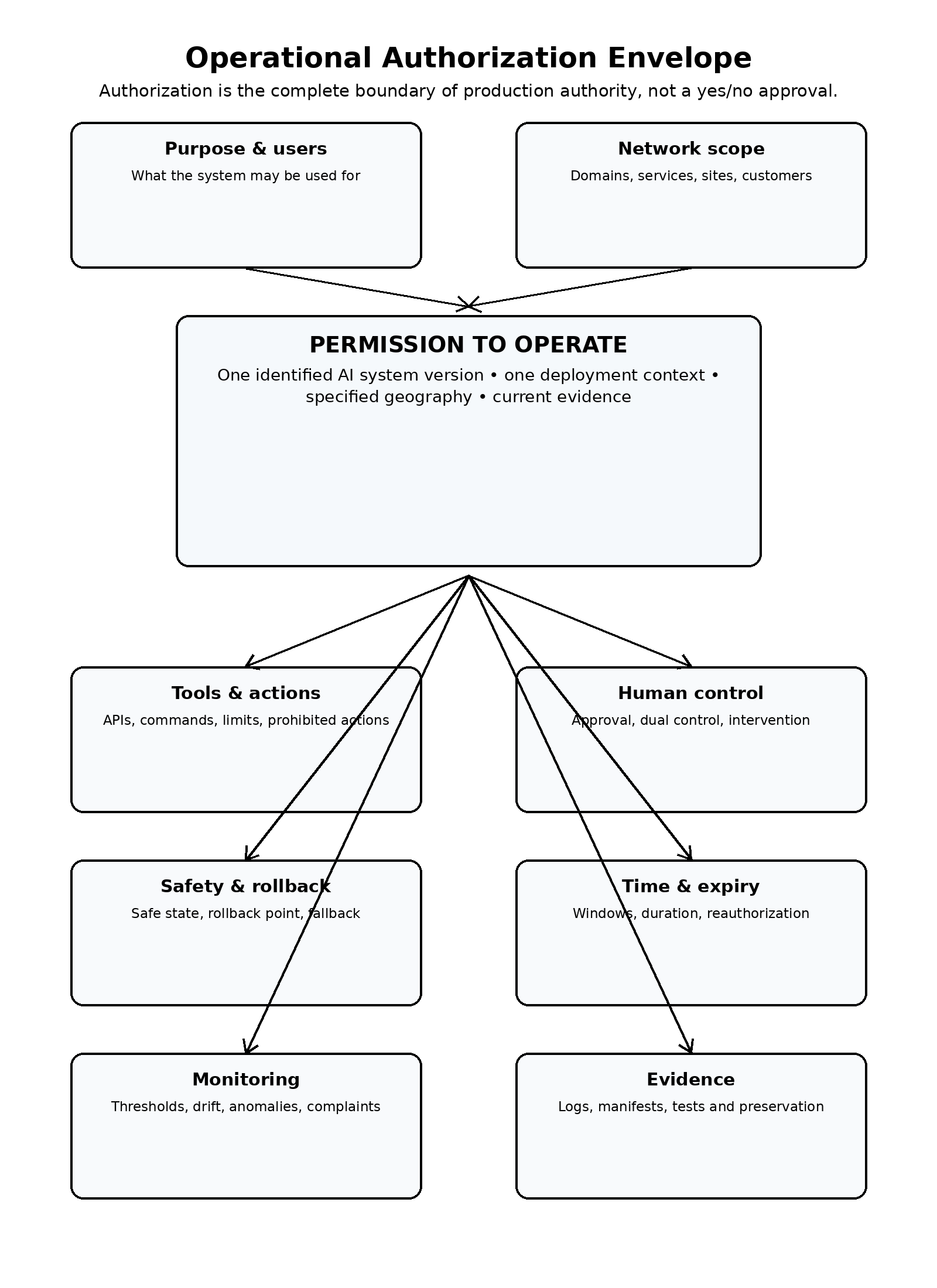
authorization envelope. An A3 change agent might be permitted to modify only defined RAN parameters, in named clusters, during a maintenance window, below a specified change magnitude, with rollback available and dual approval above a threshold. The authorization is the complete boundary, not simply the label “A3.”
| Envelope field | What it controls |
|---|---|
| Identity | System/deployment/version/digest and responsible owner |
| Purpose | Permitted and prohibited uses |
| Actions | Allowed commands, tools, APIs and action classes |
| Resources | Networks, domains, devices, services, data and customer populations |
| Magnitude | Maximum change size, rate, concurrency or blast radius |
| Human control | Approval points, dual control, required competence and intervention path |
| Thresholds | Confidence, drift, service impact, anomaly and fairness thresholds |
| Time/geography | Maintenance windows, operating hours, countries/regions |
| Safe state | Rollback point, non-AI fallback, degraded mode and containment |
| Evidence/logging | Required telemetry, reconstruction fields, evidence retention and integrity |
| Validity | Start, expiry, review cadence and evidence-freshness limits |
| Suspension triggers | Automatic authority reduction/revocation conditions |
19. Human oversight: when “human in the loop” is not enough
Human oversight must be operationally possible. Naming an engineer or requiring an approval is not enough when the system can act before the person can detect, understand, decide and intervene. EU-TEL therefore treats oversight as a timing and authority problem.
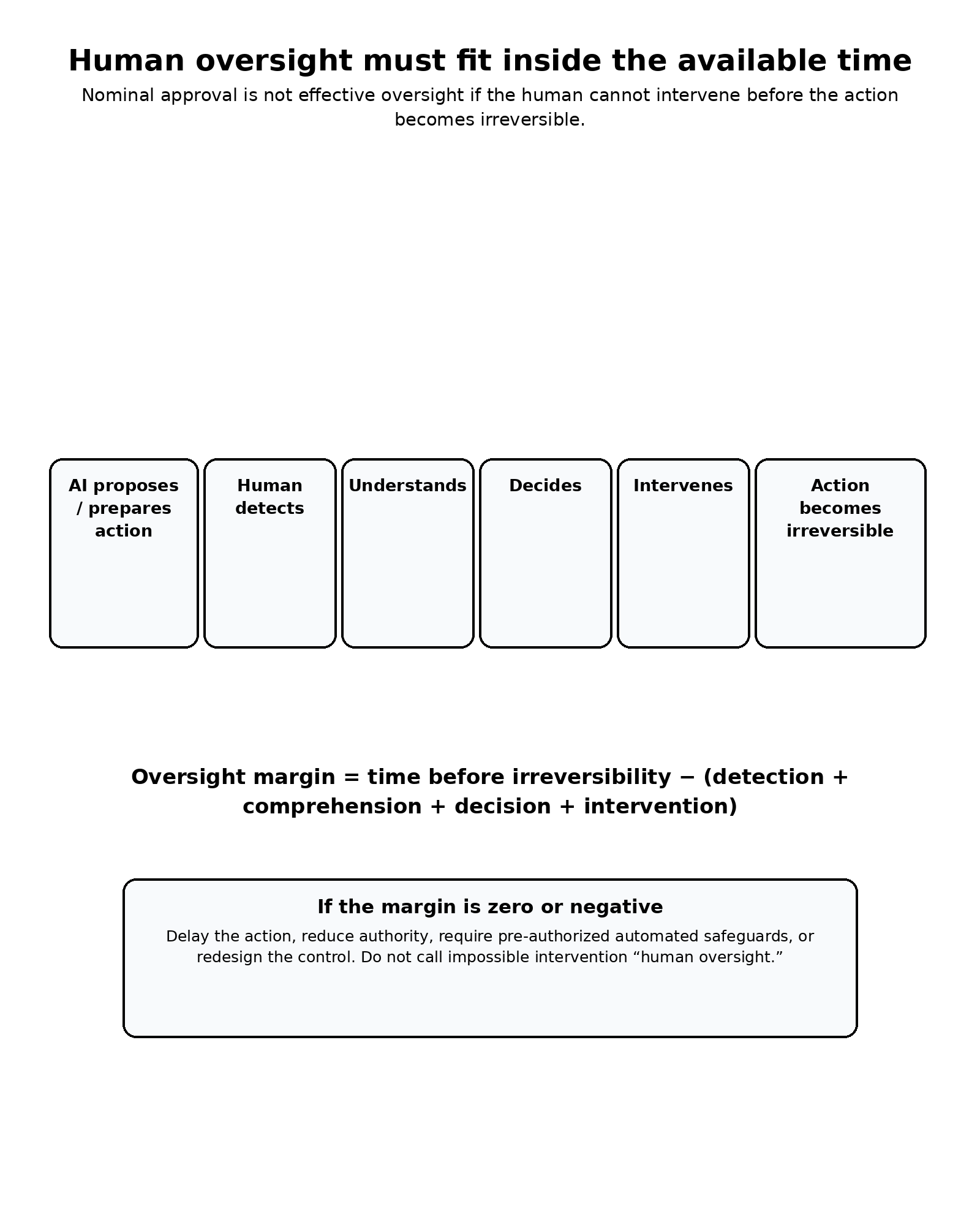
oversight timing. If an AI can execute a network action two seconds after an alarm while a human normally needs thirty seconds to detect, understand and intervene, calling the arrangement “human-in-the-loop” does not make oversight effective. The action must be delayed, constrained, dual-controlled or protected by a pre-authorized safety envelope.
Oversight margin = time before irreversible action − (detection + comprehension + decision + intervention time). If the margin is not positive, the design should slow or constrain the action, require stronger pre-authorization/dual control, or use independent automated safety containment.
The timing model is a governance aid, not a claim that every operational decision can be reduced to a single precise number. Its purpose is to prevent nominal oversight from being credited when intervention is physically or cognitively impossible within the available time.
Reference D: The 40 implementation instruments: how records connect to decisions
Volume 5 contains forty controlled instruments. They are not forty independent forms. They are linked records around the same system/version, gate, owner, evidence and authorization. The easiest way to use the toolkit is to understand the seven instrument families first, then open only the records triggered by the deployment and gate.
20. The seven instrument families
| Family | What it is for |
|---|---|
| R: Controlled registers | The persistent source of truth: system, legal status, obligations, supplier, version/change, identity and evidence/incident registers. |
| F: Assessments and decision forms | Structured analyses used to define the use case, classify law/role/authority, set requirements and assess material change. |
| S: Supplier / supply-chain records | Evidence requests, contractual assurance and dependency records. |
| C: Control / readiness checklists | Implementation and operational-readiness checks, including lifecycle gates. |
| M: Monitoring and management | Post-market/operational monitoring, thresholds, periodic review and management decisions. |
| I: Incident and recovery | Triage, command, notification, root cause/CAPA and staged recommissioning. |
| A: Authorization and assurance | Formal authorization, authorization envelope, independent assurance and exception/residual-risk records. |
21. All 40 instruments: readable reference
R-series: Controlled registers
| ID | Instrument | What you use it for | Gate(s) |
|---|---|---|---|
| R01 | AI system master register | Canonical identity, deployment, purpose, owner and lifecycle record | G0-G9 |
| R02 | EU applicability, classification and role register | AIA status, role, legal anchors, dates and re-screen trigger | G0-G2, G5, G9 |
| R03 | Lifecycle gate and authorization register | Current gate/state, decisions, approvals and authorization status | G0-G9 |
| R04 | Canonical implementation and evidence index | Links practices/tasks/controls to evidence, owner and validity | G1-G9 |
| R05 | Requirements, risk and control traceability register | Requirement→risk→control→test→evidence traceability | G1-G9 |
| R06 | Supplier, component and concentration register | Suppliers, dependencies, nth parties, concentration and exit | G1-G9 |
| R07 | Configuration, version and material-change register | Model/config/prompt/data/tool/version history and change screening | G2-G9 |
| R08 | Human role, competence and oversight qualification register | Named roles, training, demonstrated intervention and coverage | G3-G9 |
| R09 | Affected-person notice, complaint and remedy register | Notices, complaints, review, correction and redress | G1-G9 |
| R10 | Monitoring, incident, action and audit register | Runtime signals, incidents, actions, findings and closure | G7-G9 |
F-series: Assessments and decisions
| ID | Instrument | What you use it for | Gate(s) |
|---|---|---|---|
| F01 | Use-case intake and system-boundary form | Defines need, purpose, boundary, users, actions, dependencies | G0-G1 |
| F02 | EU AI Act classification and transparency screen | Screens prohibitions, Annex I/III, Article 50 and legal status | G0-G2, G5, G9 |
| F03 | Provider, deployer and value-chain role allocation form | Allocates roles and tests role shifts | G1-G6, G9 |
| F04 | Authority, consequence and Assurance Class assessment | Assigns A0-A4, C1-C4 and Class I-IV | G1-G9 |
| F05 | Integrated requirements and risk assessment | Converts law/mission/hazards into testable requirements | G2-G9 |
| F06 | Data, provenance, privacy and fairness assessment | Data lineage, privacy, sensitive inference and fairness controls | G1-G9 |
| F07 | Human oversight feasibility and decision-time assessment | Tests whether human intervention is physically/cognitively credible | G2-G9 |
| F08 | Supplier due-diligence and assurance acceptance form | Assesses supplier evidence, access, security, change and continuity | G1-G6, G9 |
| F09 | Material change, substantial modification and reauthorization screen | Determines what classification/evidence/gates must reopen | G2-G9 |
| F10 | Rights impact, notice, accessibility and redress assessment | Maps affected-person rights, notice, access and remedy | G1-G9 |
S-series: Supplier / supply-chain pack
| ID | Instrument | What you use it for | Gate(s) |
|---|---|---|---|
| S01 | Model supplier clause schedule | Minimum contract clauses for evidence, changes, incidents, audit and exit | G2-G6, G9 |
| S02 | Supplier evidence request and acceptance record | Requests, evaluates and accepts/rejects supplier evidence | G2-G9 |
C-series: Control and readiness pack
| ID | Instrument | What you use it for | Gate(s) |
|---|---|---|---|
| C01 | High-risk requirements readiness checklist | Checks readiness against applicable high-risk requirements | G2-G5, G9 |
| C02 | Provider QMS and Annex IV technical-file checklist | Supports provider QMS/technical documentation where applicable | G2-G5, G7-G9 |
| C03 | Conformity, declaration, marking and registration checklist | Controls conformity/registration route when applicable | G5, G9 |
| C04 | Deployer operational-readiness checklist | Checks instructions, oversight, logs, monitoring and production readiness | G3-G7, G9 |
| C05 | G0-G9 lifecycle gate checklist | Single gate-close/reopen control across lifecycle | G0-G9 |
M-series: Monitoring and management pack
| ID | Instrument | What you use it for | Gate(s) |
|---|---|---|---|
| M01 | Post-market and operational monitoring plan | Defines signals, cadence, owners, thresholds and review | G5-G9 |
| M02 | Metric, threshold and action catalogue | Connects each metric/threshold to required operational action | G2-G9 |
| M03 | Periodic monitoring and assurance review record | Records continued validity and reauthorization needs | G7, G9 |
| M04 | Management metrics and decision pack | Gives management decision-useful status without collapsing to a single compliance score | G1-G9 |
I-series: Incident and recovery pack
| ID | Instrument | What you use it for | Gate(s) |
|---|---|---|---|
| I01 | Integrated incident triage and legal-clock matrix | Screens all potentially applicable reporting/notification clocks | G8 |
| I02 | Incident command, containment and evidence record | Controls containment, authority, evidence and decision chronology | G8 |
| I03 | Regulatory, supplier and affected-party notification log | Tracks recipients, deadlines, submissions and follow-ups | G8 |
| I04 | Root cause, corrective and preventive action record | Connects causes/findings to CAPA and effectiveness review | G7-G9 |
| I05 | Recovery and staged recommissioning authorization | Controls what authority can be restored and in what stages | G8-G9 |
A-series: Authorization and assurance pack
| ID | Instrument | What you use it for | Gate(s) |
|---|---|---|---|
| A01 | Pilot and production authorization decision record | Records formal approve/condition/restrict/pilot/reject/retire decision | G5-G6, G9 |
| A02 | Operational authorization envelope specification | Defines machine-operational permission and constraints | G3-G9 |
| A03 | Independent assurance review and audit workpaper | Records independent challenge, control effectiveness and findings | G4-G9 |
| A04 | Exception, residual-risk and temporary-waiver record | Time-bounds exceptions/waivers and compensating controls; cannot waive law | G2-G9 |
A policy is not evidence and a register is not assurance. Every material record should resolve to a specific system/version, gate, owner, evidence set, decision, validity period and reopening trigger.
22. Which instrument do I use first?
A first-time practitioner should not start by completing forty forms. Start with the event that brought the system into the framework, then follow the connected records.
| Situation | Start with | Then connect to |
|---|---|---|
| New AI proposal | F01 + R01 | F02-F04 → G0/G1 |
| Need EU AI Act classification | F02 + R02 | F03 role + F04 operational classification |
| Buying an external model/system | F08 + S01/S02 + R06 | G3; supplier evidence ceiling; A02 envelope |
| Preparing validation | F05-F07 + R05 | C01/C04 + A03 + evidence index |
| Authorizing production | A01 + A02 | A03, C04/C05, M01-M02 |
| Supplier/model/config change | F09 + R07 | Reopen affected gates; update classification/evidence |
| Incident | I01 + I02 | I03-I05 + R10; G8/G9 |
| Temporary exception | A04 | Compensating controls, expiry, owner; no waiver of mandatory law |
| Country expansion | AC07-AC09 | Localized R02/F02/F03 plus country sign-off |
Reference E: Telecom use-case playbooks: start from function, then classify the deployment
The use-case catalogue helps a team ask better questions; it does not assign an automatic legal or operational classification. The same vendor model can be a low-authority NOC assistant in one deployment and a high-authority network-control agent in another. Intended purpose, executable actions, affected service, data, safety function, geography and human control determine the result.
23. How to use the catalogue correctly
- Choose the closest functional use-case pattern.
- Define the exact deployment boundary and executable actions.
- Apply the legal screen and operator-role analysis to that actual deployment.
- Assign A0-A4 authority and C1-C4 consequence independently.
- Select the Assurance Class and required evidence.
- Record reclassification triggers so the starting point is not mistaken for a permanent decision.
Never copy a catalogue classification into the system register without documenting the deployment facts that justify it.
| Use case | Function | Operational starting point | EU legal starting position | Reclassification triggers |
|---|---|---|---|---|
| NOC knowledge/RAG assistant | Advisory knowledge support | Usually A0-A1; C1-C2; Class I-II starting point | Generally not high-risk solely as knowledge support; transparency/privacy/data rules may still apply | Tool access, executable instructions, automatic remediation, new sensitive data |
| AI-generated network configuration with execution | Generate and optionally execute CLI/API/policy changes | Can move from A1 to A4 depending on execution chain; C2-C4; Class II-IV | Not automatically high-risk because content is generated; Annex III point 2 is conditional on safety-component function | Direct execution, new commands/targets, approval removed, model/RAG change |
| Autonomous incident-remediation agent | Diagnose, plan and execute remediation | Often A2-A4; C2-C4; Class III-IV for essential-service scope | Conditional Annex III point 2 candidate where it serves a safety function in critical digital infrastructure | New tools/credentials, self-modification, cross-domain scope, shared verifier dependency |
| Closed-loop RAN optimization | Autonomous optimization of network parameters | A2-A3; consequence depends on service and protected traffic | Annex III point 2 depends on amended safety-component test; performance optimization alone is not automatically a safety component | Emergency-service influence, safety function, larger authority/blast radius |
| Use case | Function | Operational starting point | EU legal starting position | Reclassification triggers |
|---|---|---|---|---|
| Emergency-service traffic prioritization | Prioritize emergency traffic/service | A3-A4; C4; Class IV starting point | Strong Annex III point 2 candidate where it serves a safety function; other Annex III categories may apply in specific call/dispatch contexts | Priority logic, emergency-customer scope, network/interconnect dependencies |
| Customer-service chatbot/voicebot | Answer, troubleshoot, sell, route | A0-A2; C1-C3 depending on actions | Generally not high-risk solely as chatbot; Article 50 interaction transparency unless obvious; GDPR/ePrivacy/consumer law apply as triggered | Account actions, vulnerable customers, emergency support, automated denial, emotional manipulation |
| Individualized network-experience optimization | Adjust QoS/routing/support using predicted needs/value | A1-A3; C2-C4 | Normally not high-risk; open-internet, discrimination, telecom and privacy issues may dominate | Person-level value score, emergency service, autonomous throttling, sensitive proxy |
| Device financing / creditworthiness | Creditworthiness or credit score for financing | A1-A2; C2-C3; Class III often appropriate | Likely Annex III point 5(b) high-risk except specified fraud-detection context; GDPR and consumer law central | Automated rejection, new data/proxies, provider/model change |
| Use case | Function | Operational starting point | EU legal starting position | Reclassification triggers |
|---|---|---|---|---|
| Recruitment / candidate ranking | Filter/evaluate telecom job candidates | A1-A2; C2-C3 | Likely Annex III point 4(a) high-risk | Automated rejection, new job family/data, assessment modality/vendor change |
| Workplace emotion recognition | Infer emotions in workplace | A0 unless narrow exception; C3-C4 if permitted safety use | Prohibited under Article 5 in workplace except medical or safety reasons; exception must be genuine and narrow | Any expansion beyond the narrow permitted purpose |
| Synthetic voice/avatar customer communication | Generate audio/video/text | A0-A2; C2-C4 | Article 50 synthetic/deepfake transparency may apply; manipulation/exploitation prohibitions must be screened | Executive/customer likeness, emergency content, targeted persuasion, marking change |
| Outage prediction and restoration optimization | Predict outages and sequence restoration | A1-A4; C2-C4 | Annex III point 2 conditional where restoration is a safety component; otherwise still high operational consequence | Autonomous execution, scarcity trade-offs, emergency/dependent-sector prioritization |
24. Four walkthroughs for first-time readers
NOC knowledge / RAG assistant
The system retrieves network procedures and proposes answers to engineers but has no write access. Begin by confirming data sources, intended use, hallucination/unsupported-claim controls and whether recommendations can become consequential without further validation. Operationally this often starts at low authority, but the class can rise if engineers routinely treat its output as de facto instructions.
Watch for tool access, executable instructions, sensitive operational data, new memory/RAG sources and automation bias.
AI-generated network configuration
The system generates CLI/API/policy changes. If output is only drafted, P12 validation and P14 operator transparency are central. If it can submit or execute changes, P3/P5 authority and identity controls, P4 override, P10 logging, P13 assurance and A02 envelope become decisive.
Watch for direct execution, approval removal, new command targets, model/prompt/RAG change and broadened credentials.
Closed-loop RAN optimizer
The system continuously changes parameters to optimize service objectives. Classification must consider actual execution authority, protected service classes, human intervention feasibility, rollback and whether average KPI improvement masks adverse distributional effects.
Watch for expanded domains, changed objectives, degraded observability, emergency-service impact and supplier/model releases.
Customer or workforce decision AI
The system influences people rather than network control. Operational authority may be lower than a network agent while legal, privacy, equality, transparency, notice, contestability and remedy requirements can be much stronger.
Watch for new decision purposes, profiling, sensitive inference, automated restrictions, worker monitoring and inaccessible review routes.
Reference F: Runtime operations, material change, incidents, recovery and reauthorization
Authorization is not the end of governance. In telecom, the most important question after deployment is whether the evidence and assumptions that justified authority remain true while network state, software, suppliers, traffic, people and law continue to change.
25. What the Operational Head should see every day
The operational view should show permission and exposure, not a generic compliance percentage. A system with a high score but an expired authorization, lost monitoring or critical evidence gap is not “green.”
- AI systems operating now, exact production version and deployment geography.
- Current A0-A4 authority, C-tier, Assurance Class and authorization state.
- EU legal status and operator role, including unresolved or time-dependent obligations.
- Authorization/evidence expiry, temporary waivers and compensating controls.
- Human-oversight coverage, alternate availability, qualification and intervention feasibility.
- Performance, drift, anomaly, service-quality, privacy/fairness/accessibility and resilience thresholds.
- Unreviewed supplier/model/configuration/data/prompt/RAG/tool changes.
- Open incidents with all potentially applicable legal/reporting clocks and named owners.
- Systems automatically restricted, suspended or degraded and the reason.
- Complaints, adverse outcomes, audit findings, CAPA and upcoming reauthorization/tests/drills.
A green compliance percentage must never override a red blocking condition. Authorization state is a decision state, not a dashboard average.
26. Material change and reauthorization
Material change is broader than a new model version. A prompt policy, RAG corpus, tool permission, network scope, supplier, operating country, data source, intended purpose or legal assumption can invalidate the evidence on which authorization was based. The framework therefore treats change as an evidence and authority event.
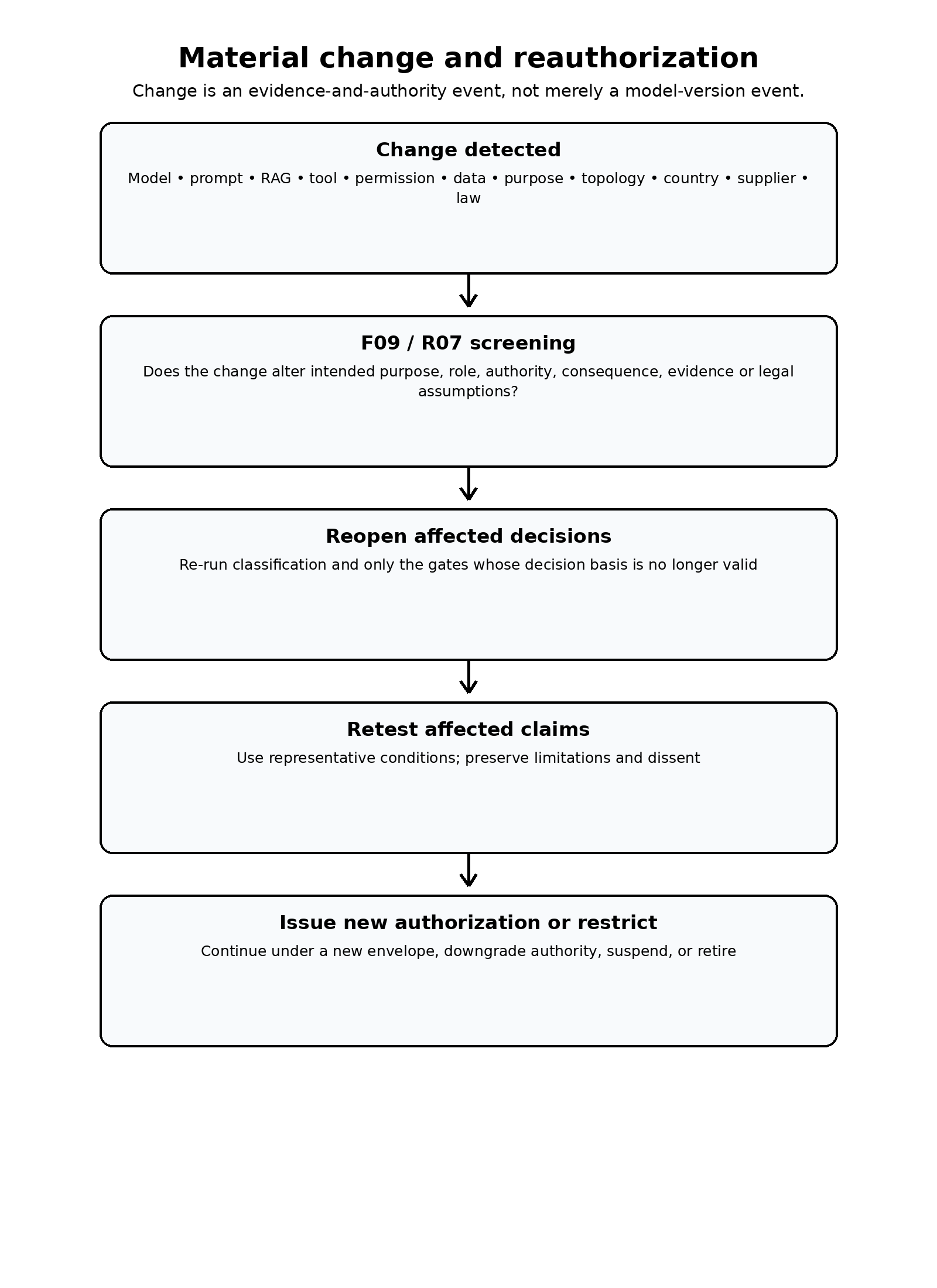
material change. Giving an existing agent access to a new configuration API can be more important than changing the model version. The new tool may expand what the agent can do, invalidate previous tests and require the authority tier, evidence and authorization envelope to be reconsidered.
- Detect and record the change: model, prompt, RAG, tool, permission, data, purpose, topology, country, supplier, personnel, threshold, law or operating assumption.
- Run F09 and update R07. Ask whether intended purpose changed, whether a substantial modification/provider-role shift occurred, and whether old evidence remains valid.
- Re-run F02/F03/F04 if legal status, role, authority, consequence or assurance may change.
- Reopen the gates whose decision basis is no longer valid; do not reopen everything blindly, but never skip an affected decision.
- Retest affected claims under representative conditions.
- Issue a new A01/A02 authorization if continuing; preserve the superseded authorization and evidence chain.
27. Multi-regime incident command
Telecom AI incidents can cross organizational and legal boundaries. The correct first move is not to argue about which regime “owns” the incident. Contain the system, preserve evidence, open the potentially applicable routes, assign an owner to each clock and then determine applicability with the appropriate legal and regulatory teams.
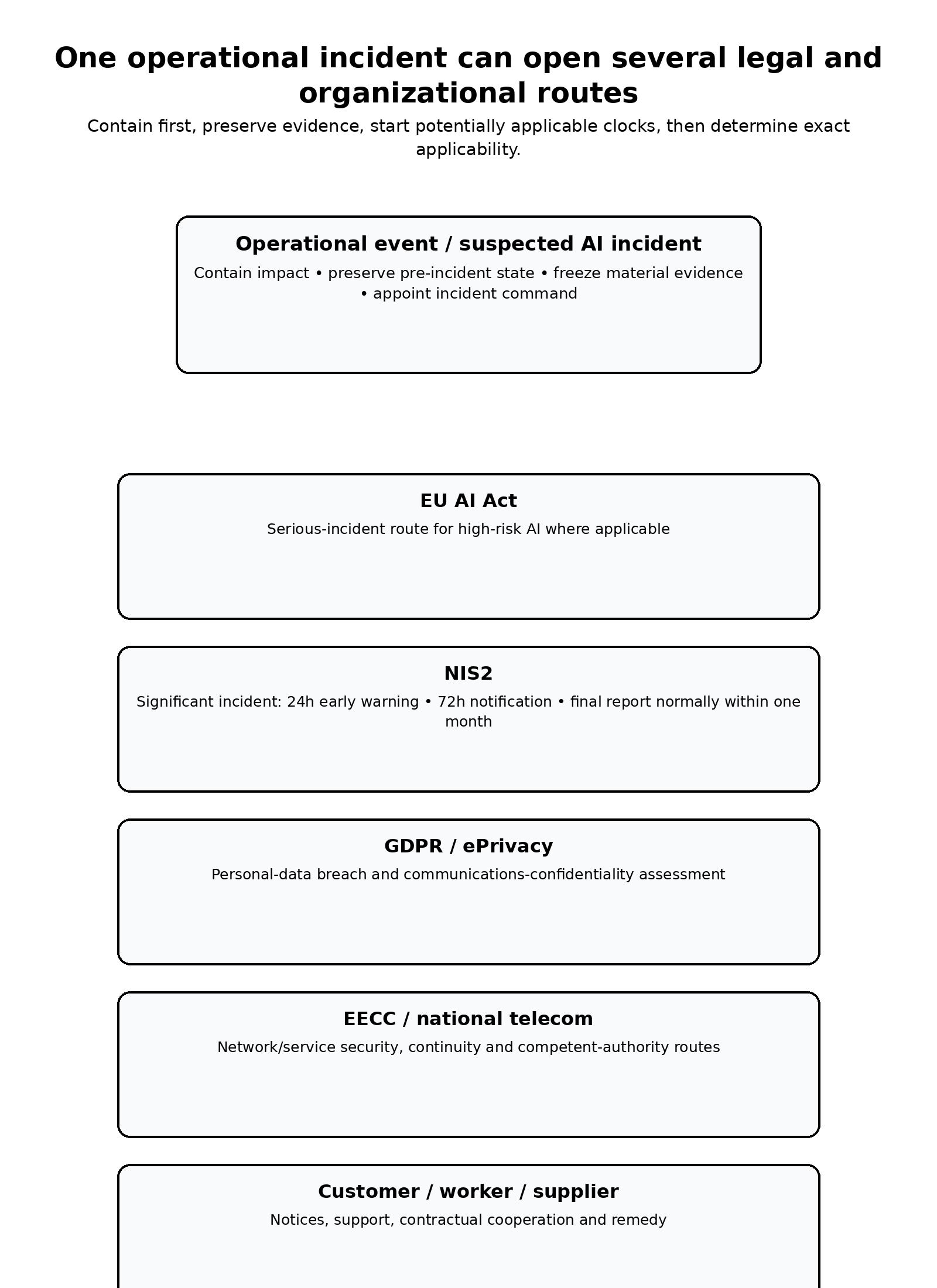
incident. If an AI-driven network action disrupts an essential service, operations should first contain the impact and preserve the relevant state. The organization then assesses every potentially applicable route: for example AI Act, NIS2, telecom and privacy routes: rather than waiting for one team to decide which regime “owns” the incident.
| Potential route | Time concept used operationally | What EU-TEL does |
|---|---|---|
| AI Act high-risk serious incident | Provider reporting is generally immediate after causal link/reasonable likelihood is established and no later than 15 days; specific severe cases have shorter outer limits | Open AI Act serious-incident assessment, preserve evidence, notify provider/distributor chain and authority as applicable |
| Serious irreversible critical-infrastructure disruption under AI Act serious-incident route | Immediate; no later than two days under the AI Act serious-incident provision | Executive/legal/regulatory escalation without waiting for perfect causality |
| Death potentially linked to high-risk AI | Immediate after causal relationship is established/suspected; no later than ten days | Highest escalation, safety/legal investigation and evidence preservation |
| NIS2 significant incident | 24-hour early warning; 72-hour incident notification; one-month final report | Assign national route/clock owner and coordinate with technical incident command |
| GDPR/ePrivacy | Screen personal-data breach and communications confidentiality/security obligations | DPO/privacy lead determines notification/communication obligations and evidence |
| EECC/national telecom/CER/other | Country- and event-specific | Use AC07/AC08 national source/authority record; do not assume one EU-wide recipient |
28. Recovery is a controlled authorization state
G8 recovery should support staged authority. A system can move from suspended to advisory-only, then to bounded execution, rather than jumping directly from incident to full production. I05 records the recommissioning decision, and a material change can route the system into G9 for full reauthorization.
Reference G: Enterprise adoption and Member State localization
CI-AIGAF EU-TEL governs individual systems and also provides a method for an organization to adopt the framework consistently across a portfolio. Maturity does not authorize systems; it describes how reliably the organization can perform the governance process.
29. AD0-AD5 adoption maturity
AD0-AD5 answers “how capable is the organization at applying EU-TEL?” It does not answer “may this A4 system operate?” An AD5 organization still has to pass the gates and produce the evidence for each deployment.
| Level | State | Evidence-based outcome |
|---|---|---|
| AD0 | Unknown / uncontrolled | Systems, roles, countries, authority or evidence materially unknown; operation relies on informal judgement |
| AD1 | Inventoried / accountable | Priority systems/owners named; mandate/discovery/basic literacy operate, but gating is inconsistent |
| AD2 | Classified / gated | Legal/operational classifications, requirements, suppliers and G0-G6 decisions controlled for priority systems |
| AD3 | Evidence-bound / authorized | Implementation, representative evidence, independent review, envelopes, monitoring and incidents linked by system/version |
| AD4 | Federated / multi-regime | Country annexes, national routes, rights, NIS2/CER/telecom interactions and cross-border incidents operate coherently |
| AD5 | Adaptive / independently assured | Monitoring, incidents, audit, regulatory change and exercises drive controlled profile/system/portfolio reauthorization |
An AD5 organization does not automatically authorize an A4 system. Organizational maturity and system permission are different decisions.
30. W01-W12 implementation workstreams
The workstreams are the enterprise build plan. They establish mandate, inventory, legal source control, practices, evidence, technology integrations, training, pilot validation and governance needed to make the framework repeatable.
| ID | Workstream | Principal outputs | Route |
|---|---|---|---|
| W01 | Mandate and operating governance | AC01; decision rights; profile owner; gate authorities | P1/P13; G0-G9 |
| W02 | Inventory, discovery and portfolio triage | R01; F01; AC02; shadow-use discovery | P1/P7/P10; G0-G1 |
| W03 | EU/national applicability, role and classification | R02; F02-F04; AC07-AC09 | P1/P6/P13-P17; G1-G2 |
| W04 | Requirements, risk and practice tailoring | R04-R05; F05/F10; tailored P1-P18 task set | P1-P18; G2 |
| W05 | Architecture, authority, IAM and change | R03/R07; F07/F09; A01-A02 | P3-P5/P12/P14; G2-G6/G9 |
| W06 | Data, model, validation and evidence | R04-R05; F06; C01-C02; AC05/AC10 | P2/P7/P10/P13; G3-G5 |
| ID | Workstream | Principal outputs | Route |
|---|---|---|---|
| W07 | Supplier, component and concentration control | R06; F08; S01-S02; exit tests | P6/P7/P12/P18; G1-G9 |
| W08 | People, competence and human oversight | R08; F07; AC06; qualification/IAM binding | P5/P9/P14; G3-G9 |
| W09 | Transparency, privacy, fairness and redress | R09; F06/F10; notices/complaints/remedies | P13-P17; G1-G9 |
| W10 | Monitoring, incidents and recovery | R10; M01-M04; I01-I05; legal-clock drills | P2/P4/P8/P10-P12/P18; G7-G9 |
| W11 | Conformity, registration, authorization and assurance | C01-C05; A01-A04; AC10-AC11 | P1-P18; G4-G9 |
| W12 | Member State localization and profile maintenance | AC07-AC12; Member State annexes; source/change control | P1/P8/P13-P18; G1-G9 |
31. AC01-AC12 adoption controls
The adoption controls are controlled records for enterprise implementation. They make the rollout itself auditable: who mandated the profile, which systems are in scope, which Member State sources were checked, what pilot evidence exists, what exceptions remain and which version of the profile is released.
| ID | Control | Primary owner | What it does |
|---|---|---|---|
| AC01 | EU-TEL adoption charter and mandate | Executive sponsor / AI governance lead | Mandate, scope, decision rights, profile ownership and gate authorities |
| AC02 | Portfolio triage and adoption-wave plan | Portfolio adoption lead | Discover systems and sequence adoption by risk/authority/country |
| AC03 | Adoption maturity baseline and target record | Independent assurance lead | Evidence-based AD0-AD5 baseline/targets |
| AC04 | Workstream implementation and dependency plan | EU-TEL programme director | Coordinates W01-W12 and dependencies |
| AC05 | Pilot charter, scenario and evidence plan | Pilot authority | Defines pilot scope, scenarios, acceptance and evidence |
| AC06 | Role, competence and adoption enablement plan | People/competence owner | Maps roles, training, qualification and support |
| ID | Control | Primary owner | What it does |
|---|---|---|---|
| AC07 | National legal source and authority register | Country legal validator | Controls national sources, authorities, dates and contacts |
| AC08 | Member State localization and release record | Country implementation authority | Approves localized control/evidence/notification routes |
| AC09 | Cross-border deployment and strictest-condition matrix | Cross-border deployment owner | Preserves country-specific requirements and identifies stricter conditions |
| AC10 | Implementation validation and operational sign-off | Independent validation / operational authority | Confirms the implemented profile works, not only that documents exist |
| AC11 | Adoption exception, residual-risk and debt register | Authorized residual-risk owner | Tracks temporary adoption debt/compensating controls/expiry |
| AC12 | EU-TEL profile maintenance and release record | Profile custodian | Controls framework/legal-source updates and downstream impact |
32. Member State localization: one framework, twenty-seven controlled deltas
EU-level consistency is valuable, but telecom obligations and authorities are not identical across Member States. EU-TEL therefore keeps a common core and localizes only the elements that truly vary: transposition, competent authorities, telecom licences, reporting routes, labour consultation, privacy/ePrivacy enforcement, language and other national requirements.
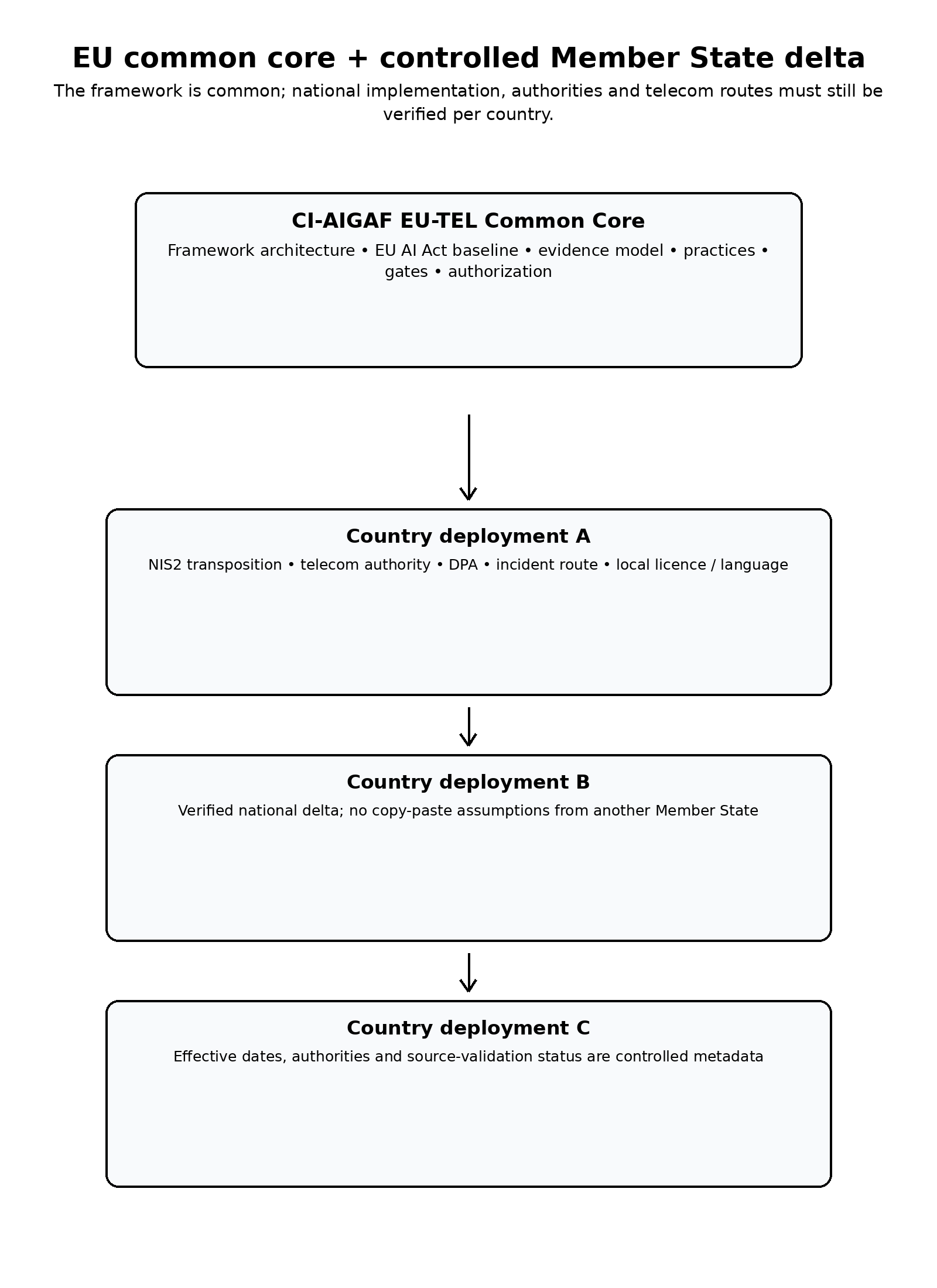
Member State localization. A common EU-TEL control for incident evidence can remain identical across countries, while the competent authority, national reporting portal, language or national telecom requirement may differ. The local annex changes the delta; it does not create a different framework.
- AC07 creates and maintains the national legal source and authority register.
- AC08 approves the localized Member State release for use.
- AC09 controls cross-border deployments and a strictest-condition matrix where one common technical configuration must satisfy several countries.
- Country annexes should carry source date, reviewer, status and next verification; a URL alone is not validation.
Member States covered by the Volume 6 annex structure
Reference H: Digital implementation: the Operational Assurance Control Plane
The application is the execution layer of the framework. It should make the framework easier to operate and harder to bypass. It is not another document repository and it should never allow AI to approve its own legal classification, evidence sufficiency or operational authorization.
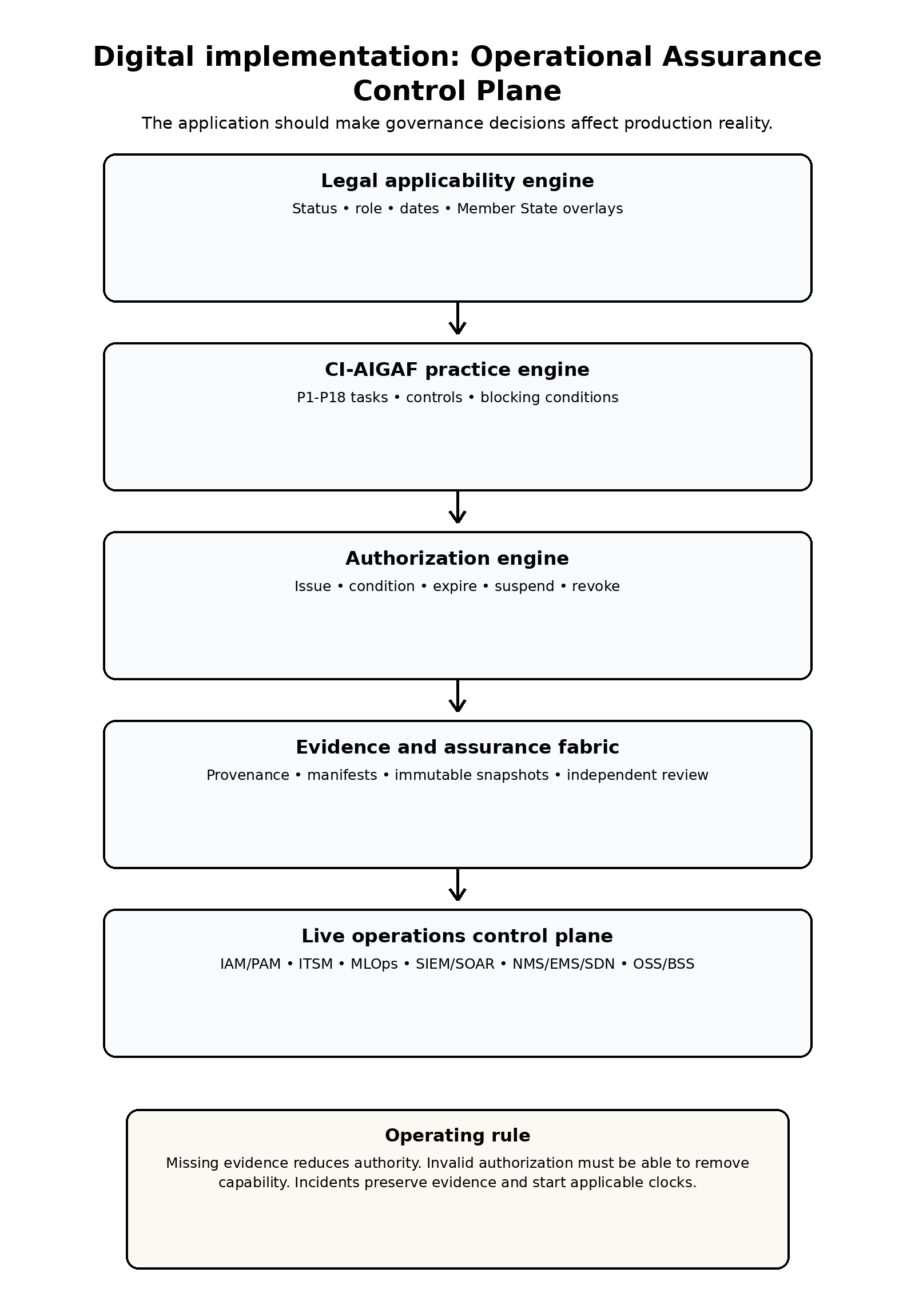
control plane. If an authorization expires, the application should be capable of doing more than turning a dashboard red. Depending on the deployment, it should be able to remove a credential, disable a tool, reduce scope, require dual approval or move the system back to recommendation-only mode.
33. What the application changes operationally
The application’s central object is the permission to operate for one identified AI system version, in one deployment context and geography, within a defined authorization envelope supported by current evidence. This is different from a conventional GRC dashboard because a decision is intended to affect production authority.
| Application module | Framework objects implemented | Operational behavior |
|---|---|---|
| AI portfolio/system-boundary registry | R01, F01, R07 | One commercial product can create multiple controlled deployments; track exact components, tools, versions and contexts |
| EU legal applicability & role engine | R02, F02, F03 | Human-confirmed legal status, operator role, dates, Member State and reclassification triggers |
| P1-P18 workbench | Practice task records, R04/R05 | Instantiates applicable tasks with owner, evidence, test method, result, expiry and blocking consequence |
| G0-G9 state engine | R03, C05 | Prevents invalid lifecycle transitions and reopens gates after change/incident/evidence expiry |
| Authorization engine | A01-A04 | Issues/conditions/expires/suspends/revokes permission; records dissent and residual risk |
| Authorization-envelope enforcement | A02 + IAM/PAM/change/API integration | Can revoke credentials, disable tools, switch to advisory mode, narrow scope, freeze deployment or trigger rollback |
| Human oversight/competence | R08, F07 | Names overseers/alternates, qualification, availability, authority and timing feasibility |
| Evidence/assurance fabric | R04/R05, A03 | Federated references, hashes, timestamps, protected snapshots, independent review and export |
| Monitoring/material change | M01-M04, F09, R07/R10 | Detects drift/anomalies/changes and reopens classification/gates when evidence becomes invalid |
| Incident command | I01-I05 | Freezes evidence, opens legal clocks, assigns owners, controls containment and staged recommissioning |
| Rights/notices/complaints | R09/F10 | Notice, complaint, human review, correction/remedy and outcome tracking |
| Enterprise/adoption federation | AC01-AC12, Member State annexes | Country releases, source-control, cross-border matrix, executive/independent assurance |
AI may help retrieve obligations, draft records or identify gaps, but it must not approve its own classification, evidence, exception or authorization.
34. Controls discovered during application development
Building the control plane exposed several controls that should be explicit in the written profile rather than remaining software-only. These are treated as strengthening of existing practices and adoption governance, not as silently invented new practices.
| Application development finding | Where it belongs in the framework | Master Guide treatment |
|---|---|---|
| Risk-based internal audit, independence, control-design/operating-effectiveness workpapers and independent retest | P10 logging/audit + P13 assurance case + A03 | Explicitly included as independent assurance and control-effectiveness evidence; control owners cannot self-close critical findings |
| Critical audit failure can force A0/G8 restriction | G7/G8 + A01/A02 + A03 | Codified as a possible blocking/restriction consequence when the authorization basis is invalidated |
| Management-body accountability, challenge/dissent and attestation | P13 + W01/AC01 + management decision rights | Executive attestation supports governance but cannot override legal or operational blocking conditions |
| Regulatory commitments with owners/milestones/deadlines | R10/M04 + AC12 + incident/legal-source controls | Commitments become controlled obligations with accountable owners and immutable deadlines |
| Exception/waiver/compensating-control governance (next work package) | A04 + AC11 | No exception can waive mandatory law; every waiver must be time-bounded, compensated, approved and automatically reopen on expiry |
Reference I: First implementation: ten steps for the Operational Head
A first-time practitioner does not need to memorize the whole framework before starting. The safest approach is to follow one deployment through the ten steps below while using the detailed volumes only when a specific decision, practice or record needs deeper treatment.
35. Ten-step practitioner method
| Step | What to do |
|---|---|
| 1. Register | Open R01/F01. Define the service need, intended purpose, system boundary, countries, affected services and non-AI alternative. |
| 2. Classify law | Run F02. Screen Article 5, Annex I, Annex III, Article 6(3) where relevant, Article 50 and other triggered EU/national law. |
| 3. Assign roles | Run F03. Record provider, deployer and other value-chain roles; identify any modification/purpose change that could shift role. |
| 4. Classify operations | Run F04. Assign A0-A4, C1-C4 and Assurance Class; use uncertainty as an escalation factor, not as permission to proceed. |
| 5. Define requirements | Use P1 and F05/F06/F07/F10. Translate mission, law, resilience, rights and oversight into testable criteria; draft the envelope. |
| 6. Build/procure under control | Apply P3/P5-P7/P12 and supplier tools. Obtain identities, evidence access, change notice, fallback and exit capability. |
| 7. Validate realistically | Apply P2/P4/P9/P10/P13-P18 as relevant. Test normal, edge, degraded, attack, human, rights, recovery and systemic scenarios. |
| 8. Authorize | At G4/G5, assemble the assurance case, independent challenge and A01/A02 decision. Authorization is time-bounded and version-bound. |
| 9. Operate and monitor | At G6/G7, bind IAM/PAM and production controls to the envelope; monitor thresholds, evidence freshness, complaints and supplier changes. |
| 10. Change/incident/retire | Use F09 and G8/G9. Freeze evidence during incidents, run all legal clocks, stage recovery and issue a new authorization or retire cleanly. |
36. Worked example: AI-generated network configuration with execution
This walkthrough shows how the framework behaves as a system. It is illustrative; the actual legal and operational classifications must be determined from the real deployment facts.
| Stage | Example decision/evidence |
|---|---|
| G0 | Need: reduce change preparation time. Non-AI alternative and minimum service documented; no AI access to production yet. |
| G1 | Boundary: model + prompt/RAG + verifier + executor + IAM + NMS/API + rollback. Legal status screened; operational starting point A2-A3/C3, Class III subject to deployment facts. |
| G2 | Requirements: only approved command families; protected resources; topology validation; change-size limits; dual approval for critical domains; rollback; reconstruction. |
| G3 | Supplier/build: evidence/log/change-notice rights; workload identity; no personal credential reuse; deterministic command validator; digital-twin capability. |
| G4 | Tests: syntax and semantic validation, stale topology, conflicting telemetry, unusual command, rollback, human timing, verifier failure, tool abuse, peak/change-window conditions. |
| G5 | A01/A02 authorizes only named network domains, approved commands, time window and rate limits; evidence expires after defined period/change triggers. |
| G6 | Production IAM/PAM matches the envelope; operators qualified; monitoring and kill/revoke tested. |
| G7 | Every execution records input/context, generated artifact, validator result, approval, tool call, execution diff, before/after network state and rollback status. |
| G8 | Incident: revoke execution credential, preserve configuration/prompt/verifier state, open legal/telecom/cyber clocks as applicable, investigate and restore only via I05. |
| G9 | New model/RAG, new command family or removed approval triggers F09, revalidation and a superseding authorization. |
37. How to know that the framework is working
The framework is working when governance decisions change operational reality. Missing evidence lowers or blocks authority. A material change reopens classification. A failed audit can invalidate the authorization basis. An incident freezes evidence and starts the applicable clocks. Recovery is staged. Retirement closes credentials and retention obligations. If the application only creates records while the AI retains the same production power regardless of those decisions, the control plane is not yet implementing the framework.
Appendix A: Framework traceability: from concept to application
Traceability prevents the Master Guide, detailed volumes, instruments, legal anchors and application from becoming separate systems. The examples below show the expected chain. The controlled v1.0 publication should maintain this mapping as the framework changes.
| Concept | Practices | Gates | Key instruments | Legal overlay | Application capability |
|---|---|---|---|---|---|
| Human oversight | P4/P9/P14 | G2/G4/G6/G7 | F07, R08, C04, A02 | AI Act Arts. 14/26 where applicable; NIS2 training/operations | Oversight & competence module; IAM authority; timing tests |
| Material change | P3/P7/P13 | G7/G9 | F09, R07, A01/A02 | AI Act substantial modification/provider-role analysis; other law as triggered | Change engine reopens classification/evidence/gates |
| Supplier evidence | P6/P7/P13 | G3-G5/G7/G9 | R06, F08, S01/S02, A03 | AI Act value-chain duties; NIS2 supply chain; CRA/Data Act as applicable | Supplier portal/evidence acceptance/freshness |
| Runtime reconstruction | P10/P12 | G6-G9 | R10, M01/M02, I02, A03 | AI Act logging where applicable; NIS2; GDPR/ePrivacy limits | Action trace + integrity/evidence manifest |
| Incident and recovery | P4/P8/P11/P18 | G8/G9 | I01-I05 | AI Act Art. 73 where applicable; NIS2 Art. 23; privacy/telecom routes | Multi-clock incident command + staged recommissioning |
| Rights and remedy | P14-P17 | G1-G9 | R09, F10, M03 | AI Act transparency/complaints/explanation where applicable; GDPR; accessibility/consumer/labour | Notice/complaint/human review/remedy case management |
| Authorization | P1/P13 | G5-G7/G9 | A01-A04 | Role-specific legal obligations + operational assurance | State engine + enforceable authorization envelope |
Appendix B: Glossary for first-time readers
The glossary intentionally defines terms in operational language. Legal terms should still be read with their statutory definitions where applicable.
| Term | Meaning in CI-AIGAF EU-TEL |
|---|---|
| Authorization envelope | The bounded, version-specific permission defining what an AI system may do, where, when, with which tools/data/identities and under what thresholds and safeguards. |
| Assurance case | Structured argument linking claims to evidence, limitations, independent challenge, residual uncertainty and a formal decision. |
| Authority tier | A0-A4 measure of real operational influence/execution capability; separate from legal risk classification. |
| Consequence tier | C1-C4 measure of potential impact severity and recoverability. |
| Evidence ceiling | Rule that operational authority cannot exceed the quality, access, realism, freshness and independence of available evidence. |
| Gate | A lifecycle decision point that requires evidence and authorized decision-making before state transition. |
| High-risk AI system | Legal classification under the EU AI Act; not synonymous with CI-AIGAF high-consequence or Class III/IV. |
| Material change | Operational change capable of invalidating the authorization basis; may or may not also be a legal “substantial modification.” |
| Operational assurance | Evidence-based confidence that the actual deployed socio-technical configuration can operate within its bounded authority and obligations. |
| Permission to operate | The current authorization status for one identified system/version/deployment context, supported by valid evidence. |
| Practice | One of P1-P18 operational capability areas; practices recur across several gates. |
| Reauthorization | Formal renewal/change of authority after expiry, material change, incident, evidence invalidation or other trigger. |
| Safety component | For AI Act analysis, apply the current legal definition and amended Article 6 rules; do not infer from telecom criticality alone. |
| Socio-technical system | Model plus data/prompts/tools/identities/people/suppliers/interfaces/environment and operating assumptions that together create the deployed behavior. |
| Strictest-condition matrix | Cross-border control that preserves country-specific requirements and applies the stricter common technical condition where needed without erasing local obligations. |
Appendix C: Primary EU source register used by the current Guide
This register is a framework source-control aid. It is not a substitute for a deployment-specific legal review or the national source registers maintained under AC07.
| ID | Primary source | EUR-Lex | Guide note |
|---|---|---|---|
| EU-AI-1 | Regulation (EU) 2024/1689: Artificial Intelligence Act | Open source | Base AI Act; use current amended/consolidated text for decisions |
| EU-AI-2 | Regulation (EU) 2026/1744: Digital Omnibus on AI | Open source | Entered into force 27 July 2026; amended safety-component rules, Article 4a and high-risk application timetable |
| NIS2 | Directive (EU) 2022/2555 | Open source | Cybersecurity risk/management/incident obligations; national transposition required |
| EECC | Directive (EU) 2018/1972 | Open source | Electronic communications framework; national implementation required |
| GDPR | Regulation (EU) 2016/679 | Open source | Personal data protection |
| ePrivacy | Directive 2002/58/EC | Open source | Communications confidentiality, traffic/location data; national implementation |
| CER | Directive (EU) 2022/2557 | Open source | Critical-entity resilience; national identification/implementation |
| Open Internet | Regulation (EU) 2015/2120 | Open source | Open-internet/traffic-management obligations |
| EAA | Directive (EU) 2019/882 | Open source | Accessibility requirements including electronic communications services |
| CRA | Regulation (EU) 2024/2847 | Open source | Cybersecurity for products with digital elements; staged application |
| Data Act | Regulation (EU) 2023/2854 | Open source | Connected-product/data-processing data rules where applicable |
Appendix D: Reconciliation findings and publication controls
This Reader-Clear edition preserves the Core architecture while making EU-TEL easier to learn. It also records where application development has clarified implementation expectations. Normative changes to the six-volume baseline should be controlled explicitly rather than being introduced only through explanatory prose.
| Finding | Resolution in Master Guide |
|---|---|
| Core and EU-TEL use the same A0-A4/C1-C4/Class/G0-G9 architecture | Core definitions remain authoritative; EU-TEL adds legal/telecom interpretation rather than redefining them |
| AIA-* and A01-A04 can be confused with A0-A4 | Notation section explicitly separates legal status, operational authority and toolkit instruments |
| Application build extends audit/executive controls beyond the initial six-volume narrative | Mapped into P10/P13 and adoption/decision-rights controls; no new practice numbers created without formal framework revision |
| Legal texts changed in July 2026 | Guide uses 2026/1744 as part of the legal baseline and identifies application dates as controlled metadata |
| Member State annexes cannot be treated as permanently current | National records must carry source-control status, reviewer and next verification; “common core + controlled delta” governs rollout |
| Static demonstration application cannot prove immutable evidence | Guide distinguishes demonstration workflow from production architecture requiring tamper-evident storage, IAM/PAM integration and enforcement |
| Framework publication should not silently modify existing volumes | Any normative correction discovered after this Guide should be issued through a controlled EU-TEL profile release and cross-volume change log |
Before freezing v1.0: complete cross-volume terminology and legal-reference consistency checks; confirm Member State source status; freeze the glossary/code dictionary; record any normative changes to the six-volume Draft 0.1 baseline; and validate that application behavior does not silently create obligations absent from the controlled framework.
Closing operating principle
No authority claim should exceed the realism of the evidence supporting it.
When evidence, law, configuration, suppliers, people or operating conditions change, authority must be capable of changing with them. This is the central discipline that turns CI-AIGAF EU-TEL from a collection of governance documents into an operational assurance framework.
Want to see it operate?
The sandbox lets you run a deployment through the lifecycle gates and see the authorization envelope in practice.
About the Institute for Technology Stewardship
The Institute for Technology Stewardship is a founder-led, newly established organization that brings operational experience from telecom and critical-infrastructure environments into the governance of increasingly autonomous AI systems. CI-AIGAF EU-TEL is published as a beta for practitioner review and feedback before wider release. Read more about ITS →