About this publication
Publication status and use
CI-AIGAF v1.0 is an independent governance and assurance framework developed by the Institute for Technology Stewardship for AI-enabled capabilities used in or materially affecting critical infrastructure and essential services.
This Public Framework Specification is the reader-facing expression of the frozen CI-AIGAF v1.0 architecture. It condenses the Master Framework and eighteen final Practice Specifications. Where this document summarizes or interprets a Practice, the standalone Practice Specification remains the controlling technical source for detailed Tasks, Implementations, assurance claims, decision rules, evidence requirements, artifacts, and crosswalks.
| Item | Status |
|---|---|
| Framework | CI-AIGAF v1.0 Final |
| Public document | Public Framework Specification v1.0 |
| Underlying technical set | Master Framework + P01-P18 final Practice specifications |
| Intended audience | Critical-infrastructure operators, AI governance leaders, engineering and assurance teams, public-interest practitioners, researchers and policy audiences |
| Source-status cut-off | Architecture and technical release frozen on 20 August 2026; this reader-first public specification published on 24 August 2026. Legal and standards references should be revalidated at point of use. |
Reader Orientation: Start Here
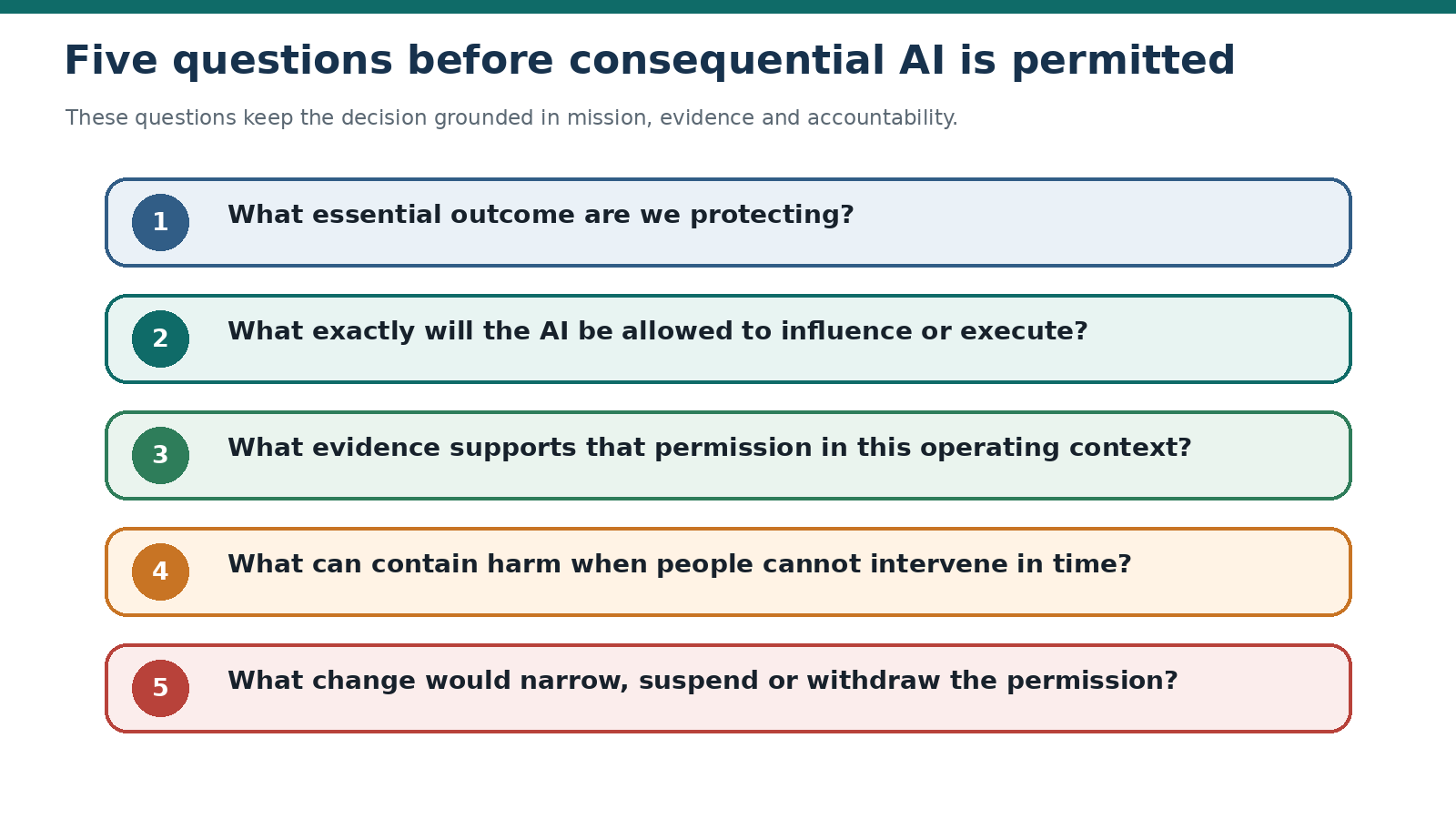
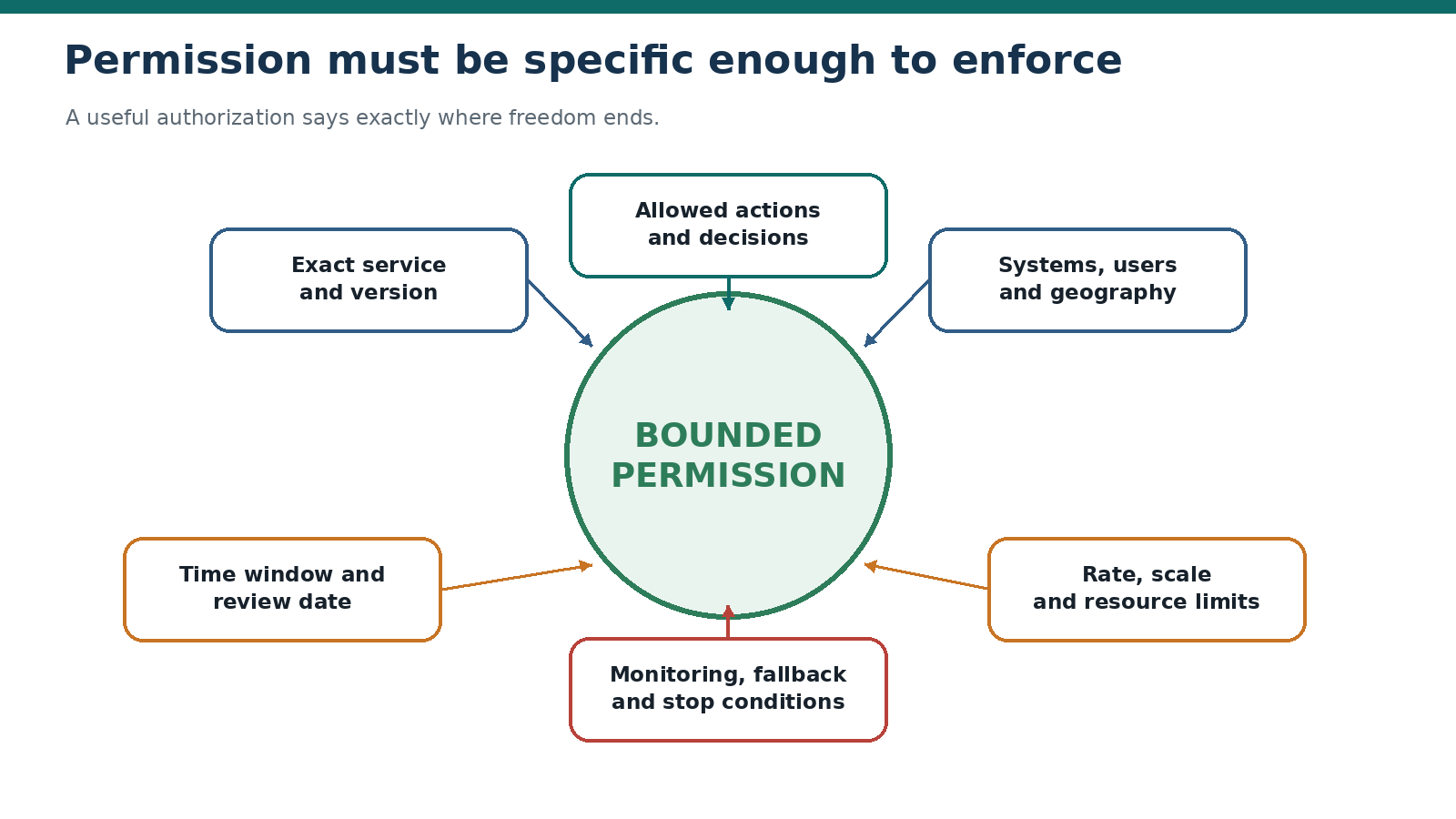
You do not need to learn eighteen Practices before understanding CI-AIGAF. Begin with one question: what is this exact AI-enabled service permitted to do, on what evidence, within what conditions, and what happens when those conditions stop being true?
| Reading step | Where to go |
|---|---|
| First: understand the problem | Sections 1–2 explain why capability, evidence and authority must remain distinct and what CI-AIGAF governs. |
| Next: learn the decision logic | Sections 3–7 explain the chain, classifications, lifecycle, evidence, AVE and OAE. |
| Then: see the operating system | Sections 8–10 show the six domains, eighteen Practices and their handoffs into P13. |
| Finally: apply it | Sections 11–12 use worked cases and an adoption path; appendices provide quick-reference material. |
The detailed Practice profiles are a reference layer. A first-time reader can understand the framework architecture before using those profiles.
Executive Summary
AI governance often asks whether a system is accurate, safe, secure, fair, compliant, explainable, or trustworthy. Critical infrastructure adds another question that is more operational and often more consequential: what is the AI system actually permitted to do, on what evidence, under what conditions, with what independent protections, and what happens when the evidence or conditions stop being true?
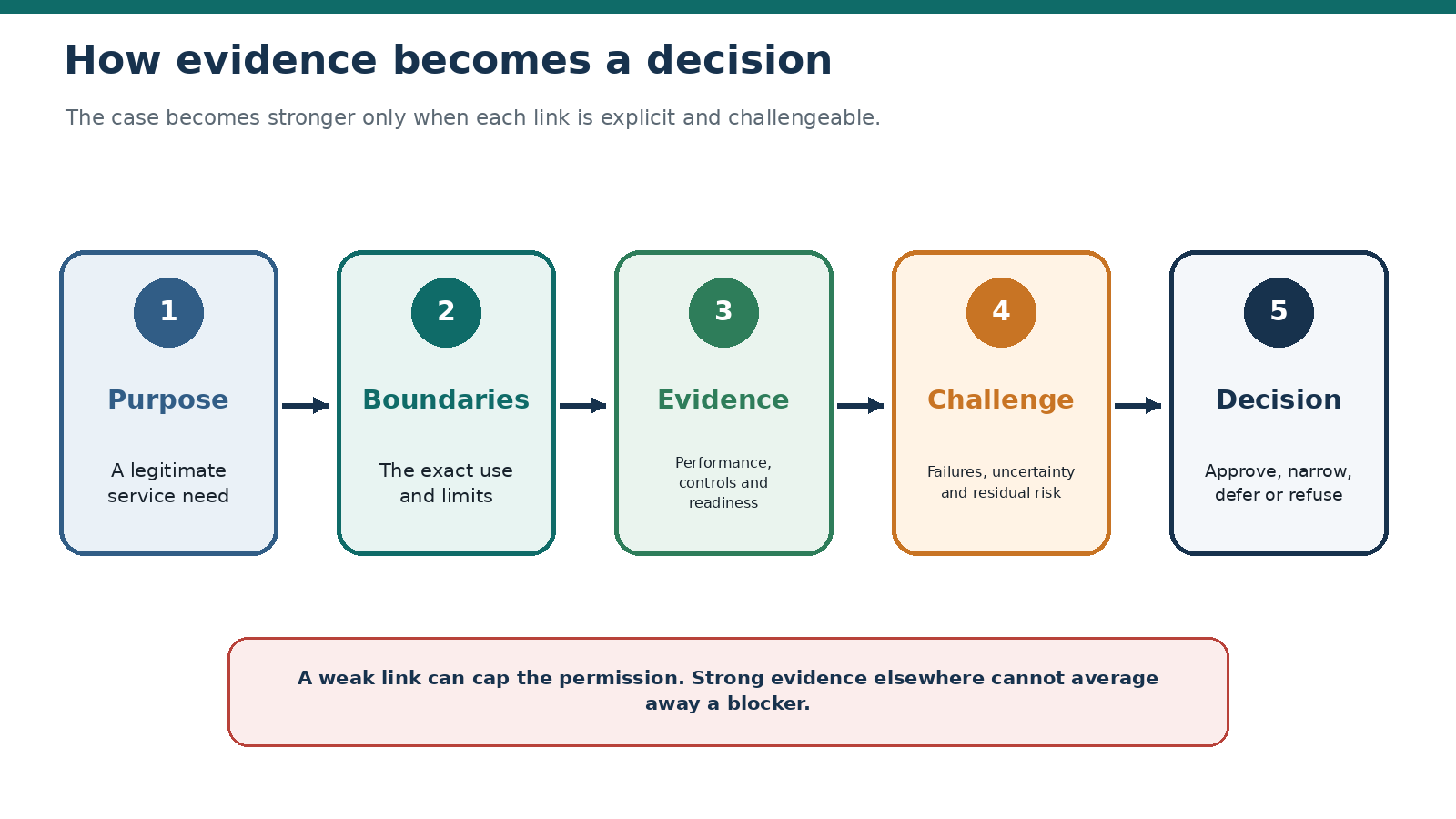
CI-AIGAF is designed around that permission problem. It treats machine operational authority as a bounded organizational decision rather than a property that arises automatically from technical capability, model access, tool availability, supplier claims, or successful testing. The framework connects mission requirements, technical controls, assurance claims, evidence quality, counterevidence, residual risk, formal authorization, runtime monitoring, authority degradation, recovery and reauthorization into one traceable governance chain.
The framework contains eighteen Practices grouped into six domains. Practices retain a NIST-style Practice–Task–Implementation grammar for operational usability, but CI-AIGAF extends that grammar through assurance and authority. Each consequential implementation can be traced to a control objective, assurance claim, argument, evidence, evidence-quality evaluation, counterevidence or defeaters, residual risk, independent challenge, decision, authority effect, continuous-assurance signals, invalidation triggers and reauthorization conditions.
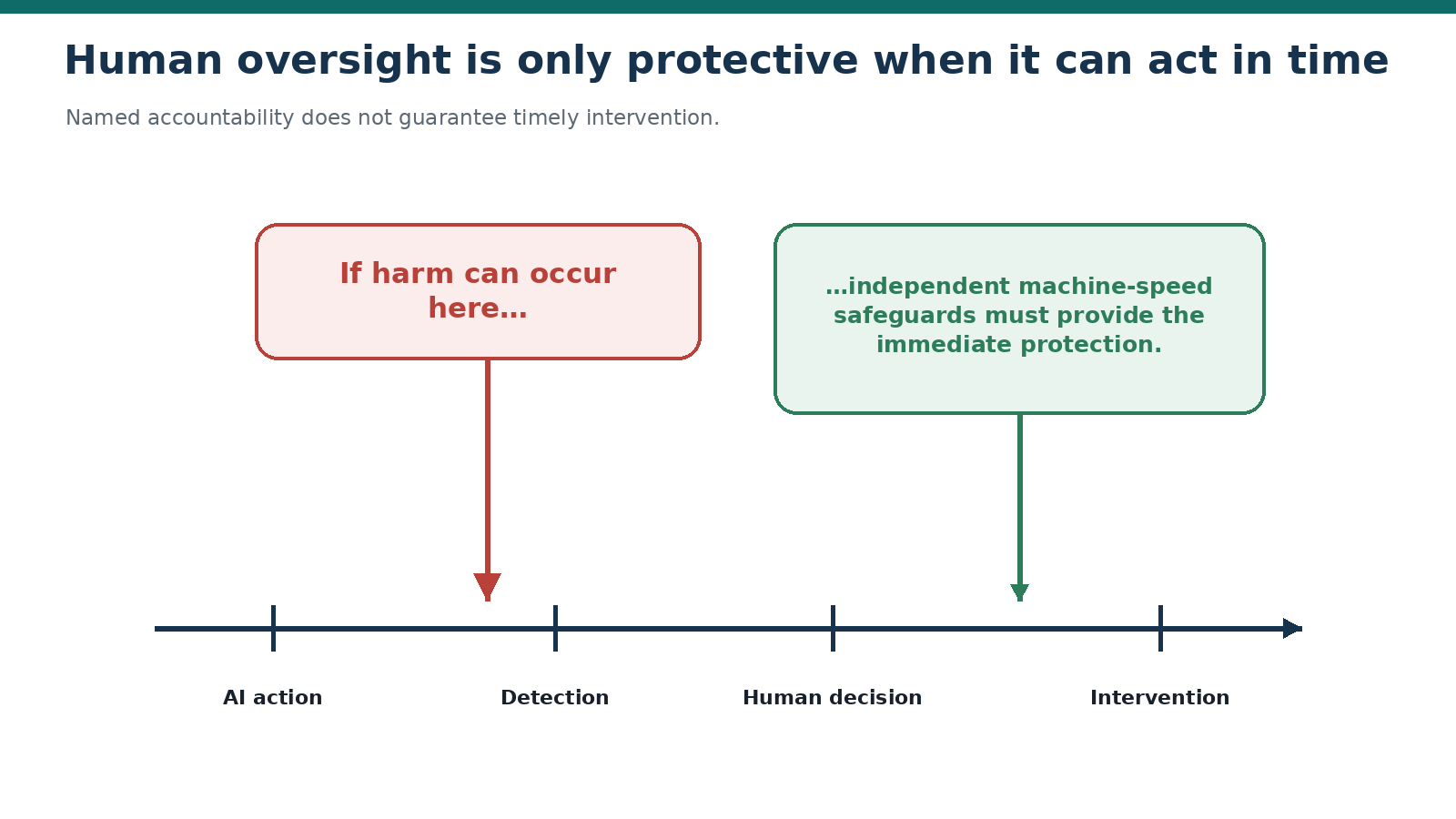
CI-AIGAF does not assume that deployment equals authorization or that human-in-the-loop language is sufficient. Human oversight counts as a control only where people have the information, competence, authority, time and practical means to intervene. Where credible time-to-harm is faster than demonstrated human intervention, immediate protection must be carried by independent, reliably enforceable safeguards.
Formal authorization is centralized in Practice 13. Other Practices contribute requirements, assurance evidence, blockers, specialist conditions, supportable ceilings, runtime responses and recommendations. P13 alone formally issues, restores, expands, restricts, suspends or withdraws the Operational Authority Envelope (OAE).
Contents at a Glance
| Section | Subject |
|---|---|
| 1 | Why CI-AIGAF exists |
| 2 | Framework identity, scope and non-goals |
| 3 | Architecture and foundational rules |
| 4 | Operational authority, consequence and assurance classification |
| 5 | R0 and lifecycle gates G0-G9 |
| 6 | Assurance claims, evidence, EQ1-EQ9 and defeaters |
| 7 | AVE, OAE and specialist conditions objects |
| 8 | Six domains as one operating system |
| 9 | Public profiles of Practices P01-P18 |
| 10 | How the Practices connect |
| 11 | Worked authorization examples |
| 12 | Practical adoption path |
| 13 | External alignment and source-status discipline |
| 14 | Framework governance, release and citation |
| Appendix A | Practice quick-reference matrix |
| Appendix B | Evidence quality dimensions EQ1-EQ9 |
| Appendix C | Material-change catalogue MC-01-MC-12 |
| Appendix D | Minimum authorization evidence pack |
| Appendix E | Glossary of core CI-AIGAF terms |
1. Why CI-AIGAF Exists
1.1 The governance gap appears at the point of permission
Critical-infrastructure organizations already govern safety, cyber risk, operations, identity, change, suppliers, resilience and emergency response. AI introduces new uncertainty, but the central governance problem is not simply that AI is probabilistic. The harder problem appears when AI capability is allowed to influence or execute consequential action. At that point, the organization is transferring or delegating operational discretion.
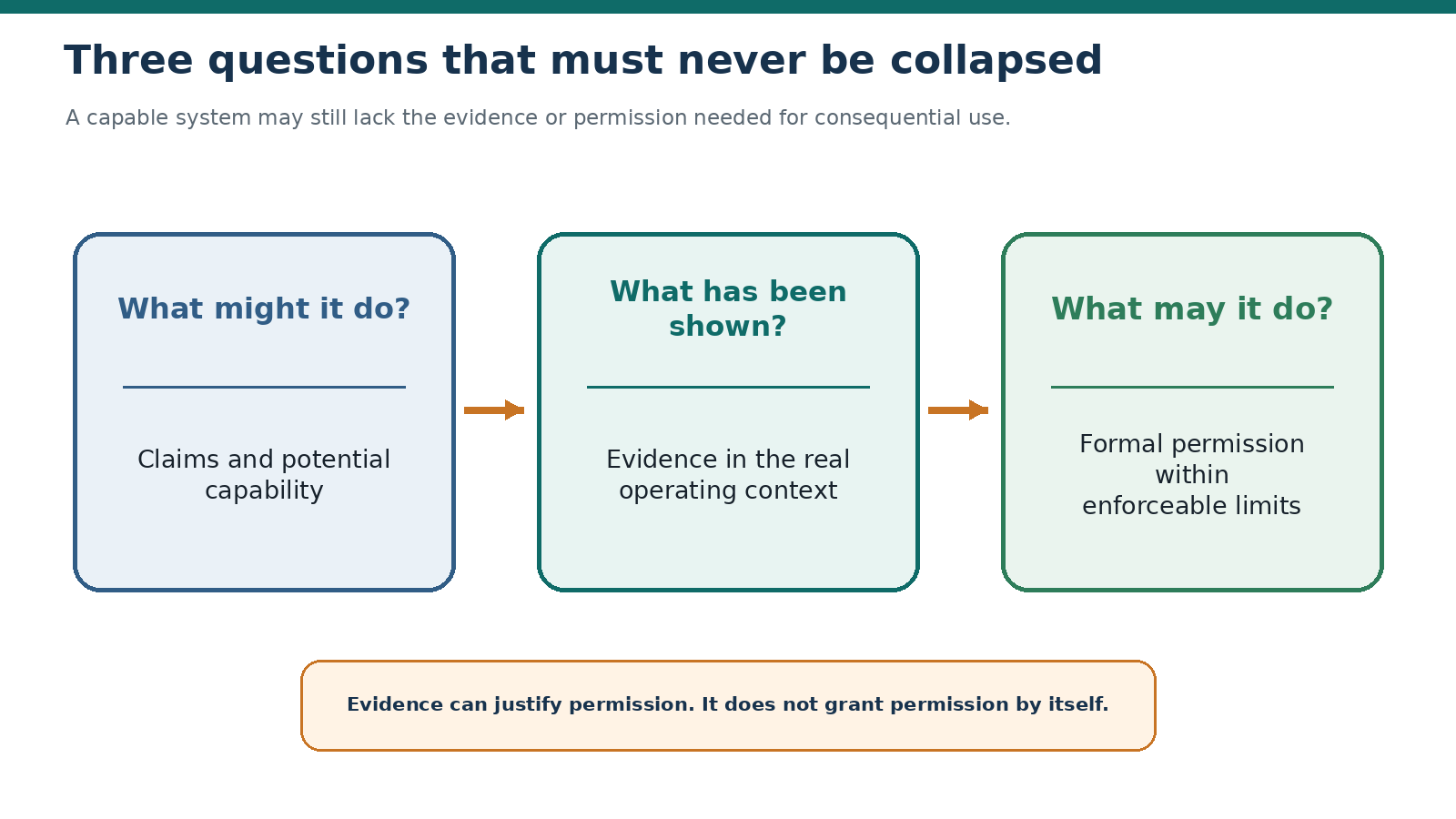
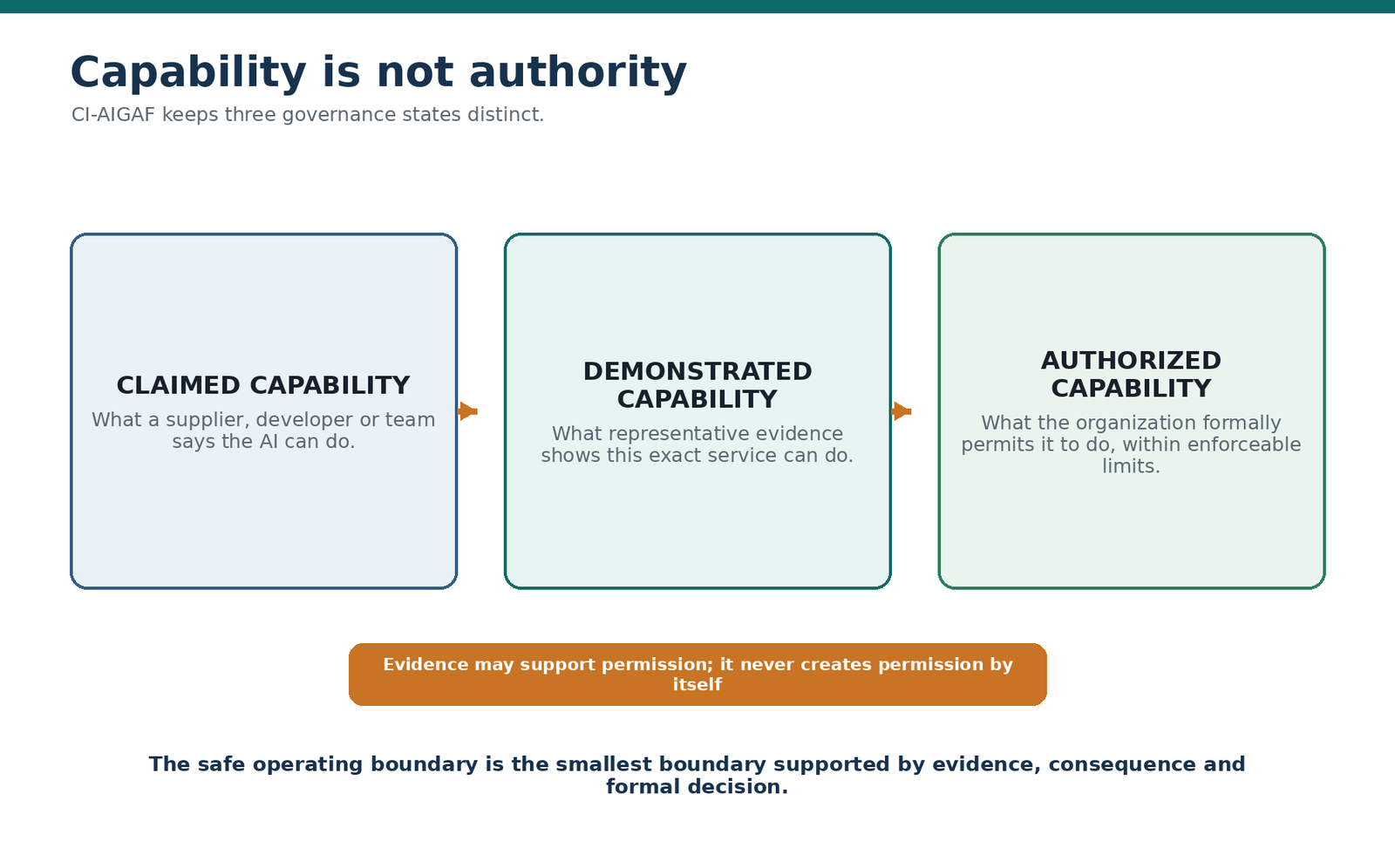
CI-AIGAF therefore distinguishes between what an AI system can do, what it has demonstrated under evidence, and what the organization has actually authorized it to do. These states may overlap, but they must not be silently collapsed.
1.2 The governed object is the AI-enabled service
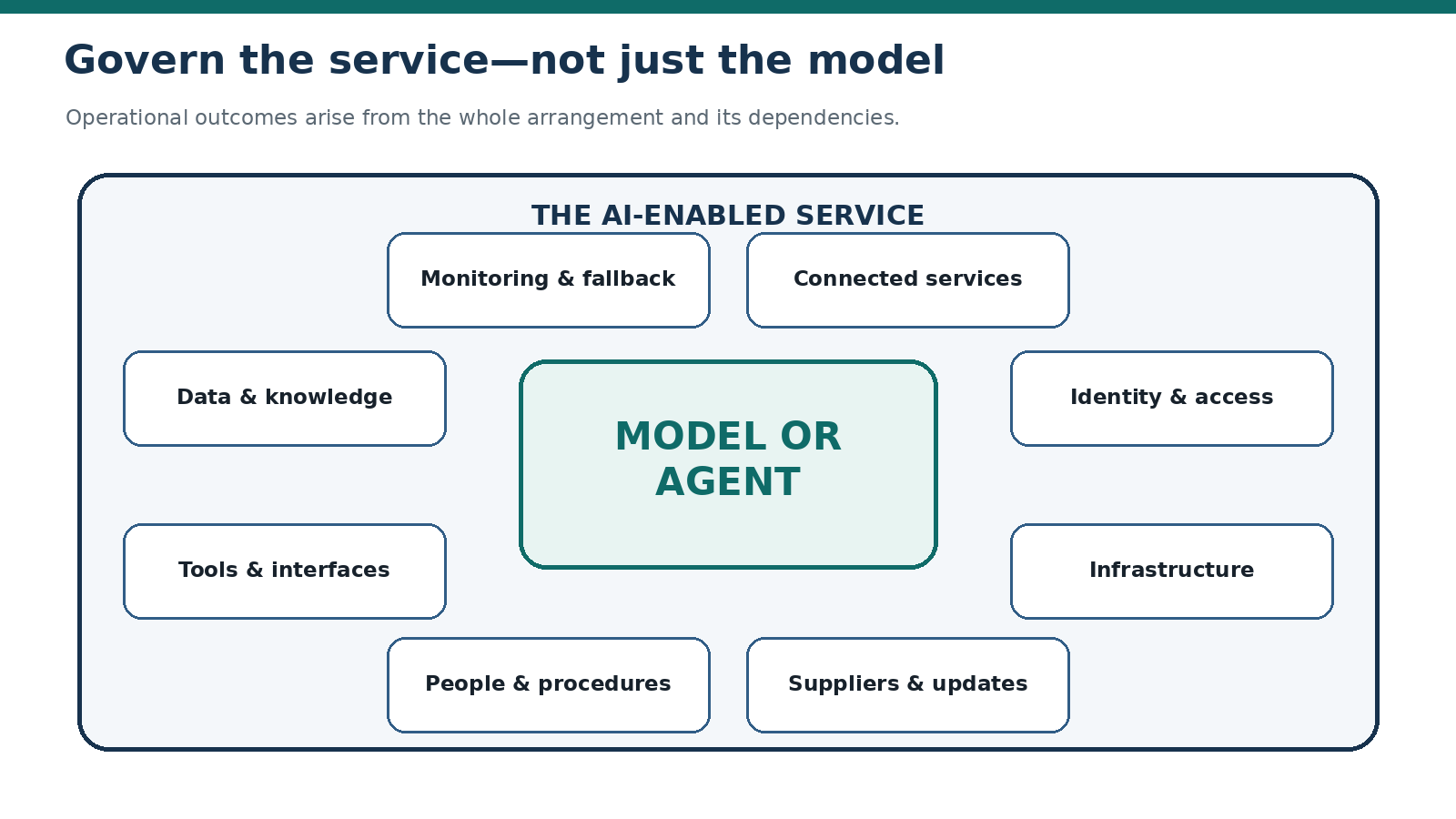
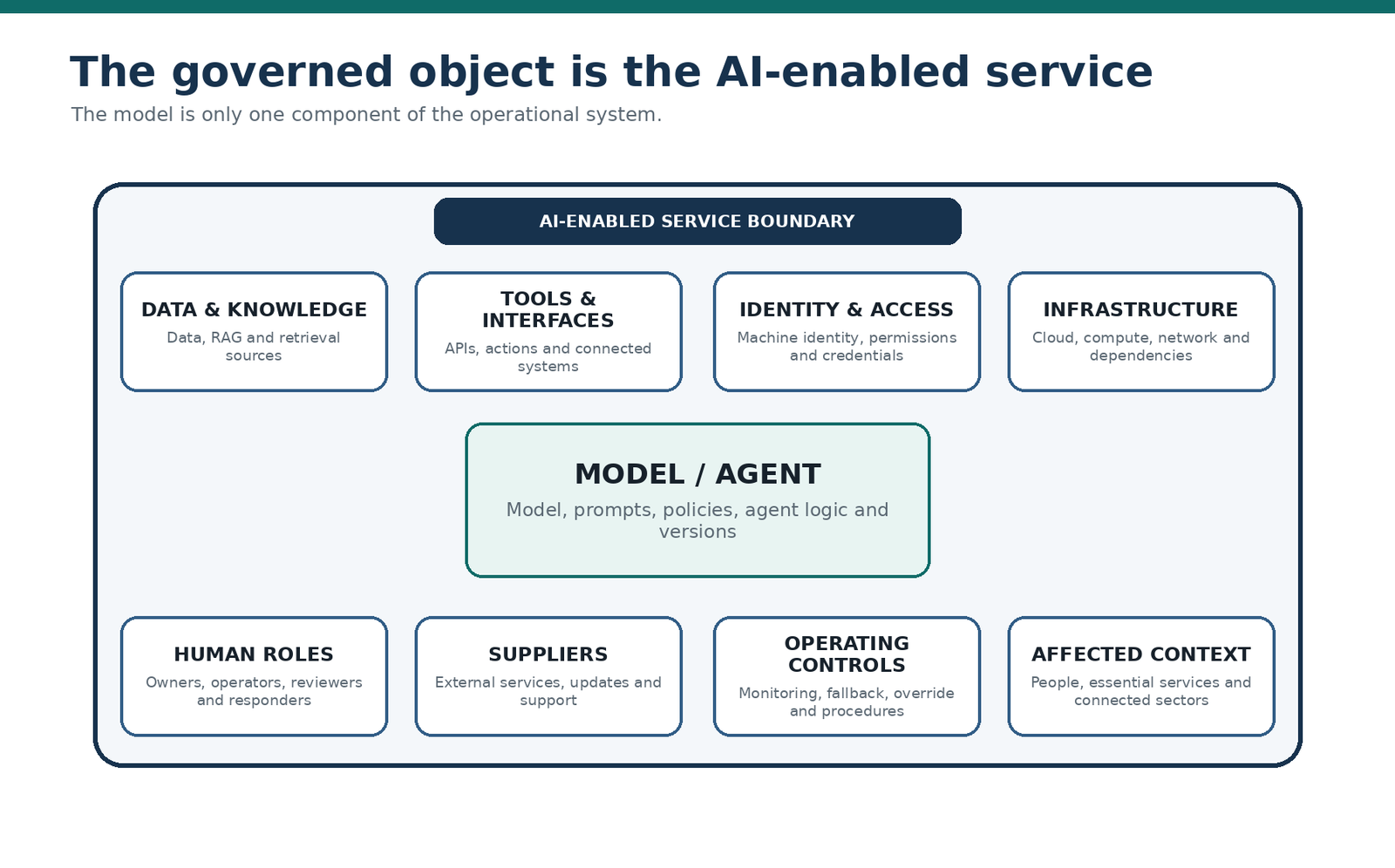
CI-AIGAF does not govern the model in isolation. The governed object is the AI-enabled service: model, data, knowledge and retrieval sources, prompts and configuration, tools and interfaces, identity and permissions, infrastructure and cloud dependencies, supplier services, human roles, monitoring, fallback, emergency controls, operational procedures, affected populations and connected systems.
This service-level view is necessary because a model can appear technically healthy while the surrounding authorization case has failed. Identity can broaden, a tool can change, retrieval sources can drift, fallback can become unavailable, an operator role can disappear, a supplier can alter a service, or cross-sector dependency can make a previously local action systemically unsafe.
1.3 What CI-AIGAF adds
- An explicit authority model that separates capability, evidence and permission.
- A canonical evidence-to-authority chain rather than a control checklist alone.
- Evidence-quality dimensions that require representativeness, fidelity, independence, currency and provenance to be considered explicitly.
- Counterevidence and defeaters as first-class governance objects.
- A formal Assurance Validity Envelope (AVE) and Operational Authority Envelope (OAE).
- Continuous assurance tied to material change and authority degradation.
- A human-oversight feasibility test that accounts for time-to-harm and machine-speed protection.
- A systemic-risk Practice for common-mode failure, scarcity and cross-sector cascades.
2. Framework Identity, Scope and Non-Goals
CI-AIGAF stands for Critical Infrastructure AI Governance and Assurance Framework. It is intended for AI-enabled capabilities that can materially influence the safety, continuity, reliability, rights, accessibility, privacy, equity, security or public-interest performance of essential services.
Publication architecture: The Master Framework is the frozen normative architecture and controlling framework baseline. The Master Book is a separate, expanded practitioner and worked-case companion; it does not replace the Master Framework or the final Practice Specifications and may be released on its own maturity cycle.
2.1 In-scope AI-enabled capabilities
- Administrative or advisory AI whose outputs can materially influence critical operations.
- AI/ML embedded in operational technology, network management, safety, maintenance, planning, allocation or assurance.
- Generative AI and AI-generated operational artifacts such as code, configurations, procedures, policies and queries.
- Automated and agentic systems with tool use, delegated identity, memory, dynamic dependency selection or multi-agent coordination.
- AI supplied as products, components, APIs, managed services, cloud services or embedded capabilities.
- System-of-systems and cross-sector interactions where local AI action can propagate into other essential services.
2.2 Non-goals
- CI-AIGAF is not a substitute for law or competent-authority interpretation.
- It does not create a presumption of conformity under the EU AI Act or any other legal regime.
- It does not replace detailed cybersecurity, functional-safety, sector engineering, privacy or business-continuity standards.
- It does not treat implementation completeness as proof of acceptable risk.
- It does not assume that a “human in the loop” label establishes meaningful oversight.
- It does not bind its internal numbering to the numbering of any external framework.
3. Architecture and Foundational Rules
3.1 Canonical chain
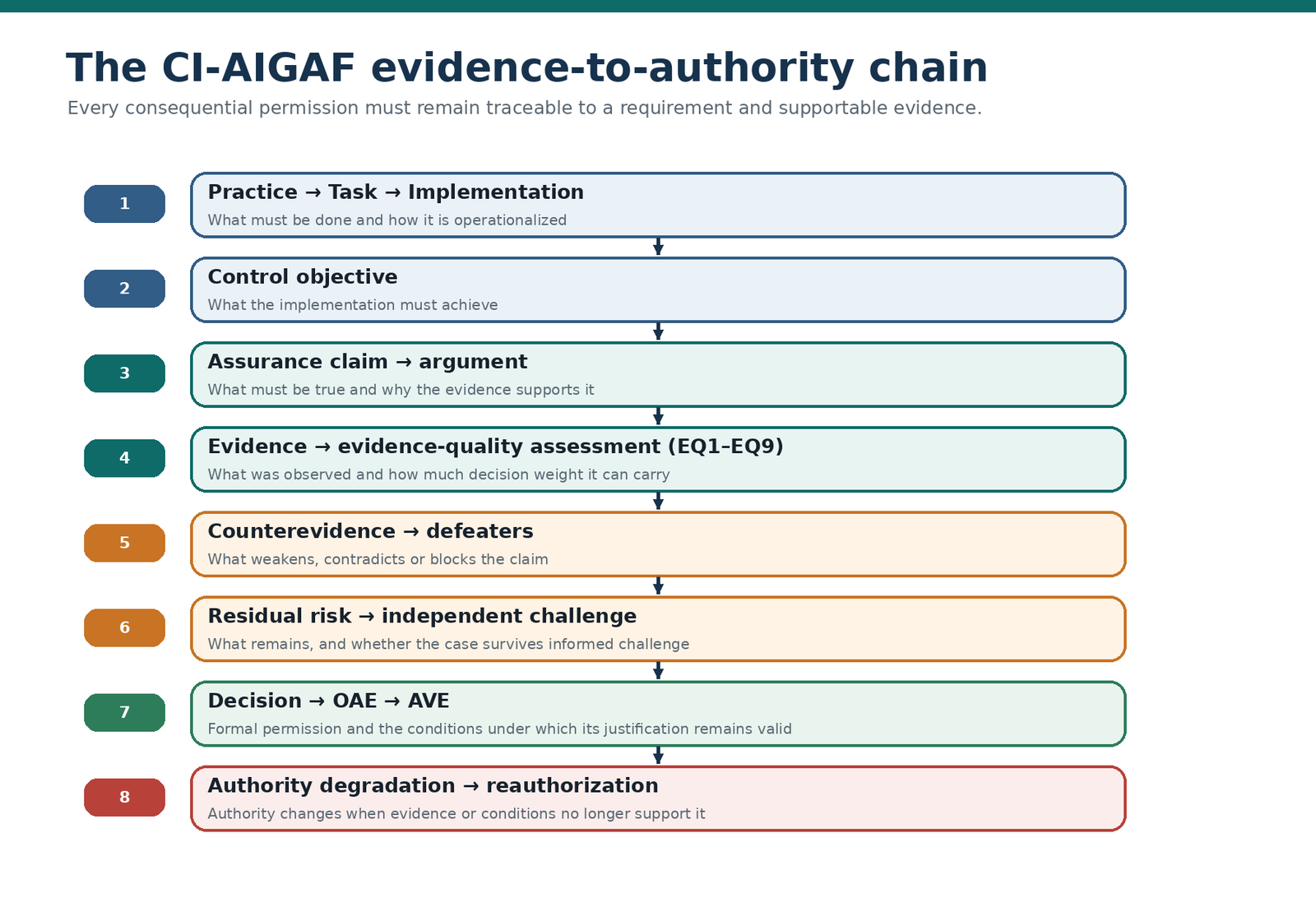
The chain is designed to prevent three common failures: controls existing without a claim about what they prove; evidence existing without a boundary on where it remains valid; and permission being granted without a traceable explanation of why the evidence justifies that permission.
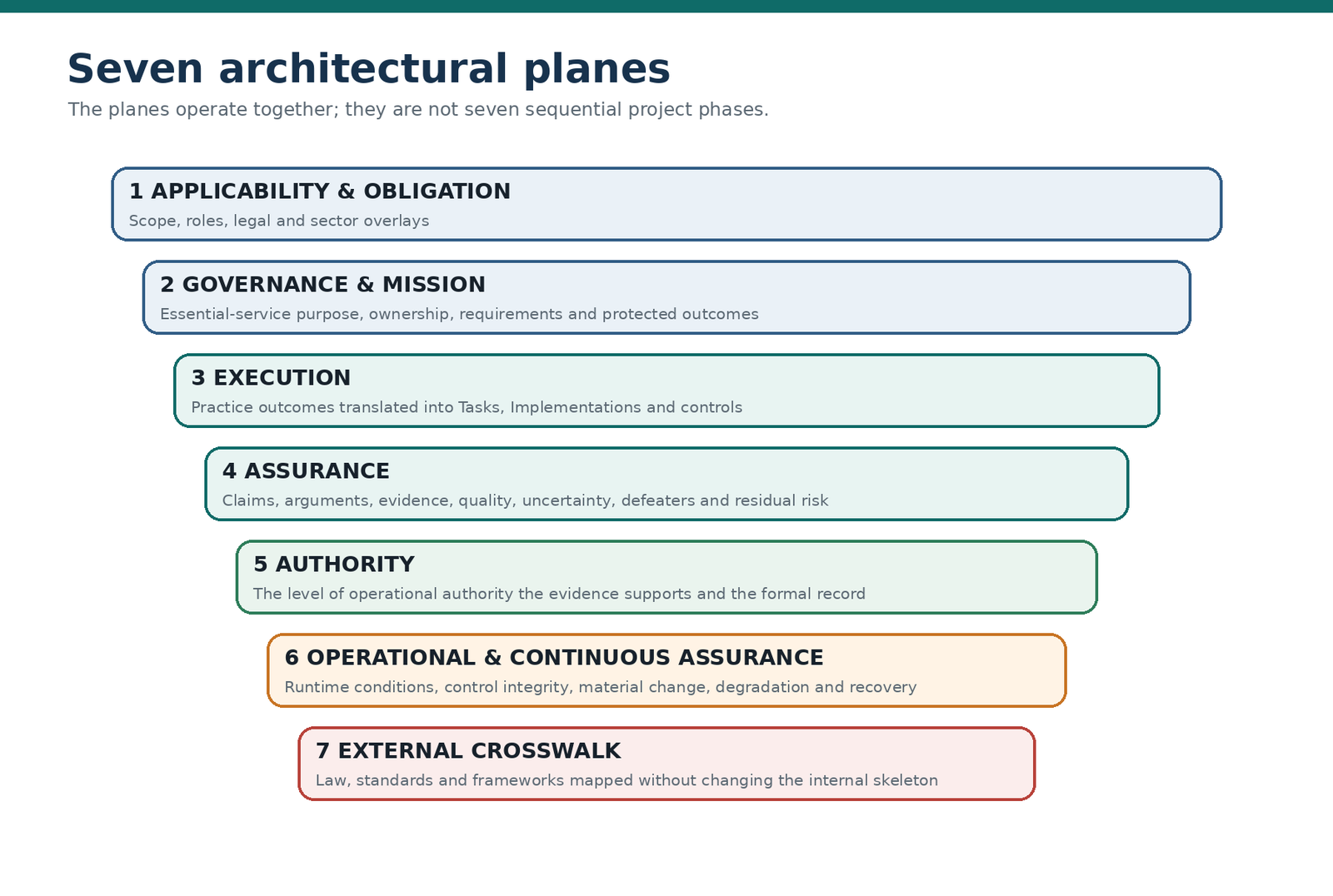
3.2 Seven architectural planes
| Plane | Purpose |
|---|---|
| 1. Applicability & Obligation | Determine scope, roles, legal/regulatory overlays and uncertainty before technical assurance begins. |
| 2. Governance & Mission | Define essential-service purpose, accountable ownership, requirements, protected outcomes and decision rights. |
| 3. Execution | Translate Practice outcomes into Tasks, Implementations and operational controls. |
| 4. Assurance | Connect claims, arguments, evidence, evidence quality, uncertainty, defeaters and residual risk. |
| 5. Authority | Determine what level of operational authority the evidence can support and formally record it. |
| 6. Operational & Continuous Assurance | Monitor runtime conditions, service floors, control integrity, material change, degradation and recovery. |
| 7. External Crosswalk | Map external law, standards and frameworks without making them the internal numbering skeleton. |
3.3 Twelve foundational rules
| # | Rule | Operational meaning |
|---|---|---|
| 1 | Mission before model | Begin with the essential-service purpose, alternatives, protected outcomes and mission constraints. |
| 2 | Capability does not confer authority | Technical capability, supplier claims, model access or tool availability do not create permission to act. |
| 3 | Authority shall not exceed demonstrated capability | Claimed, demonstrated and authorized capability are distinct states. |
| 4 | Evidence is valid only for the conditions it represents | Evidence does not automatically transfer across versions, tools, data, permissions, people, suppliers or environments. |
| 5 | Higher authority and consequence require stronger assurance | Realism, independence, coverage, challenge and monitoring rise with consequence and authority. |
| 6 | Compliance does not by itself establish operational assurance | A compliant system can still be unsuitable for the requested authority or context. |
| 7 | Human oversight must be feasible, not nominal | The human must have information, competence, authority, time and means. |
| 8 | Machine-speed risk requires machine-speed protection | If time-to-harm is faster than intervention, immediate protection must be independently enforceable. |
| 9 | Protected floors may not be silently optimized away | Safety, rights, accessibility, fairness, privacy, emergency and minimum-service floors require explicit governance. |
| 10 | Material change can invalidate evidence and authority | Change triggers validity assessment and may reduce or suspend authority. |
| 11 | Cumulative action is a governance object | Individually acceptable actions may become unsafe in aggregate, sequence or interaction. |
| 12 | Accountability remains human and institutional | AI cannot own the governance decision or accept residual risk for the organization. |
4. Operational Authority, Consequence and Assurance Classification
CI-AIGAF uses three linked lenses: the authority requested of AI, the potential consequence of failure or misuse, and the assurance posture needed to support the requested authority in that consequence context. These are governance classifications, not claims of mathematical precision.
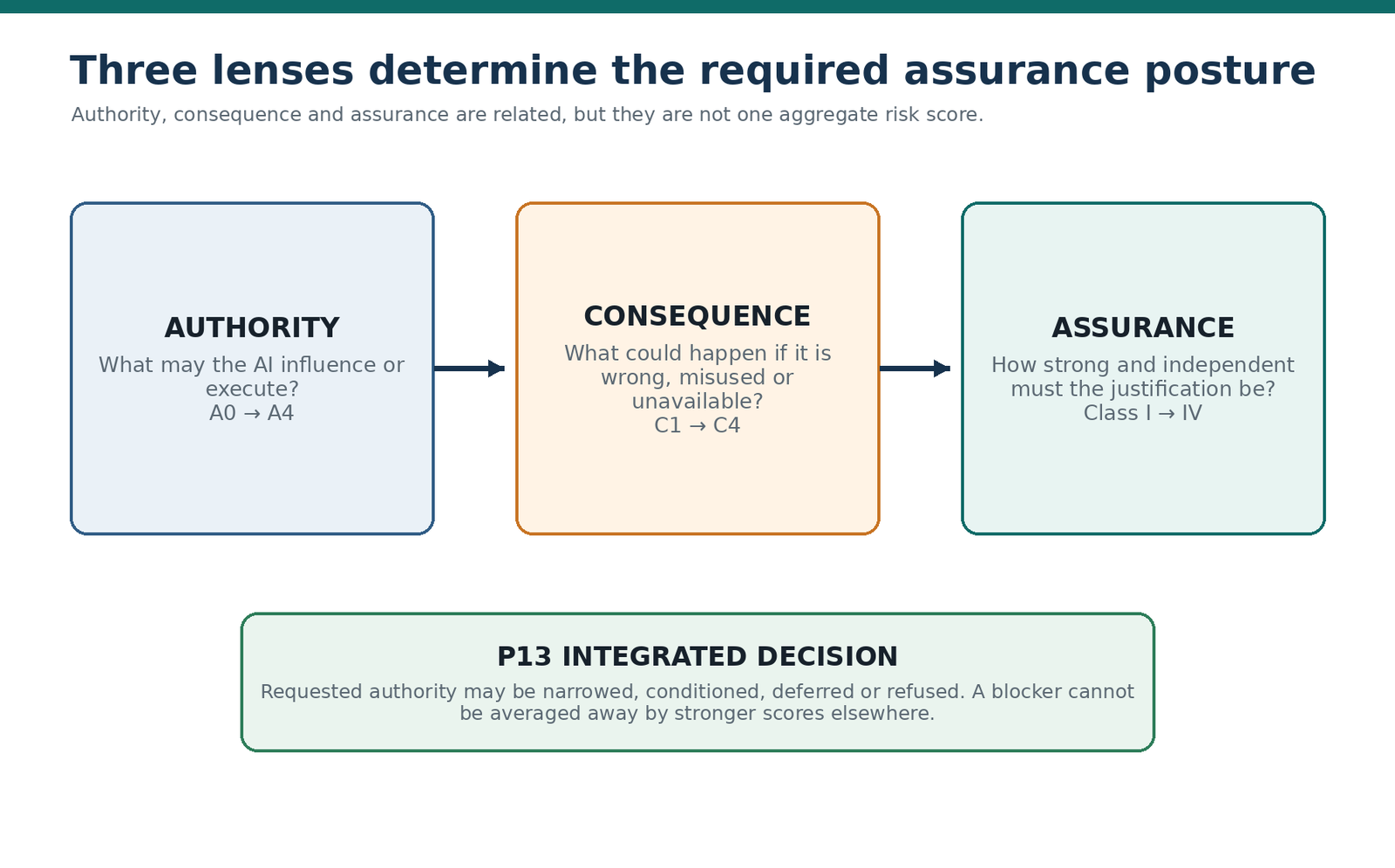
4.1 Operational Authority tiers
| Tier | AI role | Typical characteristics |
|---|---|---|
| A0 - Informational | No intended consequential operational influence. | Drafting/search/administrative assistance; consequential use prohibited unless separately reviewed. |
| A1 - Decision support | AI materially influences a human decision but cannot directly execute the consequential action. | Recommendations, prioritization, diagnosis, forecasting, generated procedures/configurations subject to human decision. |
| A2 - Bounded automation | AI executes predefined actions inside enforceable bounds. | Approved action set, constrained resources, rate/sequence limits, rollback and active monitoring. |
| A3 - Consequential autonomous operation | AI can plan, sequence or execute high-consequence actions under supervisory oversight. | Broad tool use, dynamic planning, limited human decision time, service/safety impact. |
| A4 - Systemic / cross-domain autonomy | AI authority spans multiple systems, agents, operators, sectors or shared essential-service resources. | Cross-domain orchestration, shared scarcity decisions, multi-agent authority and cross-sector coupling. |
4.2 Consequence tiers
| Tier | Consequence |
|---|---|
| C1 - Limited | Localized, reversible, readily detectable impact with no material essential-service degradation. |
| C2 - Material | Meaningful operational, financial, privacy, accessibility, fairness or service impact that remains containable. |
| C3 - Serious | Significant safety, service, legal, rights, economic, environmental or community impact; difficult recovery or broad affected population. |
| C4 - Critical/Catastrophic | Potential loss of life, severe public harm, national/regional disruption, irreversible environmental damage or cascading cross-sector failure. |
4.3 Assurance classes
| Class | Indicative use | Minimum posture |
|---|---|---|
| Class I - Basic | A0-A1/C1 or equivalent | Named owner; purpose/use limits; basic data/supplier controls; boundary verification; incident and retirement path. |
| Class II - Controlled | A1-A2/C2 | Defined requirements; representative testing; access/logging; incident/fallback; trained human review; public-interest checks; decision record. |
| Class III - High Assurance | A2-A3/C3 or material essential-service failure | Production-relevant TEVV; explicit claims; evidence-quality review; independent challenge; assured fallback; qualified operators; formal authorization; continuous assurance. |
| Class IV - Systemic | A3-A4/C4, catastrophic uncertainty or cross-sector/common-mode exposure | Highest feasible realism and independence; diverse protections; coordinated exercises; systemic indicators; authority degradation; multi-party governance; frequent reauthorization. |
5. R0 and Lifecycle Gates G0-G9
CI-AIGAF places an applicability pre-gate before the operational lifecycle. This reduces a common failure mode in which legal status, sector role, affected populations or external obligations are discovered only after the system has already been designed or deployed.
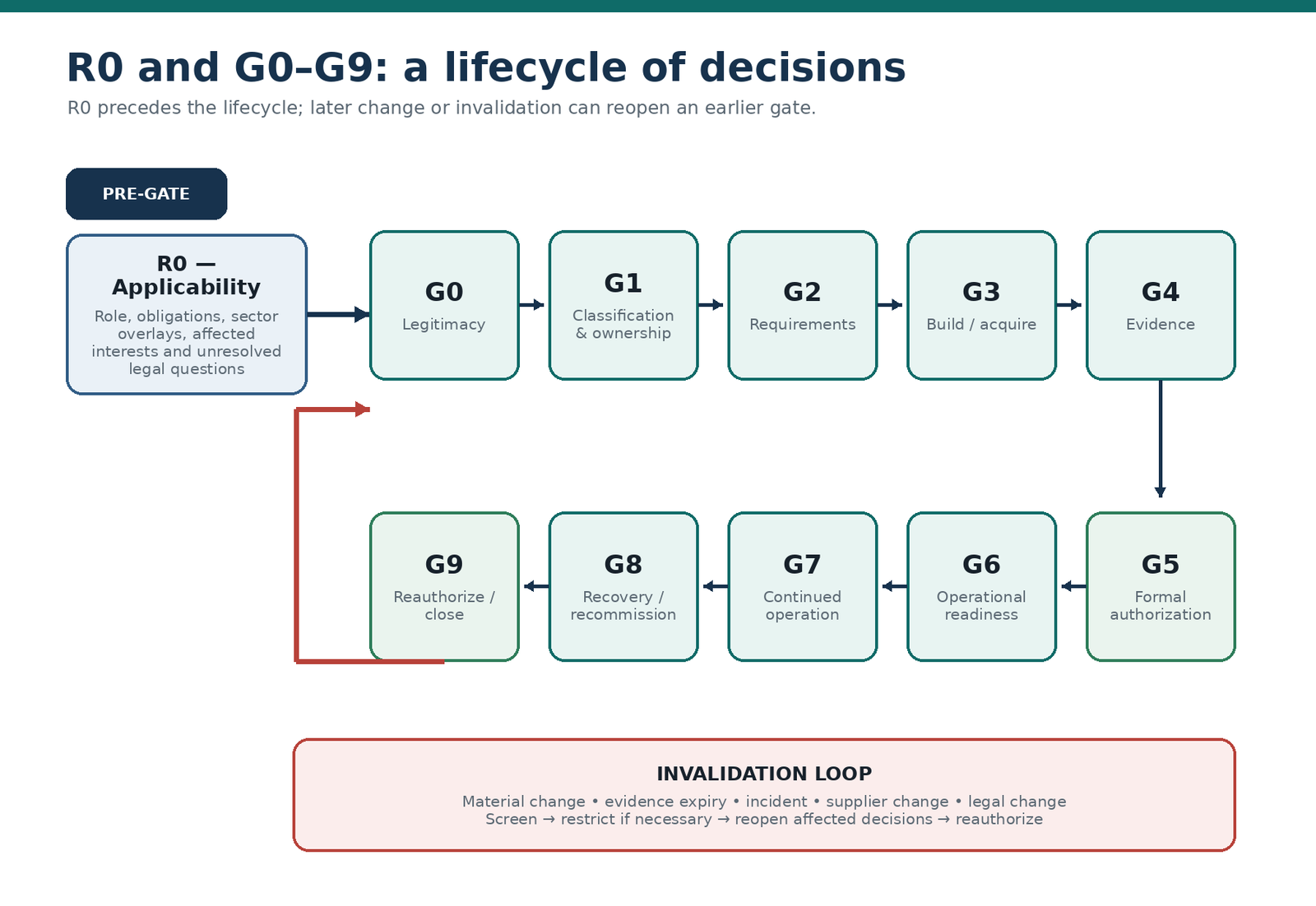
| Gate | Decision focus | Key question | Principal output |
|---|---|---|---|
| R0 | Applicability | Determine legal/regulatory status, organizational role, obligations, sector overlay and uncertainty. | Applicable obligation register. |
| G0 | Use-case legitimacy | Is AI appropriate and justified relative to non-AI alternatives and prohibited outcomes? | Proceed / redesign / reject. |
| G1 | Classification & ownership | Are boundary, owner, authority ceiling, consequence, assurance class, Practices and affected parties established? | Classification decision. |
| G2 | Requirements approval | Are mission, safety, rights, service floors, acceptance criteria, fallback and monitoring requirements testable? | Requirements baseline. |
| G3 | Build/acquisition readiness | Can sufficient control, identity, provenance, supplier evidence, continuity, change rights and exit capability be obtained? | Acquire/build approval. |
| G4 | Evidence sufficiency | Do representative tests and other evidence support material claims and expose uncertainty/counterevidence? | Evidence acceptance / gap decision. |
| G5 | Formal authorization | Does the integrated assurance case justify requested authority and residual risk? | Approve / condition / restrict / pilot / defer / reject. |
| G6 | Operational readiness | Are people, procedures, monitoring, incident, continuity, logging, rollback and enforcement controls ready? | Deploy / hold. |
| G7 | Continued operation | Do claims, service floors, evidence, people, dependencies and conditions remain valid? | Continue / degrade / pause / reassess. |
| G8 | Recovery & recommissioning | After incident or degradation, what has been restored and what authority can safely return? | Restore / restrict / continue fallback. |
| G9 | Reauthorization or closure | After material change or expiry, should authority continue, change, suspend, transfer, archive or end? | Reauthorize / reduce / retire. |
6. Assurance Claims, Evidence, EQ1-EQ9 and Defeaters
6.1 Claims first, evidence second
CI-AIGAF treats evidence as support for explicit assurance claims rather than as a volume of documentation. A claim states what must be true for the proposed operational authority to be justified. The argument explains why the evidence supports the claim. Evidence quality then constrains how much authority that support can carry.
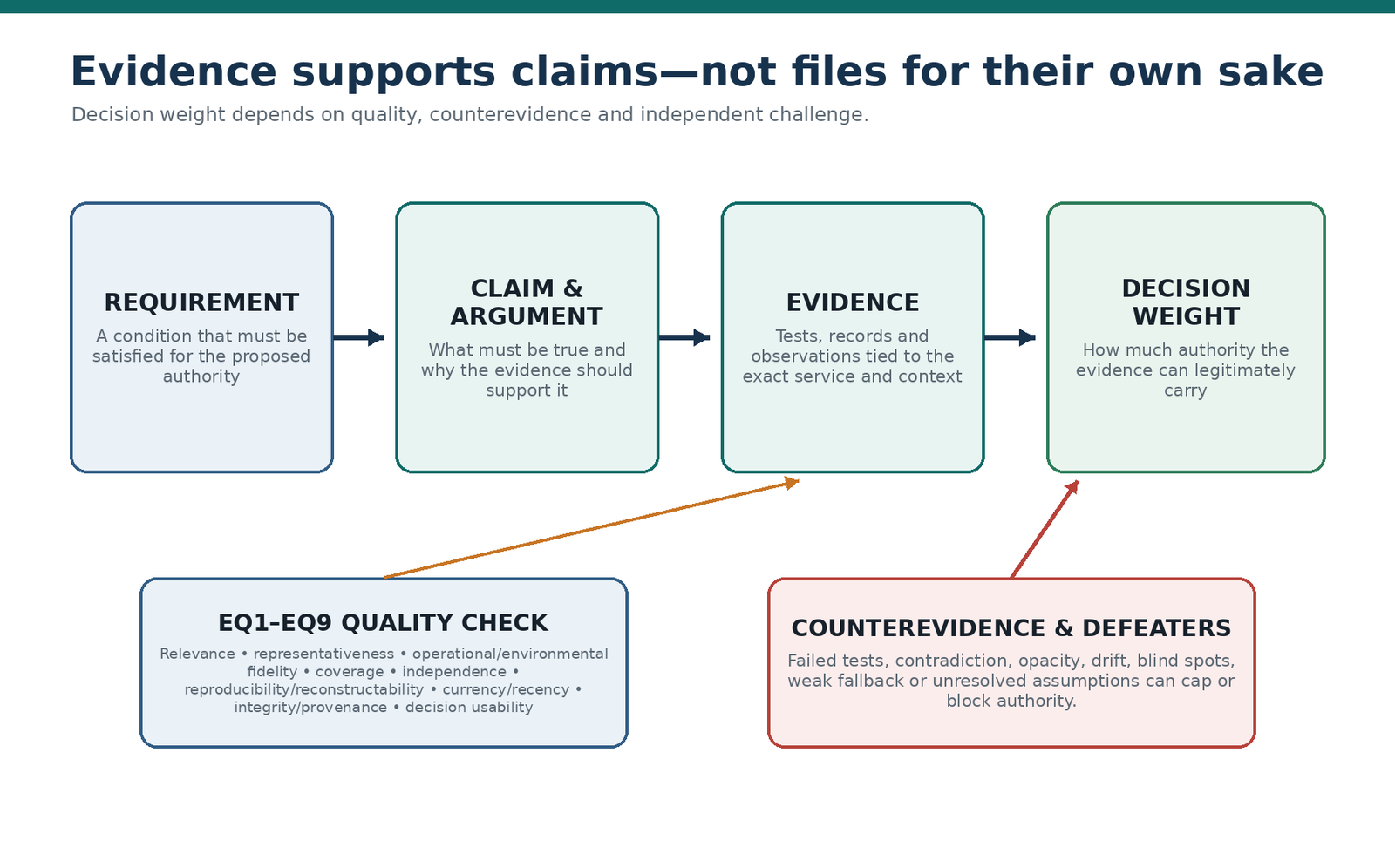
6.2 Evidence quality dimensions
| ID | Dimension | Public interpretation |
|---|---|---|
| EQ1 | Relevance | Does the evidence address the claim? |
| EQ2 | Representativeness | Does it represent the population, states, failures and operating conditions that matter? |
| EQ3 | Operational/environmental fidelity | How closely does the evidence environment reproduce real operational conditions and dependencies? |
| EQ4 | Coverage | What important scenarios, paths or requirements remain untested? |
| EQ5 | Independence | How independent is the evidence from the system, supplier or decision being evaluated? |
| EQ6 | Reproducibility/reconstructability | Can the result be reproduced or reconstructed well enough for assurance and audit? |
| EQ7 | Currency/recency | Is the evidence recent enough for the current model, configuration, people, supplier and environment? |
| EQ8 | Provenance/integrity | Can the origin, transformation and integrity of evidence be trusted? |
| EQ9 | Uncertainty/transfer limits | Are uncertainty, assumptions and limits on transfer to other conditions explicit? |
6.3 Counterevidence and defeaters
A credible assurance case records evidence that weakens a claim, not only evidence that supports it. Defeaters include failed tests, unexplained behavior, contradictory results, unsupported assumptions, monitoring blind spots, supplier opacity, fallback weakness, human-readiness gaps and changed conditions. Defeaters are resolved, bounded, accepted as residual risk, or treated as blockers. They are not silently averaged away.
6.4 Independent challenge
The stronger the requested authority and consequence, the stronger the need for independent challenge. CI-AIGAF uses independent challenge to test claim logic, evidence realism, missing scenarios, correlated failure, optimistic assumptions and organizational incentives before formal authorization.
7. AVE, OAE and Specialist Conditions Objects
7.1 Assurance Validity Envelope (AVE)
The AVE is a P13 assurance-case object describing the conditions under which the accepted claims and evidence remain valid. It is about the validity of the justification, not direct machine permission.
7.2 Operational Authority Envelope (OAE)
The OAE is the enforceable operational structure defining what the AI-enabled capability may and may not do. P03 defines the operational structure and enforceable constraints; P13 formally issues or changes the OAE. The OAE must remain within the conditions supported by the AVE.
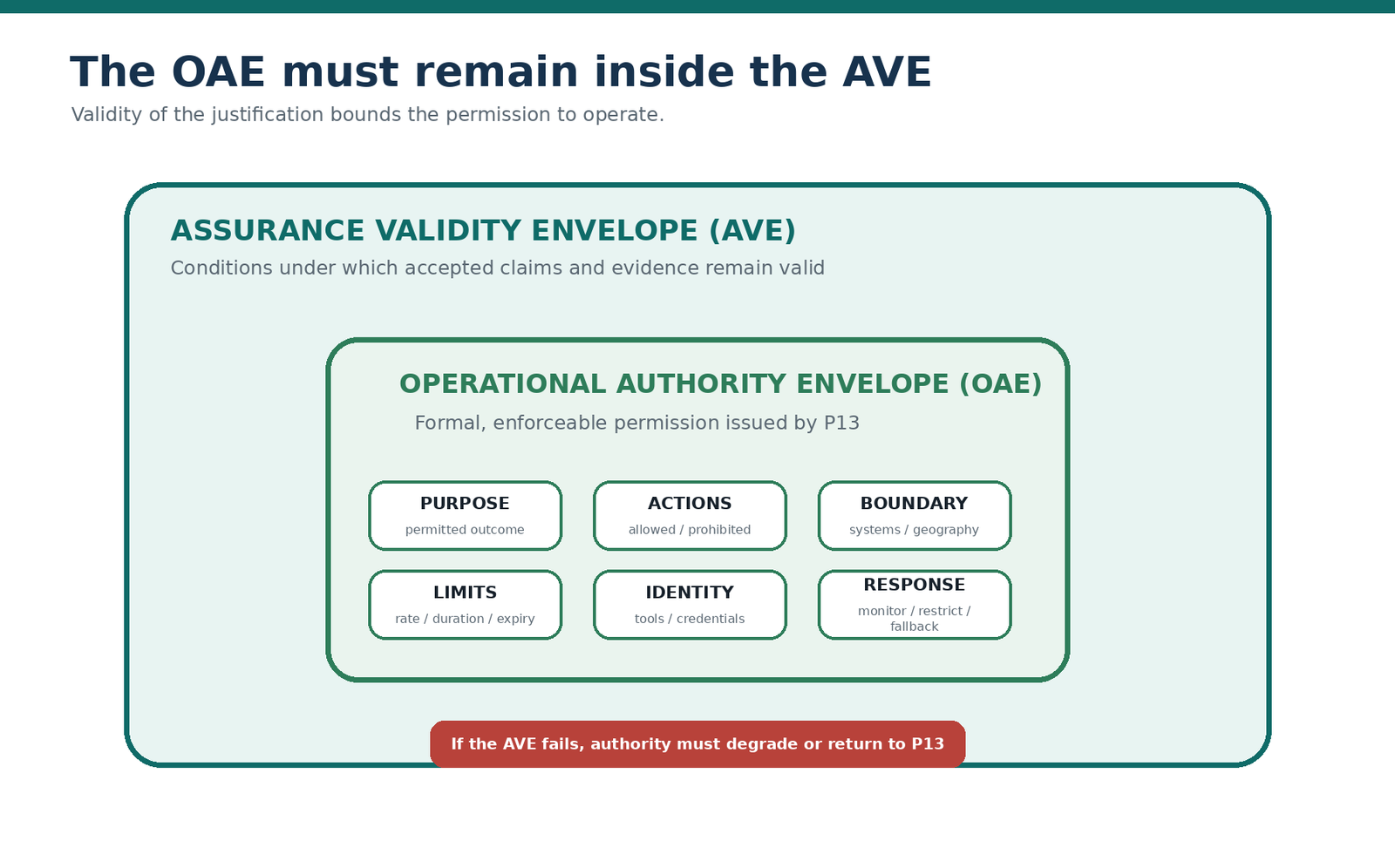
| Object | Role | Authority rule |
|---|---|---|
| PCE - Privacy Conditions Envelope | Specialist privacy conditions/evidence from P15. | Does not independently authorize AI. |
| ECE - Equity Conditions Envelope | Specialist fairness/accessibility/equity conditions from P16. | Does not independently authorize AI. |
| PRCE - Participation & Remedy Conditions Envelope | Stakeholder, contestability, notification and remedy conditions from P17. | Does not independently authorize AI. |
| SRCE - Systemic Risk Conditions Envelope | Cross-sector dependency, common-mode, scarcity and cascade conditions from P18. | Does not independently authorize AI. |
| AVE - Assurance Validity Envelope | P13 case boundary for claim/evidence validity. | Supports but is not itself direct execution permission. |
| OAE - Operational Authority Envelope | Formal operational authority boundary. | P13 alone formally issues/restores/expands/restricts/suspends/withdraws it. |
7.3 Authority degradation
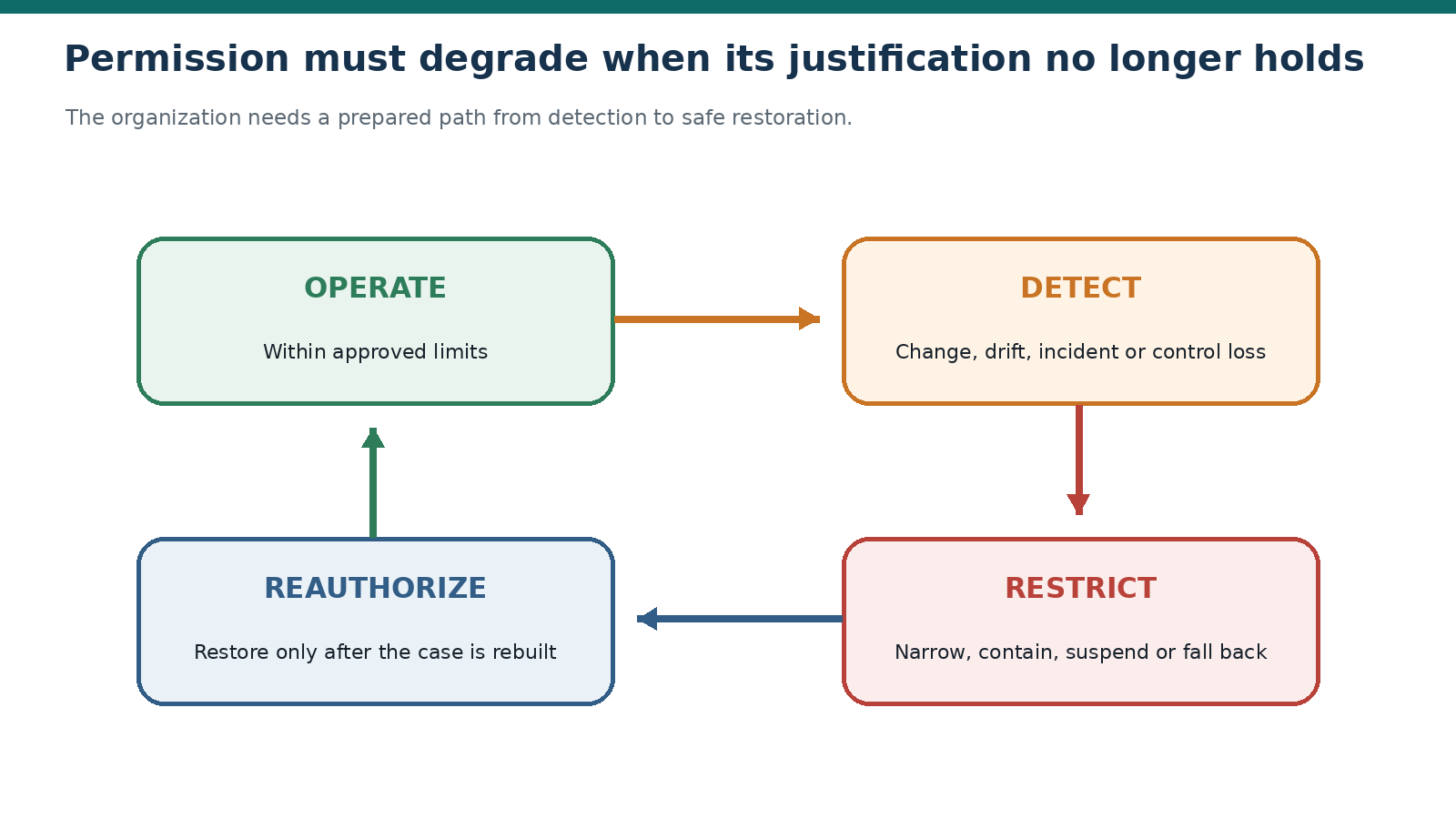
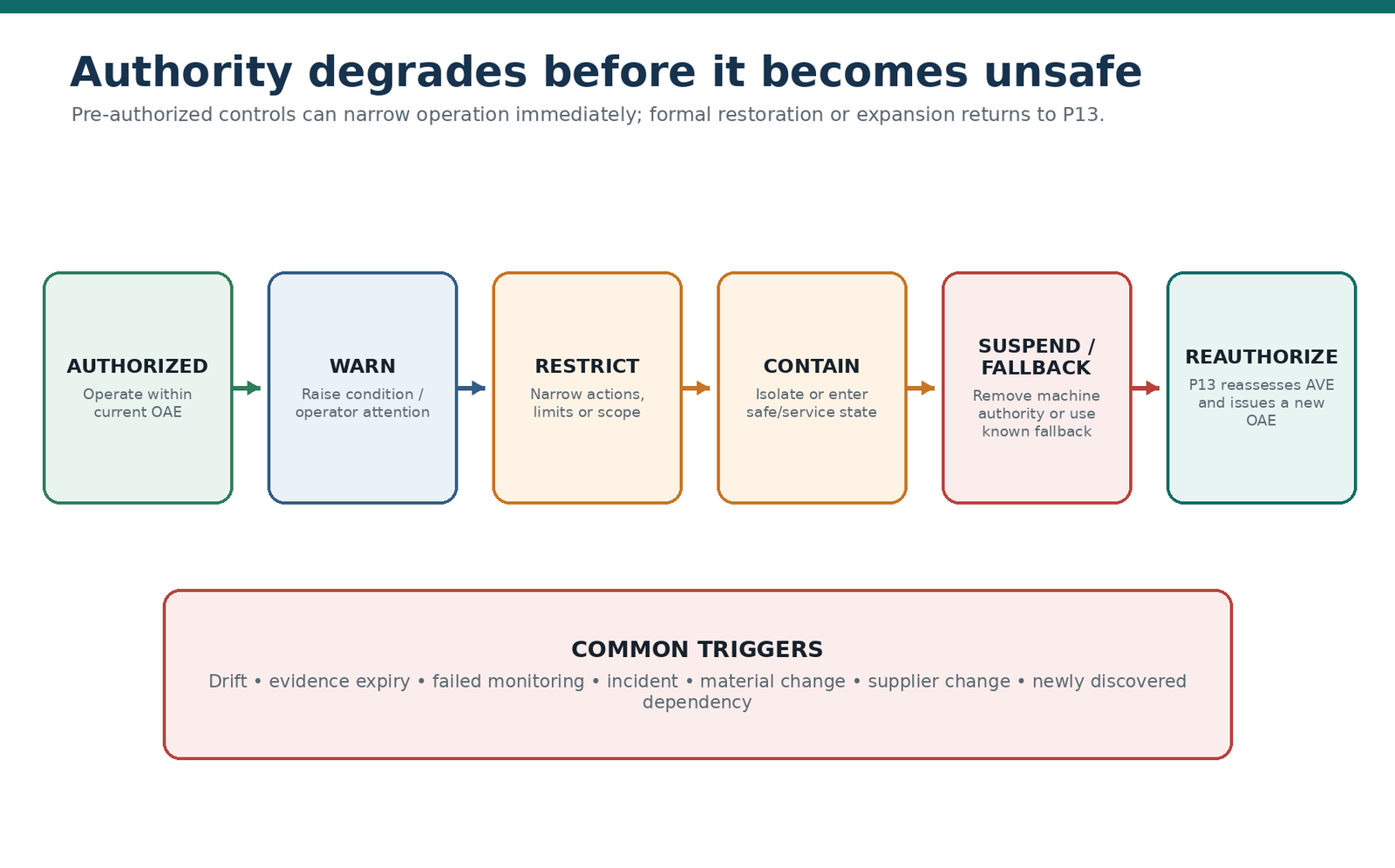
CI-AIGAF does not require authority to be treated as simply “approved” or “revoked.” Where evidence weakens or conditions change, pre-authorized runtime controls may warn, restrict, contain, fail safe, or move the service to a known fallback state. Restoration or expansion of formal authority returns to P13.
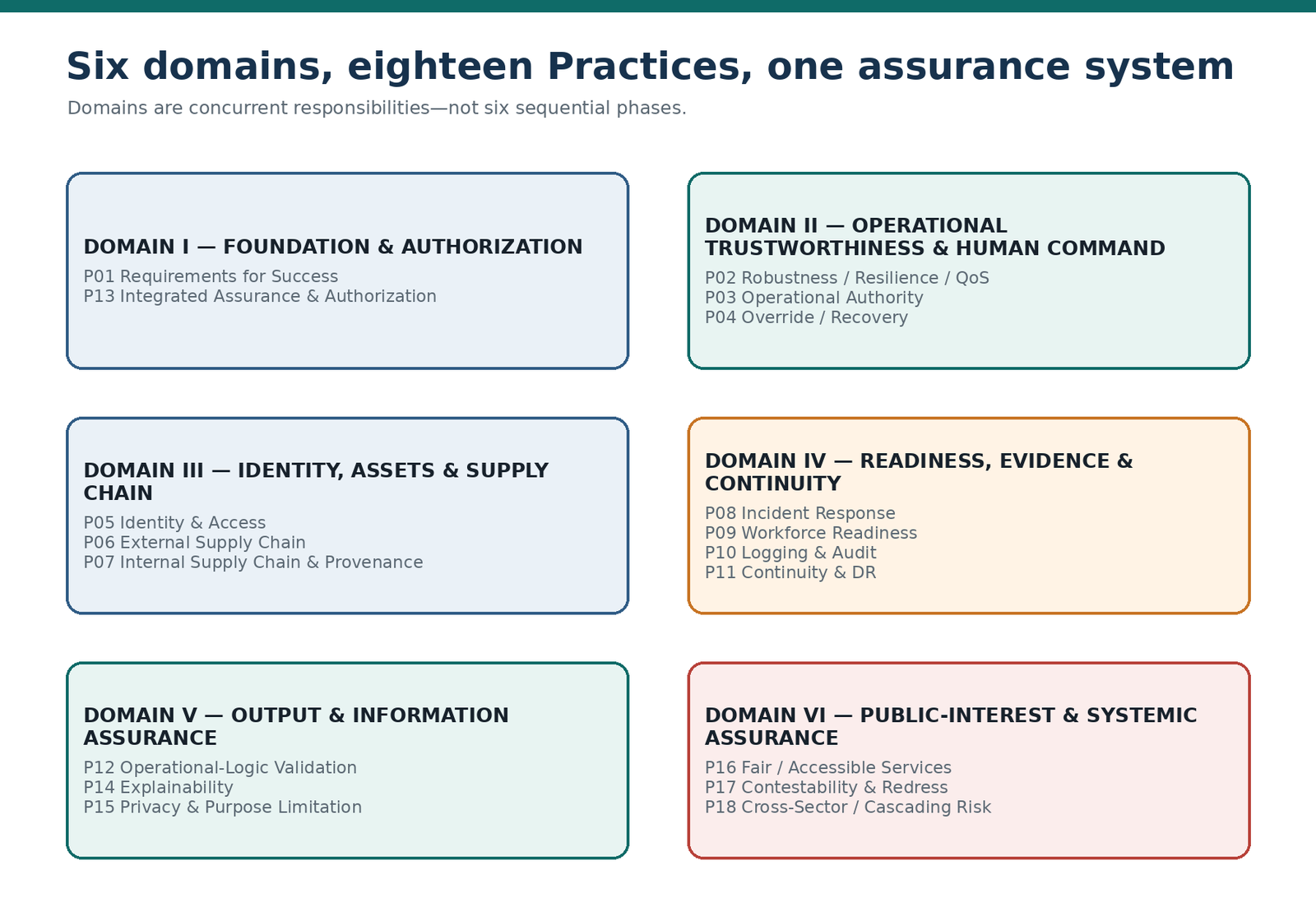
8. The Six Domains as One Operating System
| Domain | Practices | Integrated governing question |
|---|---|---|
| I. Foundation & Authorization | P01, P13 | What must the AI achieve, what evidence will count, and does the integrated assurance case justify the requested authority? |
| II. Operational Trustworthiness & Human Command | P02, P03, P04 | How reliably may the system operate, what may it do, and can unsafe action be prevented, contained, overridden and recovered? |
| III. Identity, Assets & Supply Chain | P05, P06, P07 | What is acting, what may it access, where did it come from, what changed, and can every consequential action be attributed? |
| IV. Readiness, Evidence & Continuity | P08, P09, P10, P11 | Can the organization detect, understand, preserve evidence, respond, continue service, recover and learn? |
| V. Output & Information Assurance | P12, P14, P15 | Can the organization validate what AI creates, understand consequential decisions, and control information use and inference? |
| VI. Public-Interest & Systemic Assurance | P16, P17, P18 | Who bears the consequences, can affected parties obtain practical review/remedy, and can local AI action cause wider systemic harm? |
The domains are not six sequential phases. They are concurrent assurance responsibilities that contribute to one authorization case. A supplier change in Domain III may invalidate continuity evidence in Domain IV, privacy conditions in Domain V, systemic assumptions in Domain VI and ultimately the P13 authority decision in Domain I.
9. Public Profiles of Practices P01-P18
How to use the profiles: begin with the “authority implication” for the Practice, then read its Tasks as the work needed to support, constrain or challenge the authorization case. You do not need to implement every Practice at the same depth for every use case.
The following profiles are intentionally more detailed than a marketing summary but shorter than the standalone Practice Specifications. Canonical Task wording is taken from the frozen Master Framework. Artifact examples are taken from the corresponding final Practice Specification. “Principal interfaces” and “authority implication” are public-reader synthesis and should be read alongside the controlling Practice text.
Domain
DOMAIN I: FOUNDATION & AUTHORIZATION
What must the AI achieve, what evidence will count, and does the integrated case justify the requested authority?
The Practice profiles that follow are public summaries of the frozen final specifications. They preserve canonical Task wording but omit implementation-level detail that remains in the standalone technical documents.
P01: Establish Requirements for Success
Requirements, Baselines, Evidence and Authorization Preconditions
CI-AIGAF-P01 establishes the requirements, success criteria, operational baselines, evidence expectations, and acceptance logic that must exist before an AI-enabled capability can be evaluated for consequential operational use. It is a foundation Practice: later Practices may add controls, tests, and evidence, but they should not silently redefine what success means after evaluation has begun.
The Practice applies to AI systems, AI-enabled functions, agentic systems, general-purpose AI assistants whose outputs can enter operational workflows, and AI-generated operational artifacts where a consequential decision or action can reach a critical-infrastructure service directly or through a human-mediated path. Its focus is not limited to models; the governed object is the AI-enabled service, including relevant data, software, tools, interfaces, infrastructure dependencies, human roles, safety constraints, and fallback paths.
| Task | Canonical public description |
|---|---|
| P01-T01 | Identify current legal, mission, safety, service, contractual, stakeholder, and operational requirements. |
| P01-T02 | Establish quantitative and qualitative baselines in normal, stressed, degraded, and fallback conditions. |
| P01-T03 | Define TEVV scope, test environments, pass/fail criteria, and evidence requirements before testing. |
| P01-T04 | Establish domain-knowledge, linguistic, context, and operational-meaning requirements. |
| P01-T05 | Separate declared mission objective from optimization target/proxy; define protected floors and non-tradable constraints. |
| P01-T06 | Distinguish claimed, demonstrated, and authorized capability; define acceptance and evidence limitations. |
Public implementation questions (interpretive)
- What authoritative requirements and conflicts have been resolved before testing begins?
- What are the normal, stressed, degraded and fallback baselines?
- Were TEVV criteria and evidence requirements fixed before results were known?
- Which protected floors may not be traded away by optimization?
- What is claimed, what is demonstrated, and what is actually requested for authorization?
| Example artifact | Name | Purpose / contents |
|---|---|---|
| P01-AR-01 | Applicability and Role Record | Intended purpose, jurisdiction, organizational role, classification position, applicable external obligations and unresolved classification questions. |
| P01-AR-02 | Requirements Authority Register | Requirement, source, bindingness, owner, rationale, verification method, conflict/precedence rule and change trigger. |
| P01-AR-03 | Operational Baseline Pack | Normal, peak/stressed, degraded, fallback/manual and recovery baselines, including data quality and evidence limitations. |
| P01-AR-04 | TEVV and Evidence Plan | Test scope, environment category, success/failure criteria, scenarios, datasets, uncertainty treatment, evidence ownership and retention. |
| P01-AR-05 | Domain and Operational Meaning Register | Critical terms, state distinctions, unacceptable ambiguity, required domain knowledge and validation method. |
| P01-AR-06 | Objective-Proxy-Constraint Record | Mission objective, optimization target/proxy, protected floors, non-tradable constraints, specification-gaming tests and trade-off authority. |
| P01-AR-07 | Capability-State Record | Claimed, demonstrated and requested/authorized capability with conditions, limitations, expiry and evidence references. |
| P01-AR-08 | Acceptance and Authority Preconditions Record | Acceptance result, residual uncertainty, restrictions, preconditions for higher authority and reauthorization triggers. |
Principal interfaces: P02, P03, P04, P12, P13 and all Practices that consume requirements or protected floors.
Technical source: CI-AIGAF-P01, v1.0 Final Practice Specification.
Domain
DOMAIN II: OPERATIONAL TRUSTWORTHINESS & HUMAN COMMAND
How reliably may the system operate, what may it do, and can unsafe action be prevented, contained, overridden and recovered?
The Practice profiles that follow are public summaries of the frozen final specifications. They preserve canonical Task wording but omit implementation-level detail that remains in the standalone technical documents.
P02: Define Robustness, Resilience, and Quality-of-Service Expectations
Operating Envelopes, Service Floors, Fallback, TEVV, Continuous Assurance and Reauthorization
CI-AIGAF-P02 establishes the dependable operating conditions under which an AI-enabled capability may influence a critical-infrastructure service. It translates the requirements and baselines established in Practice 1 into measurable operating margins, resilience controls, testable fallback, scenario-based assurance evidence, continuous monitoring signals, and predetermined authority responses.
The Practice deliberately distinguishes model robustness from service resilience. A model may remain statistically accurate while the service fails because of stale telemetry, queueing, cloud loss, operator overload, schema change, control-loop coupling, insufficient fallback capacity, or an upstream dependency. Conversely, a model can degrade without the service failing if independent constraints, fallback and human or deterministic recovery paths preserve the protected service floor.
| Task | Canonical public description |
|---|---|
| P02-T01 | Establish usage thresholds, rate/resource/cumulative limits, protected classes, and overload behavior. |
| P02-T02 | Define redundancy, fallback independence, capacity, duration, and common-mode criteria. |
| P02-T03 | Perform systematic TEVV, drift/degradation evaluation, reassessment cadence, and change-triggered evaluation. |
| P02-T04 | Test linguistic and domain-context robustness. |
| P02-T05 | Test component, vendor, hardware, schema, cloud, telemetry, and dependency variance. |
| P02-T06 | Define the AI-enabled service assurance boundary and operating envelope, not only model-level metrics. |
Public implementation questions (interpretive)
- What service-level operating envelope is supported, beyond model accuracy alone?
- What happens under overload, dependency loss, drift and component variance?
- Is fallback genuinely independent, sufficiently capable and long-lasting?
- What monitoring signal would show that resilience evidence has stopped being valid?
- What authority response is pre-authorized when robustness or fallback degrades?
| Example artifact | Name | Purpose / contents |
|---|---|---|
| P02-AR-01 | Service-Level Assurance Boundary Record | Versioned boundary of the complete AI-enabled service and dependencies included in assurance claims. |
| P02-AR-02 | Operating Envelope Record | Validated conditions, excluded conditions, uncertainty, monitoring signals and out-of-envelope response. |
| P02-AR-03 | Linked Threshold & Service-Floor Register | Target/warning, protected floor, restriction/stop, recovery/re-entry thresholds with owners and evidence. |
| P02-AR-04 | Protected Class & Resource Reservation Register | Emergency, override, priority, safety and essential classes that cannot be indiscriminately throttled. |
| P02-AR-05 | Fallback Credibility Case | Independence, availability, transition time, sustainable capacity/duration, state integrity and exercised readiness. |
| P02-AR-06 | Scenario Assurance Plan and Results | Normal, edge, stress, fault, adversarial, degraded, recovery, variance and common-dependency scenarios. |
| P02-AR-07 | Simulation/Digital-Twin Evidence-Ceiling Statement | Validated fidelity and coverage; explicit conditions for which simulation evidence cannot support authority. |
| P02-AR-08 | TTD & Material-Change Reassessment Record | TTD method/uncertainty, scheduled maximum interval, triggers and earlier-of reassessment logic. |
| P02-AR-09 | Continuous Assurance & Authority Response Matrix | Monitoring signal -> assurance claim -> authority response -> reassurance/re-entry condition. |
| P02-AR-10 | P02 Evidence Sufficiency Decision | Supporting evidence, counterevidence, uncertainty, residual risk and contribution to P13 authorization. |
Principal interfaces: P01, P03, P04, P11, P13.
Technical source: CI-AIGAF-P02, v1.0 Final Practice Specification.
P03: Govern Automated and Agentic Operational Authority
Operational Authority Envelopes, Independent Enforcement, Dynamic Delegation, Cumulative Action, Continuous Assurance and Reauthorization
Practice 3 applies whenever AI can directly execute consequential actions, materially influence a consequential human decision, generate artifacts likely to enter an operational path, invoke tools or services, delegate work to other agents, obtain or exercise machine credentials, manipulate shared resources, or alter the conditions under which essential services are delivered.
The Practice therefore applies to more than autonomous controllers. A general-purpose assistant that drafts a configuration, incident runbook, software patch or customer-impact decision can fall within the governed decision-action surface when its output is promoted into consequential use. Likewise, a vendor-managed service can be within scope even when the organization does not control the underlying model, because the organization still controls whether and how the service is granted operational influence.
| Task | Canonical public description |
|---|---|
| P03-T01 | Identify consequential decision/action points and maintain a Decision-Action-Authority Register. |
| P03-T02 | Implement independent guardrails and deterministic/externally enforceable constraints for high-consequence boundaries. |
| P03-T03 | Define failure-notification modes and fail-safe transitions. |
| P03-T04 | Monitor anomalous behavior, drift, unexpected capability, cumulative action, and policy violation. |
| P03-T05 | Map blast radius, adjacent-system effects, shared-risk groups, and coupled service chains. |
| P03-T06 | Mitigate automation complacency and preserve viable human/manual capability. |
| P03-T07 | Govern Shadow AI, transient AI, public-service tools, embedded assistants, and unauthorized agents. |
| P03-T08 | Maintain separate AI Attack Surface and non-adversarial Risk Surface registers. |
| P03-T09 | Treat new tool, sub-agent, memory source, or dependency pulls as change-control and authorization events. |
Public implementation questions (interpretive)
- Which decisions and actions are consequential, and what can the AI reach directly or indirectly?
- What is explicitly permitted, conditional, emergency-only or prohibited?
- Can high-consequence boundaries be enforced independently of the AI being governed?
- How are identity, tools, delegation, memory and cumulative action bounded?
- What happens automatically when observability, enforcement or dependency conditions degrade?
| Example artifact | Name | Purpose / contents |
|---|---|---|
| P03-AR-01 | Decision-Action-Authority Register | Versioned inventory of consequential decisions, recommendations, generated artifacts, tool calls, commands, allocations and downstream human decisions. |
| P03-AR-02 | Operational Authority Envelope | The authorized boundary of actions, tools, identities, data/memory, service scope, operating conditions, resources, safeguards, supervision, dependencies, evidence, expiry and triggers. |
| P03-AR-03 | Independent Enforcement Map | Intercept points, deterministic constraints, control owners, bypass paths, control integrity signals and tested safe-state behavior. |
| P03-AR-04 | Agent Identity and Delegation Register | Principal-agent relationships, non-human identities, credentials, scopes, delegation chains, parent ceilings and expiry. |
| P03-AR-05 | Tool / Dependency Promotion Register | Approved tools/dependencies with provenance, version, permission, compatibility, TEVV and promotion status. |
| P03-AR-06 | Cumulative Action Budget | Rolling limits for action count, change magnitude, resource use, topology/transaction impact, agent-to-agent propagation and operator attention. |
| P03-AR-07 | Runtime Observability and Anomaly Plan | Minimum authority signals, baselines, thresholds, blind-spot detection, anomaly ownership and escalation. |
| P03-AR-08 | Authority Degradation and Containment Plan | Observe / Warn-Approve / Restrict / Contain-Fail Safe / Retire-Redesign response states mapped to A4-A0 authority changes. |
| P03-AR-09 | Attack Surface / Risk Surface and Dynamic Coupling Map | Adversarial and non-adversarial exposure, shared-risk groups and changing agent/tool/service dependencies. |
| P03-AR-10 | Human-Control Dependency and P04 Evidence Link Record | Evidence of information, competence, authority, time and means for each claimed human oversight path. |
Principal interfaces: P04, P05, P10, P12, P13, P18.
Technical source: CI-AIGAF-P03, v1.0 Final Practice Specification.
P04: Engineer Emergency Avoidance, Override, Recovery, and Situation Awareness
Intervention Readiness, Machine-Speed Protection, Attention Governance, Independent Control, Recommissioning and Reauthorization
P04 applies when AI can influence or execute actions whose consequences may require urgent prevention, restriction, override, containment, degraded operation, emergency coordination or recovery. It covers automated control, agentic workflows, AI-generated operational artifacts used by people or machines, decision support that materially shapes intervention, and AI embedded in critical digital or cyber-physical operating environments.
The governed object is the emergency intervention system surrounding the AI-enabled service: people, roles, controls, safety wrappers, emergency states, independent monitoring and communications, alarms, supervision capacity, local/manual access, fallback, drills, evidence, state confirmation and authority restoration.
| Task | Canonical public description |
|---|---|
| P04-T01 | Establish break-glass interception and safe/service-state transition procedures. |
| P04-T02 | Provide role-specific situational awareness and cold-start reconstruction capability. |
| P04-T03 | Establish independent/out-of-band communication, monitoring, alerting, and control paths. |
| P04-T04 | Govern attention, alarms, correlation, acknowledgement, escalation, and supervision-pool capacity. |
| P04-T05 | Select human-in/on/out-of-loop operating regimes based on consequence, time-to-harm, and independent protections. |
| P04-T06 | Measure the complete intervention readiness chain and path-specific intervention-time budget. |
| P04-T07 | Exercise correlated safeguard failure, silent failure, loss of interface/identity/telemetry, and external responder scenarios. |
Public implementation questions (interpretive)
- Can the claimed human actually detect, understand, decide, access and intervene before harm?
- What is the measured end-to-end intervention-time budget?
- Which hazards require machine-speed independent protection?
- Can emergency control survive loss of the primary network, identity path, telemetry or cloud?
- What evidence is required before AI authority is recommissioned after an incident?
| Example artifact | Name | Purpose / contents |
|---|---|---|
| P04-AR-01 | Intervention Readiness Chain Register | Maps Detect -> Present -> Comprehend -> Authorize -> Access -> Actuate -> Confirm -> Recover for each consequential path. |
| P04-AR-02 | Intervention Time Budget | Captures time-to-harm/loss-of-recoverability, measured latency components, uncertainty and safety margin. |
| P04-AR-03 | Emergency Mode and State Transition Matrix | Defines operating states, entry/exit criteria, service floors and authority by state. |
| P04-AR-04 | Break-Glass / Override Control Map | Identifies intercept points, controls, resulting states and reachability. |
| P04-AR-05 | Out-of-Band Independence Map | Records emergency monitoring/communication/control paths and common-mode dependencies. |
| P04-AR-06 | Situation Awareness Minimum Dataset and Interface Verification | Defines role-specific minimum information, freshness, uncertainty and interface evidence. |
| P04-AR-07 | Alarm and Attention Governance Register | Records alarm philosophy, priority, correlation, escalation, suppression and action. |
| P04-AR-08 | Supervision Capacity and Attention Budget | Quantifies systems supervised, alert/case load, skill coverage, surge capacity and authority-degradation thresholds. |
| P04-AR-09 | Human Oversight Feasibility Record | Tests Information, Competence, Authority, Time and Means for each relied-upon human-control path. |
| P04-AR-10 | Emergency Role, Competence and Delegation Matrix | Defines qualifications, decision rights, alternates, delegation limits and expiry. |
Principal interfaces: P03, P09, P11, P13.
Technical source: CI-AIGAF-P04, v1.0 Final Practice Specification.
Domain
DOMAIN III: IDENTITY, ASSETS & SUPPLY CHAIN
What is acting, what may it access, where did it come from, what changed, and can every consequential action be attributed?
The Practice profiles that follow are public summaries of the frozen final specifications. They preserve canonical Task wording but omit implementation-level detail that remains in the standalone technical documents.
P05: Implement Identity and Access Management for AI Agents, Systems, and Tools
Identity and Access Management for AI Agents, Systems and Tools
AI agents and sub-agents, including ephemeral task or session instances.
AI services, model services, orchestration components, plugins, tools and machine-to-machine execution paths.
| Task | Canonical public description |
|---|---|
| P05-T01 | Require unique identities and authentication for consequential AI entities. |
| P05-T02 | Determine and enforce specific access requirements. |
| P05-T03 | Enforce least agency and least privilege, including delegation limits. |
| P05-T04 | Continuously monitor AI-entity actions and privilege use. |
| P05-T05 | Govern identity lifecycle, credential rotation, revocation, expiry, and emergency disablement. |
Public implementation questions (interpretive)
- Does every consequential AI entity have a distinct accountable identity?
- Are credentials purpose-bound, least-privilege, time-bounded and revocable?
- Can delegation or capability inheritance exceed the parent authority ceiling?
- Are privilege use and identity anomalies visible continuously?
- Can emergency disablement work under degraded operating conditions?
| Example artifact | Name | Purpose / contents |
|---|---|---|
| P05-AR-01 | AI Entity Identity and Ownership Register | Entity ID/type; parent; owner; version/environment; purpose; lifespan; status; OAE/AVE refs; proxy if any. |
| P05-AR-02 | Credential, Trust-Anchor and Identity-Lifecycle Record | Issuer/trust anchor; credential type; validity; bootstrap; rotation; revocation; supplier/operator control; lifecycle state. |
| P05-AR-03 | Effective Access and Transitive-Reach Graph | Direct edges; invocable tools/services; delegation/re-delegation; downstream authority; P03 block annotations; last recalculation. |
| P05-AR-04 | Context-Aware Authorization Policy and Decision Record | Context; decision logic; PDP/PEP; fail behavior; scope; expiry; approvals; policy version. |
| P05-AR-05 | Least-Agency and Least-Privilege Profile | Task-derived permissions; tools/actions/data/communication/self-change/memory/delegation/budgets/exceptions. |
| P05-AR-06 | Delegation and On-Behalf-Of Chain Register | Original principal; caller; delegate; purpose; scope; session/token; depth; re-delegation; expiry; outcome correlation. |
| P05-AR-07 | Revocation Granularity and Selective-Containment Test Record | Unit revoked; mechanism; propagation; collateral service effect; fallback; evidence preservation; residual risk. |
| P05-AR-08 | High-Impact Approval and Separation-of-Duties Record | Action class; requester; approvers; step-up; SoD; P04 evidence link; emergency override; expiry. |
| P05-AR-09 | Identity/Authorization Telemetry Schema and Monitoring Plan | Event fields; sources; correlation; denials; anomaly logic; thresholds; SOC response; P10/P08 links. |
| P05-AR-10 | Identity Control-Plane Failure and Safe-State Record | Failure modes; affected enforcement; stale context behavior; fail mode; bounded operation; fallback; restoration tests. |
Principal interfaces: P03, P07, P10, P13.
Technical source: CI-AIGAF-P05, v1.0 Final Practice Specification.
P06: Govern External AI Supply Chain and Third-Party Risk
Supplier Assurance, Material Change, Dataflow, Concentration and Exit Governance
P06 governs the operational assurance area expressed by its canonical Tasks. It is designed to produce evidence and conditions that can be used by the integrated CI-AIGAF authorization case rather than to function as a stand-alone compliance checklist.
| Task | Canonical public description |
|---|---|
| P06-T01 | Develop risk-tiered external AI supply-chain requirements. |
| P06-T02 | Perform supplier/product/service due diligence. |
| P06-T03 | Establish contractual control, audit, evidence, update, continuity, notification, and service-level rights. |
| P06-T04 | Align external components with asset, update, and lifecycle management. |
| P06-T05 | Identify and control external dataflows, subprocessors, hosting, and processing. |
| P06-T06 | Manage nth-party, concentration, substitution, portability, and exit risk. |
| P06-T07 | Continuously monitor suppliers and refresh assurance. |
Public implementation questions (interpretive)
- What external AI and nth-party dependencies are critical to the service?
- What supplier evidence is required before dependence is created?
- Do contracts provide audit, evidence, update, incident, continuity and exit rights?
- How will unannounced supplier change be detected and governed?
- What concentration, substitution, portability and exit risks remain?
| Example artifact | Name | Purpose / contents |
|---|---|---|
| P06-AR-01 | External AI Dependency and Assurance-Boundary Register | Supplier/product/use; upstream dependencies; owner; use case; authority; data; regions; contacts; OAE/AVE links. |
| P06-AR-02 | External Dependency Criticality and Supplier-Risk Tier Record | Consequence; authority/coupling; data; opacity; change velocity; concentration; substitutability; reversibility; external impact. |
| P06-AR-03 | Supplier and Product Due-Diligence Dossier | Ownership/control; governance; stability; secure development; incidents; product limits; legal/IP; nth parties. |
| P06-AR-04 | Supplier Assurance Evidence Pack and Evidence-Status Register | Claim/evidence mapping; supplier-declared vs independent/operator/runtime status; scope; version; expiry; limitations. |
| P06-AR-05 | AI/ML Composition and AIBOM Runtime-Match Record | BOM scope/exclusions/unknowns; model/data/tool/service IDs; relationships; deployment observations; deltas; discrepancy status. |
| P06-AR-06 | Deployment-Bound Hazard Reachability Record | Hazard; exposure path; containment; owner; independence; local verification; deployment scope; status; invalidation triggers. |
| P06-AR-07 | Contractual Control, Evidence and Service Rights Schedule | Disclosure; evidence; updates; data; incidents; audit; subprocessors; continuity; suspension; remedies; exit. |
| P06-AR-08 | Supplier Material-Change Evidence Record | Current/proposed state; affected model/routing/policy/data/tool/region/subprocessor/terms; expected impact; tests; rollout; fallback. |
| P06-AR-09 | Approved External Dependency Baseline and Lifecycle Record | Approved supplier/product/version/config/region/endpoints/dataflow/tools/contract/tests/support/EOL and authorization status. |
| P06-AR-10 | External Dataflow, Processing, Subprocessor and Egress Register | Flow; sensitivity; purpose; destination; jurisdiction; subprocessor; retention; training/secondary use; deletion; controls. |
Principal interfaces: P07, P11, P18, P13.
Technical source: CI-AIGAF-P06, v1.0 Final Practice Specification.
P07: Manage Internal AI Supply Chain, Configuration, and Provenance
Configuration Truth, Data/Knowledge Lineage, Controlled Change and Revalidation
P07 governs the operational assurance area expressed by its canonical Tasks. It is designed to produce evidence and conditions that can be used by the integrated CI-AIGAF authorization case rather than to function as a stand-alone compliance checklist.
| Task | Canonical public description |
|---|---|
| P07-T01 | Maintain a Master AI Asset Register. |
| P07-T02 | Govern data, knowledge, memory, model, prompt, and retrieval provenance. |
| P07-T03 | Establish an operational configuration baseline. |
| P07-T04 | Control versions, material change, and promotion. |
| P07-T05 | Restrict modification authority and preserve separation of duties. |
| P07-T06 | Validate, compare, stage, and promote updates. |
| P07-T07 | Monitor integrity, drift, currency, and Shadow AI. |
| P07-T08 | Roll back, retire, archive, and preserve evidence. |
Public implementation questions (interpretive)
- Is there one authoritative inventory of AI deployments, use cases and configurations?
- Can data, knowledge, retrieval and memory provenance be traced bidirectionally?
- Does the running configuration match the configuration represented by assurance evidence?
- Which changes are material and require revalidation before promotion?
- Can the organization roll back to a validated configuration bundle?
| Example artifact | Name | Purpose / contents |
|---|---|---|
| P07-AR-01 | Master AI Asset and Deployment Register | Inventory of AI assets and deployments, including owners, versions, environments, lifecycle state and operational status. |
| P07-AR-02 | AI Use-Case and Authority Register | Maps each AI use case to its requested and current authority, decision status, conditions and accountable owner. |
| P07-AR-03 | Data, Knowledge, Retrieval and Memory Provenance Register | Records the origin, rights, versions, transformations and currency of data, knowledge, retrieval and memory sources. |
| P07-AR-04 | Bidirectional Provenance and Dependency Graph | Traces upstream dependencies and downstream consumers, operational effects and affected assurance claims in both directions. |
| P07-AR-05 | Operational AI Configuration Baseline (OACB) Manifest | Defines the versioned operational configuration bundle for models, prompts, retrieval, memory, tools, identities, guardrails and runtime settings. |
| P07-AR-06 | Configuration-to-Evidence Applicability Matrix | Shows which evidence applies to each configuration element and where changes create evidence gaps or validity limits. |
| P07-AR-07 | Material-Change and Affected-Claim Decision Record | Records a proposed or observed change, affected claims and evidence, materiality decision, authority impact and required action. |
| P07-AR-08 | Adaptive Learning and Logical Policy-Lock Record | Defines permitted learning or adaptation modes, update boundaries, policy locks, enforcement evidence and review triggers. |
| P07-AR-09 | Modification Authority and Separation-of-Duties Record | Identifies who may modify, review, approve, promote or roll back each controlled component and enforces separation of duties. |
| P07-AR-10 | Candidate / Running / Rollback Bundle Record | Records the signed candidate, running and rollback bundles, their integrity, deployment state and recovery readiness. |
Principal interfaces: P05, P06, P10, P12, P13.
Technical source: CI-AIGAF-P07, v1.0 Final Practice Specification.
Domain
DOMAIN IV: READINESS, EVIDENCE & CONTINUITY
Can the organization detect, understand, preserve evidence, respond, continue service, recover and learn?
The Practice profiles that follow are public summaries of the frozen final specifications. They preserve canonical Task wording but omit implementation-level detail that remains in the standalone technical documents.
P08: Incorporate AI-Aware Incident Analysis and Response
Recognize, Stabilize, Preserve, Investigate, Recover, Recommission and Learn
P08 governs the operational assurance area expressed by its canonical Tasks. It is designed to produce evidence and conditions that can be used by the integrated CI-AIGAF authorization case rather than to function as a stand-alone compliance checklist.
| Task | Canonical public description |
|---|---|
| P08-T01 | Define AI incident, anomaly, near-miss, severity, and reporting criteria. |
| P08-T02 | Build system-specific readiness and playbooks. |
| P08-T03 | Detect, triage, stabilize, and contain. |
| P08-T04 | Preserve evidence and reconstruct decision/action chains. |
| P08-T05 | Investigate causes, contributors, coupling, and propagation. |
| P08-T06 | Govern decisions, communications, external reporting, and legal/regulatory notifications. |
| P08-T07 | Recover, revalidate, and recommission. |
| P08-T08 | Learn, share, trend, and improve. |
Public implementation questions (interpretive)
- What counts as an AI incident, anomaly, near-miss or control failure?
- Can the organization preserve enough evidence to reconstruct decision and action chains?
- Are attack, non-adversarial risk, interaction and unknown causes kept distinct during triage?
- Which runtime containment actions are pre-authorized?
- What evidence is required before recommissioning and formal authority restoration?
| Example artifact | Name | Purpose / contents |
|---|---|---|
| P08-AR-01 | AI Incident, Anomaly and Near-Miss Taxonomy Register | Classifies AI incidents, anomalies and near misses by failure, misuse, interaction, evidence loss and operational consequence. |
| P08-AR-02 | Severity, Declaration and Runtime Authority-Response Matrix | Links severity and declaration thresholds to notification, containment, authority degradation, fallback and escalation responses. |
| P08-AR-03 | System-Specific Incident Readiness Profile | Defines service-specific incident dependencies, contacts, evidence sources, playbook assumptions and readiness limitations. |
| P08-AR-04 | AI Incident Playbook and Decision-Rights Matrix | Sets incident roles, decision rights, actions, escalation paths, containment choices and recovery responsibilities. |
| P08-AR-05 | AIRT, Deputy, Out-of-Hours and Specialist Readiness Record | Records the AI incident response team, deputies, out-of-hours coverage, specialist competence and unresolved readiness gaps. |
| P08-AR-06 | Incident Declaration, Common Operating Picture and Parallel-Track Decision Log | Maintains the declaration basis, shared operational picture, event timeline, hypotheses, decisions and parallel response tracks. |
| P08-AR-07 | Attack/Risk/Interaction/Unknown Hypothesis Triage Record | Tests attack, risk, interaction and unknown-cause hypotheses against available and missing evidence without premature closure. |
| P08-AR-08 | Volatile AI State Capture and Evidence-Preservation Manifest | Captures volatile prompts, context, memory, tool state, runtime state and other transient evidence needed for reconstruction. |
| P08-AR-09 | Chain-of-Custody, Time and Evidence-Integrity Record | Preserves custody, timestamps, integrity, access history and handling decisions for incident evidence. |
| P08-AR-10 | Incident OACB and Pre-Incident Authorization-State Snapshot | Snapshots the exact operational configuration and authorization state that existed immediately before and during the incident. |
Principal interfaces: P10, P11, P17, P13.
Technical source: CI-AIGAF-P08, v1.0 Final Practice Specification.
P09: Provide Calibrated AI Risk Training and Workforce Readiness
Competence, Qualification, Human-AI Reliance, Intervention and Skill Sustainment
P09 governs the operational assurance area expressed by its canonical Tasks. It is designed to produce evidence and conditions that can be used by the integrated CI-AIGAF authorization case rather than to function as a stand-alone compliance checklist.
| Task | Canonical public description |
|---|---|
| P09-T01 | Inventory roles, AI interactions, and decision rights. |
| P09-T02 | Define role-specific competencies and learning pathways. |
| P09-T03 | Build calibrated trust and human-AI interaction capability. |
| P09-T04 | Qualify high-consequence operators for intervention and safe takeover. |
| P09-T05 | Prepare incident, continuity, forensic, and recovery roles. |
| P09-T06 | Develop executive, procurement, legal, assurance, supplier, and stakeholder competence. |
| P09-T07 | Assess, qualify, and document workforce readiness. |
| P09-T08 | Sustain competence, drills, skill retention, and continuous improvement. |
Public implementation questions (interpretive)
- Which roles are materially affected by AI and what decision rights do they hold?
- What competence is required for ordinary use, challenge, override, incident and recovery?
- Does training address over-trust and under-trust rather than only tool familiarity?
- Can operators still perform manual/fallback functions after prolonged automation?
- What evidence shows that competence is current across shifts, sites, languages and suppliers?
| Example artifact | Name | Purpose / contents |
|---|---|---|
| P09-AR-01 | AI-Affected Role, Team and Work-Interaction Inventory | People/teams, use cases, work interactions, source of truth, owners and lifecycle/coverage. |
| P09-AR-02 | Decision Rights, Human-Control Dependency and Handover Map | Decision rights, handovers, human-control dependencies, consequence/timing/independent information. |
| P09-AR-03 | Role Competency and Critical-Error Matrix | Observable competencies, criteria, critical errors, protected outcomes and assessment approach. |
| P09-AR-04 | Learning, Practice and Requalification Pathway Record | Learning/practice prerequisites, methods, versions, accessibility, refresh and requalification triggers. |
| P09-AR-05 | Scenario, Simulation and Drill Design/Fidelity Record | Scenario objective, participants, AI mode/behavior, hidden failures, fidelity, timing, expected actions and evidence ceiling. |
| P09-AR-06 | Calibrated Reliance and Independent-Evidence Assessment Record | Over/under-trust, mode awareness, independent verification, uncertainty, workload and reliance behavior. |
| P09-AR-07 | Intervention, Takeover and Safe-State Qualification Record | P04-linked timed performance, cold start, takeover/fallback, critical errors, limits and expiry. |
| P09-AR-08 | Incident, Forensic, Continuity and Recovery Readiness Record | P08/P10/P11 role capability, evidence duties, incident/continuity/recovery exercises and coverage. |
| P09-AR-09 | Executive, Procurement, Legal, Assurance and Supplier Competence Record | Case-based readiness of governance/support roles, supplier/contractor personnel and specialist dependencies. |
| P09-AR-10 | Workforce/Stakeholder Feedback and Work-as-Done Record | Work-as-done observations, workarounds, accessibility concerns, stakeholder/worker feedback and closure. |
Principal interfaces: P03, P04, P08, P11, P13.
Technical source: CI-AIGAF-P09, v1.0 Final Practice Specification.
P10: Establish Multi-Tiered AI Logging, Evidence, and Audit Capabilities
Decision-Level Evidence, Integrity, Correlation, Reconstruction and Continuous Assurance
Predictive, optimization, generative, retrieval-augmented, embedded, autonomous and agentic AI used in IT, OT, ICS and cyber-physical environments.
AI-generated or AI-modified operational artifacts, including code, configuration, procedures, plans, queries and decision-support outputs.
| Task | Canonical public description |
|---|---|
| P10-T01 | Define risk-tiered logging and retention policy. |
| P10-T02 | Capture decision-level and execution-context evidence. |
| P10-T03 | Establish integrity, time, provenance, and tamper-evidence controls. |
| P10-T04 | Partition privacy, confidentiality, and access. |
| P10-T05 | Assure capacity, availability, and constrained-edge logging. |
| P10-T06 | Correlate and reconstruct cross-system, cross-agent, and human events. |
| P10-T07 | Conduct audit review, trend analysis, and assurance testing. |
| P10-T08 | Govern retention, legal hold, export, access, and disposal. |
Public implementation questions (interpretive)
- What must be logged at decision and execution level for the requested authority?
- Can logs reconstruct prompt/context/tool/identity/guardrail/action chains where needed?
- Are time, provenance and integrity strong enough for forensic and assurance use?
- How are privacy/confidentiality constraints balanced with evidence needs?
- Does loss of logging or correlation capability automatically reduce permissible authority?
| Example artifact | Name | Purpose / contents |
|---|---|---|
| P10-AR-01 | AI Evidence Criticality, Purpose and Logging Policy Register | Pathway/use case; E0-E4 floor; purposes; owner; event classes; access/retention; evidence-loss response; review triggers. |
| P10-AR-02 | Decision/Action Evidence Requirement and Event-Class Catalogue | Event class; mandatory/optional fields; protected references; sampling; prohibited fields; source owner. |
| P10-AR-03 | Minimum Decision Event Schema and Data Dictionary | Identifiers; time; actor; authority; OACB; inputs/sources; outputs; tools/agents; human interaction; action; outcome; evidence controls. |
| P10-AR-04 | Evidence Source, Ownership and Trust-Boundary Map | Source/system; owner; trust basis; native/provider/edge/OT; blind spots; heartbeat; export/correlation path. |
| P10-AR-05 | Decision-Level Event and Execution-Context Record | Material event instance resolving the Evidence Spine from actor/authority through outcome. |
| P10-AR-06 | Artifact, Tool, Agent and Downstream-Action Correlation Record | Generated artifact/tool/agent relationships, transactions, delegation, validation, deployment and side effects. |
| P10-AR-07 | Time, Sequence and Clock-Quality Assurance Record | Clock source/domain; sync/uncertainty; sequence/logical clock; drift; ordering tests. |
| P10-AR-08 | Evidence Integrity, Provenance and Tamper-Evidence Manifest | Source authentication; hashes/signatures/manifests; storage controls; key lifecycle; access/change; verification results. |
| P10-AR-09 | Privacy, Confidentiality, Partitioning and Access Matrix | Field purpose/sensitivity; routine vs forensic views; masking/tokenization; privileged access; dual approval; disclosure controls. |
| P10-AR-10 | Logging Capacity, Priority, Edge Buffer and Failure-Response Record | Capacity; priority/drop policy; backpressure; edge buffer; provider quota; evidence-floor thresholds; degraded-mode response. |
Principal interfaces: P03, P08, P13, P14, P17.
Technical source: CI-AIGAF-P10, v1.0 Final Practice Specification.
P11: Maintain AI-Aware Mission Continuity and Disaster Recovery
Minimum-Service Continuity, Independent Fallback, Recovery Integrity and Evidence-Based Recommissioning
Planned and unplanned AI restriction, suspension, isolation, provider withdrawal, cloud loss, identity/control-plane loss, data/RAG corruption, model uncertainty, tool/orchestration failure and evidence-plane degradation.
Normal, constrained, deterministic-safe, manual/legacy, recovery/shadow and recommissioned operating states.
| Task | Canonical public description |
|---|---|
| P11-T01 | Identify and prioritize AI-dependent essential functions. |
| P11-T02 | Map dependencies, failure domains, and minimum service levels. |
| P11-T03 | Define alternative operating modes and transition pathways. |
| P11-T04 | Pre-allocate people, tools, infrastructure, suppliers, and reserves. |
| P11-T05 | Protect and restore data, models, configuration, and operational state. |
| P11-T06 | Revalidate, recommission, and reconcile backlogs. |
| P11-T07 | Exercise total AI loss, degraded AI, supplier loss, common-mode, and recovery scenarios. |
| P11-T08 | Govern maintenance, metrics, readiness, and improvement. |
Public implementation questions (interpretive)
- Which essential functions depend on AI and what minimum service must survive AI loss?
- What dependencies and shared failure domains can defeat continuity plans?
- Are manual, degraded and alternate operating modes actually resourced and exercised?
- Can data, models, configurations and state be restored coherently?
- What prevents service recovery from being mistaken for automatic restoration of AI authority?
| Example artifact | Name | Purpose / contents |
|---|---|---|
| P11-AR-01 | AI-Dependent Essential Function and Ownership Register | Function/purpose; AI influence; consequence; owner/succession; linked OACB/OAE; protected users. |
| P11-AR-02 | Minimum Mission Service, Outage, Transition and Restoration Objectives Record | MMSL; max tolerable AI loss; target transition; backlog/data-loss limits; endurance; restoration order. |
| P11-AR-03 | Continuity Dependency, Failure-Domain and Interdependency Graph | Technical/human/data/physical/supplier/cross-sector dependencies; common-mode groups. |
| P11-AR-04 | Continuity Independence Boundary and Fallback Credibility Record | Scenario; failed domain; required separation; fallback path; test; residual sharing; compensating control; endurance. |
| P11-AR-05 | Alternative Operating Mode and State-Transition Playbook | Trigger; authority; sequence; awareness; MMSL; resources; records; exhaustion; recovery handoff. |
| P11-AR-06 | Reduced-Service Priority, Protected-Population and Scarcity Rules | Priority groups; service floors; restoration allocation; decision rights; fairness/equity evidence; exceptions. |
| P11-AR-07 | Human Endurance, Staffing, Handover and Skill-Readiness Model | Roles/shifts; competence; safe hours; handover; decision load; error/fatigue/backlog; relief/mutual aid. |
| P11-AR-08 | Continuity Resource, Reserve, Communications and Mutual-Aid Readiness Record | Tools; offline data; facilities; standby infra; communications; spares; funding; stock; callout; availability. |
| P11-AR-09 | Supplier, Cloud and External-Service Continuity / Exit Record | Provider recovery; support; alternate source; data/config export; evidence; EOL/exit; contacts; surge capacity. |
| P11-AR-10 | Trusted Recovery Baseline and OACB Recovery Manifest | Model/prompt/RAG/memory/tool/identity/runtime/guardrail/monitoring state; source; integrity; separation. |
Principal interfaces: P04, P06, P16, P18, P13.
Technical source: CI-AIGAF-P11, v1.0 Final Practice Specification.
Domain
DOMAIN V: OUTPUT & INFORMATION ASSURANCE
Can the organization validate what AI creates, understand consequential decisions, and control information use and inference?
The Practice profiles that follow are public summaries of the frozen final specifications. They preserve canonical Task wording but omit implementation-level detail that remains in the standalone technical documents.
P12: Validate AI-Generated Operational Logic and Artifacts
Requirements, Independent Verification, Representative Validation, Controlled Promotion and Lifecycle Assurance
P12 governs the operational assurance area expressed by its canonical Tasks. It is designed to produce evidence and conditions that can be used by the integrated CI-AIGAF authorization case rather than to function as a stand-alone compliance checklist.
| Task | Canonical public description |
|---|---|
| P12-T01 | Establish governance, scope, and accountability. |
| P12-T02 | Classify artifacts by execution pathway and consequence. |
| P12-T03 | Define requirements, constraints, and test oracles before generation. |
| P12-T04 | Preserve provenance, configuration, source, and change traceability. |
| P12-T05 | Perform deterministic verification, static/dynamic/security analysis. |
| P12-T06 | Conduct domain review and representative operational validation. |
| P12-T07 | Authorize, promote, deploy, and roll back safely. |
| P12-T08 | Monitor latent failure, drift, documentation mismatch, change, and retirement. |
Public implementation questions (interpretive)
- Which AI-generated artifacts can directly or indirectly reach operational execution?
- Were requirements and test oracles defined before generation?
- What deterministic verification and representative operational validation are required?
- Are generation, verification, approval, promotion and deployment authorities separated?
- What happens when a generated artifact drifts from documentation or the running environment changes?
| Example artifact | Name | Purpose / contents |
|---|---|---|
| P12-AR-01 | Operational Artifact Inventory and Ownership Register | Artifact ID/title/type; owner; lifecycle/status; active version; affected function; target; AI-generated/modified status. |
| P12-AR-02 | Artifact Use, Execution-Path and Consequence Classification Record | E0-E4 path; consumers/transformers; C-tier; modifiers; A-tier/OAE relevance; assurance posture; reclassification triggers. |
| P12-AR-03 | Artifact Requirements, Negative Constraints, Hazards and Test-Oracle Specification | Purpose; positive/negative requirements; hazards; forbidden states; invariants; oracle source; acceptance/stop/recovery criteria. |
| P12-AR-04 | Approved Generation Boundary and Generator/Tool/Source Profile | Model/provider/version; prompt template; sources/retrieval; tools/libraries; data classes; target versions; prohibited services. |
| P12-AR-05 | Artifact Identity, Provenance, Composition and Change-Diff Record | Version/digest; generation context; sources/tools/dependencies; AI/human edits; candidate-approved-deployed diff. |
| P12-AR-06 | Generate-Edit-Verify-Validate-Promote-Deploy Authority and Separation-of-Duties Record | Role/identity permissions; independence; conflicts; emergency path; stop/reject/rollback rights. |
| P12-AR-07 | Verifier Bootstrapping, Independence and Coverage Record | Verifier origin; independent oracle; known-good/bad tests; bypass resistance; rules/version; coverage; blind spots/false-green risk. |
| P12-AR-08 | Deterministic Verification, Static/Dynamic and Security Analysis Record | Syntax/schema/target checks; security/secret/dependency; privilege/invariant; property/formal; dynamic/failure; exceptions. |
| P12-AR-09 | Domain/SME Review and Hazardous-Omission Record | Reviewer competence/independence; authoritative sources; omission checks; tacit knowledge; dissent/resolution. |
| P12-AR-10 | Representative Validation Environment, Scenario and Evidence-Ceiling Record | Target similarity; data/load/timing/interfaces/people/failure states; scenario coverage; EQ1-EQ9; unrepresented conditions; ceiling. |
Principal interfaces: P03, P07, P10, P13.
Technical source: CI-AIGAF-P12, v1.0 Final Practice Specification.
P13: Maintain an Integrated AI Assurance Case and Formal Authorization Decision
Claim-Argument-Evidence Integration, Evidence Sufficiency, Residual Risk, Bounded Authority, Continuous Assurance and Reauthorization
CI-AIGAF-P13 requires organizations to assemble, evaluate, challenge, authorize, maintain and retire an integrated body of assurance for each consequential AI deployment. It applies before initial production authorization, when authority increases, after material change, following serious incidents or near misses, when evidence expires or becomes unreliable, and whenever law, mission need, risk tolerance or operating assumptions materially alter the decision basis.
The governed object is not the model alone. The assurance case covers the AI-enabled operational service and the exact authority requested: model and configuration, data and knowledge sources, tools, identities, permissions, orchestration, safeguards, interfaces, human roles, fallback, suppliers, dependencies, affected services and populations, operating conditions, monitoring, recovery and the time period for which the evidence remains credible.
| Task | Canonical public description |
|---|---|
| P13-T01 | Establish scope, authority request, decision authority, and risk context. |
| P13-T02 | Define top-level and supporting assurance claims. |
| P13-T03 | Build evidence architecture and traceability. |
| P13-T04 | Evaluate evidence quality, coverage, independence, freshness, and validity. |
| P13-T05 | Document assumptions, uncertainty, limitations, counterevidence, defeaters, and residual risk. |
| P13-T06 | Conduct independent challenge, dissent, and adversarial review. |
| P13-T07 | Make and record the formal authorization decision and operational authority envelope. |
| P13-T08 | Monitor assurance validity and trigger reauthorization. |
| P13-T09 | Suspend, withdraw, expire, archive, and capture lessons. |
Public implementation questions (interpretive)
- What exact authority is being requested and by whom?
- What top-level claims must be true for that authority to be justified?
- Where are evidence limitations, counterevidence, uncertainty and dissent recorded?
- What does independent challenge say the organization may be overlooking?
- What AVE and OAE are justified, and what conditions force degradation or reauthorization?
| Example artifact | Name | Purpose / contents |
|---|---|---|
| P13-AR-01 | Integrated AI Assurance Case | Bounded claims, arguments, evidence, assumptions, defeaters, residual risk and recommendation. |
| P13-AR-02 | Assurance Validity Envelope | Conditions under which the case remains valid. |
| P13-AR-03 | Claim Catalogue and Traceability Matrix | Claim IDs, requirements/hazards, owners, criteria, evidence and status. |
| P13-AR-04 | Federated Evidence Register | Evidence IDs, provenance, versions, context, limitations, integrity, expiry. |
| P13-AR-05 | Evidence Quality and Weakest-Claim Worksheet | Quality dimensions, materiality, ceilings, weakest unresolved claim and authority ceiling. |
| P13-AR-06 | Assumption / Limitation / Defeater Register | Assumptions, uncertainty, counterevidence, dissent and disposition. |
| P13-AR-07 | Residual-Risk Ownership Record | Remaining risk, affected services/parties, owner, acceptance limits and treatment. |
| P13-AR-08 | Independent Challenge and Dissent Record | Reviewer scope, findings, dissent, closure and unresolved blockers. |
| P13-AR-09 | Formal Authorization Decision Record | Disposition, rationale, risk owner, authorizer, effective date and case snapshot. |
| P13-AR-10 | Operational Authority Envelope and Conditions Register | Exact authority, permissions, limits, safeguards, conditions, expiry and triggers. |
Principal interfaces: All Practices; sole formal authorization engine.
Technical source: CI-AIGAF-P13, v1.0 Final Practice Specification.
P14: Establish Explainability, Interpretability, and Operational Decision Transparency
Explanation Contracts, Decision Windows, Fidelity, Protected Disclosure and Operational Actionability
Predictive, optimization, generative, embedded, autonomous and agentic AI; AI-generated operational artifacts; and AI embedded in larger products or managed services.
Immediate operator cues, operational rationales, engineering diagnostics, assurance explanations, incident/audit evidence and affected-party/public-safe explanations.
| Task | Canonical public description |
|---|---|
| P14-T01 | Establish explainability governance, policy, and accountability. |
| P14-T02 | Identify stakeholders, decisions, and explanation needs. |
| P14-T03 | Classify decisions by consequence, authority, reversibility, and time. |
| P14-T04 | Design explanation and transparency architecture. |
| P14-T05 | Represent context, evidence, uncertainty, alternatives, and guardrail state. |
| P14-T06 | Verify explanation fidelity, accuracy, and technical quality. |
| P14-T07 | Validate meaningfulness, comprehension, and operational actionability. |
| P14-T08 | Integrate explanation with override, incident response, audit, and contestability. |
| P14-T09 | Protect security, privacy, confidentiality, and IP. |
| P14-T10 | Monitor, revalidate, authorize, and retire explanation capabilities. |
Public implementation questions (interpretive)
- Who needs an explanation, for what decision, consequence and time window?
- Is the explanation faithful enough to support the claimed operational or accountability use?
- Does it communicate uncertainty, evidence limits, alternatives and guardrail state?
- Can users comprehend and act on it under realistic operating pressure?
- What security, privacy or confidentiality limits constrain explanation content?
| Example artifact | Name | Purpose / contents |
|---|---|---|
| P14-AR-01 | Explanation Governance, Scope and Accountability Register | Defines explanation scope, accountable owners, decision rights, assurance responsibilities and applicable transparency obligations. |
| P14-AR-02 | Stakeholder, Decision and Explanation-Need Map | Maps stakeholders and decisions to the explanation content, timing, accessibility and actionability each audience requires. |
| P14-AR-03 | Explanation Contract Register | Specifies the promised explanation content, evidence basis, delivery channel, timing, fidelity and known limitations. |
| P14-AR-04 | Decision Consequence, Authority and Time Classification Record | Classifies explanation needs by consequence, operational authority, reversibility and the time available for understanding or action. |
| P14-AR-05 | Layered Explanation Architecture and Degraded-Mode Design | Designs layered explanations for operators, affected parties, reviewers and authorities, including safe degraded-mode behavior. |
| P14-AR-06 | Explanation Validity Envelope and Residual-Opacity Record | States the conditions under which explanations remain reliable and records residual opacity, uncertainty and prohibited interpretations. |
| P14-AR-07 | Decision Transparency and Explanation Instance Record | Records the explanation delivered for a material decision, its version, inputs, evidence, uncertainty, recipient and outcome. |
| P14-AR-08 | Context, Evidence, Uncertainty, Alternatives and Guardrail-State Schema | Defines the schema for context, evidence, uncertainty, alternatives, guardrail state and other decision-reconstruction information. |
| P14-AR-09 | Explanation Method Selection and Causal-Claim Classification Record | Documents why an explanation method was selected and distinguishes supported causal claims from association or attribution. |
| P14-AR-10 | Fidelity, Grounding, Stability and Completeness Test Record | Tests explanation fidelity, grounding, stability, completeness and usefulness against the underlying service behavior and evidence. |
Principal interfaces: P03, P04, P10, P17, P13.
Technical source: CI-AIGAF-P14, v1.0 Final Practice Specification.
P15: Govern AI Privacy, Sensitive Inference, and Purpose Limitation
Purpose-Bound Data and Inference Authority, Privacy Engineering, Correctability and Continuous Reauthorization
Training, fine-tuning, evaluation, retrieval, prompts, embeddings, vector stores, memory and model-resident information.
Telemetry, sensors, voice/video/location, customer/workforce/device/service data, generated summaries and derived operational information.
| Task | Canonical public description |
|---|---|
| P15-T01 | Establish privacy governance, accountability, lawful/purpose authority. |
| P15-T02 | Map data, inferences, actors, processing roles, and flows. |
| P15-T03 | Apply data, inference, retention, and disclosure minimization. |
| P15-T04 | Govern sensitive inference, proxies, linkage, group privacy, and protected data. |
| P15-T05 | Control secondary use, purpose change, model reuse, and memory. |
| P15-T06 | Engineer privacy into models, agents, RAG, memory, tools, and logs. |
| P15-T07 | Govern vendors, cross-border processing, cloud and data sovereignty. |
| P15-T08 | Test memorization, extraction, re-identification, leakage, and inference. |
| P15-T09 | Enable notice, access, correction, deletion, review, and redress where applicable. |
| P15-T10 | Manage emergency exceptions, incidents, monitoring, reauthorization, and retirement. |
Public implementation questions (interpretive)
- What data and sensitive inferences are created, linked or exposed across the AI-enabled service?
- Is processing bounded to an authorized purpose and are secondary uses controlled?
- How are proxy inference, group privacy, memory and retrieval governed?
- What testing covers memorization, extraction, re-identification and leakage?
- Which privacy conditions constrain the authority P13 can support?
| Example artifact | Name | Purpose / contents |
|---|---|---|
| P15-AR-01 | Purpose Authority and Processing Charter | Defines the authorized purpose, processing basis, accountable roles, prohibited uses, protected interests and review conditions. |
| P15-AR-02 | Purpose-Data-Inference-Action/Disclosure-Retention Chain Register | Traces the chain from purpose through data and inference to action, disclosure, retention and deletion. |
| P15-AR-03 | Privacy Conditions Envelope and Expiry/Trigger Register | States the conditions under which privacy justification remains valid, with expiry, monitoring and material-change triggers. |
| P15-AR-04 | Processing Activity, Actor, Role and Data-Flow Map | Maps processing activities, actors, roles, systems, data flows, recipients, locations and trust boundaries. |
| P15-AR-05 | AI Data, RAG, Memory, Log and Model-Resident Information Inventory | Inventories information in data, retrieval, memory, logs and model-resident states, including sensitivity and lifecycle status. |
| P15-AR-06 | Sensitive Inference, Proxy, Linkage and Group-Privacy Register | Identifies sensitive inferences, proxies, linkage effects and individual or group privacy risks and their controls. |
| P15-AR-07 | Minimization, Necessity and Intrusion Trade-off Record | Records necessity, proportionality, minimization choices, less-intrusive alternatives, trade-offs and residual intrusion. |
| P15-AR-08 | Retention, Memory and Deletion-State Matrix | Defines retention, memory, deletion, suppression, archive and residual-copy states across the complete service. |
| P15-AR-09 | Purpose Compatibility and Secondary-Use Decision Record | Assesses whether a proposed secondary use is compatible with the authorized purpose and records the resulting decision and limits. |
| P15-AR-10 | Privacy Architecture and Technical-Control Traceability Record | Traces privacy requirements and risks to architectural, technical and operational controls and their evidence. |
Principal interfaces: P07, P10, P16, P17, P13.
Technical source: CI-AIGAF-P15, v1.0 Final Practice Specification.
Domain
DOMAIN VI: PUBLIC-INTEREST & SYSTEMIC ASSURANCE
Who bears the consequences, can affected parties obtain practical review/remedy, and can local AI action cause wider systemic harm?
The Practice profiles that follow are public summaries of the frozen final specifications. They preserve canonical Task wording but omit implementation-level detail that remains in the standalone technical documents.
P16: Assure Fair, Accessible, and Equitable Delivery of Essential Services
Distributional Service Assurance, Functional Equivalence, Essential-Service Floors and Burden-Shifting Governance
AI that predicts, prioritizes, allocates, schedules, routes, restores, denies, restricts, prices, inspects, communicates, authenticates, detects fraud, allocates maintenance or otherwise influences an essential-service outcome.
Customers, workers, contractors, communities, facilities, organizations, public-interest users and dependent sectors directly or indirectly affected by the service.
| Task | Canonical public description |
|---|---|
| P16-T01 | Establish fairness/accessibility objectives and accountable decision rights. |
| P16-T02 | Map affected populations, geographies, service pathways, and dependencies. |
| P16-T03 | Establish baselines and existing inequities. |
| P16-T04 | Define distributional performance, equity, and accessibility requirements. |
| P16-T05 | Govern data representation, measurement, proxies, feedback, and uncertainty. |
| P16-T06 | Design accessible, inclusive, and alternative service channels. |
| P16-T07 | Test subgroup, intersectional, geographic, temporal, and worst-case performance. |
| P16-T08 | Prevent burden shifting, local optimization, and systemic disadvantage. |
| P16-T09 | Monitor production outcomes, disparities, and remediation. |
| P16-T10 | Enable engagement, explanation, human review, redress, and reauthorization. |
Public implementation questions (interpretive)
- Which populations, geographies and service pathways can be differently affected?
- What baseline inequities already exist before AI is introduced?
- What distributional, accessibility and worst-case requirements are protected floors?
- Could optimization shift burden onto less visible groups or locations?
- What production disparity would trigger remediation, restriction or reauthorization?
| Example artifact | Name | Purpose / contents |
|---|---|---|
| P16-AR-01 | Fairness, Accessibility and Essential-Service Governance Charter | Mission; legitimate differentiation; prohibited use; floors; roles; escalation; review. |
| P16-AR-02 | Essential Service Equity Chain | Seven links; owners; evidence; dependencies; service outcome; burden; remedy. |
| P16-AR-03 | Affected Population, Geography and Service Pathway Map | Direct/indirect populations; places; channels; dependencies; barriers; uncertainty. |
| P16-AR-04 | Manual/Legacy Baseline and Existing-Inequity Profile | Disaggregated baseline; measurement inequity; structural causes; limitations. |
| P16-AR-05 | Target Equity State and Improvement Obligation | Target distribution; improvement trajectory; rationale; actions. |
| P16-AR-06 | Fairness Metric Selection and Trade-off Record | Metric portfolio; harm/objective; threshold; uncertainty; conflicts. |
| P16-AR-07 | Essential-Service Floor and Severe-Harm Threshold Register | Floor; scope; objective wiring; TEVV; monitoring; runtime response. |
| P16-AR-08 | Data Representation and Measurement-Quality Profile | Coverage; missingness; labels; comparability; observability; uncertainty. |
| P16-AR-09 | Proxy, Sensitive-Attribute and Feedback-Loop Register | Proxy/sensitive relationship; P15 authority; purpose; risk; feedback; controls. |
| P16-AR-10 | Accessibility and Functional-Equivalence Plan | Interface requirements; users/tasks; assistive tech; degraded/emergency states. |
Principal interfaces: P11, P15, P17, P18, P13.
Technical source: CI-AIGAF-P16, v1.0 Final Practice Specification.
P17: Establish Stakeholder Engagement, Contestability, Notification, and Redress
Affected-Party Participation, Actionable Notice, Correction, Qualified Human Review, Effective Remedy and Public Accountability
AI-enabled decisions or actions that materially affect essential-service access, safety, priority, restoration, price, inspection, enforcement, eligibility, routing, staffing, resource allocation or another material interest.
Direct, indirect, cumulative, emergency, worker, community, customer, supplier, regulator and dependent-sector impacts.
| Task | Canonical public description |
|---|---|
| P17-T01 | Identify affected stakeholders and representation gaps. |
| P17-T02 | Establish engagement governance and participation plans. |
| P17-T03 | Engage stakeholders in problem framing and requirements. |
| P17-T04 | Provide proactive and event-triggered notice. |
| P17-T05 | Provide decision-specific information and explanation. |
| P17-T06 | Enable data, fact, and context correction. |
| P17-T07 | Provide timely human review and contestability. |
| P17-T08 | Operate accessible grievance, escalation, and emergency channels. |
| P17-T09 | Determine and deliver effective remedy. |
| P17-T10 | Protect participants, complainants, whistleblowers, and sensitive disclosures. |
| P17-T11 | Monitor case patterns and systemic signals. |
| P17-T12 | Report, learn, remediate, and reauthorize. |
Public implementation questions (interpretive)
- Who is affected and who is missing from engagement or representation?
- When must people receive proactive or event-triggered notice?
- Can affected parties correct data, context or facts and obtain timely human review?
- Are grievance and emergency channels actually accessible and protected from retaliation?
- Do case patterns feed back into assurance and reauthorization rather than ending at complaint closure?
| Example artifact | Name | Purpose / contents |
|---|---|---|
| P17-AR-01 | Affected Stakeholder, Dependency and Representation-Gap Map | Identifies affected stakeholders, dependency relationships, indirect impacts and gaps in representation or access. |
| P17-AR-02 | Participation Governance Charter and Engagement-Level Matrix | Defines participation principles, decision rights and the appropriate engagement level for each lifecycle decision. |
| P17-AR-03 | Lifecycle Participation Plan and Resource / Safeguarding Record | Plans participation across the lifecycle, including timing, resources, accessibility, safeguarding and feedback closure. |
| P17-AR-04 | Stakeholder Issue, Dissent and Disposition Log | Records stakeholder issues, evidence, dissent, organizational responses, disposition, owner and closure status. |
| P17-AR-05 | Problem-Framing, Alternatives and Requirement Traceability Record | Traces stakeholder input into problem framing, alternatives, requirements, protected outcomes and design decisions. |
| P17-AR-06 | Notice Taxonomy, Trigger and Content Standard | Defines notice types, triggers, required content, timing, channels, owners and update conditions. |
| P17-AR-07 | Notice Comprehension, Accessibility and Actionability Test Record | Tests whether notices are understandable, accessible, timely and capable of enabling meaningful action or challenge. |
| P17-AR-08 | Notice Delivery, Version and Audit Log | Records notice delivery, audience, version, channel, timing, acknowledgement, failures and corrective action. |
| P17-AR-09 | Affected-Party Decision Information Package | Assembles the information an affected party needs to understand, question, contest or seek review of a decision. |
| P17-AR-10 | Protected Disclosure and Trusted-Review Decision Record | Protects disclosures and records referral, trusted review, decision rights, safeguards, outcome and remediation. |
Principal interfaces: P08, P14, P15, P16, P13.
Technical source: CI-AIGAF-P17, v1.0 Final Practice Specification.
P18: Manage Cross-Sector Interdependencies, Common-Mode Failure, and Cascading AI Risk
Cross-Sector Interdependencies, Common-Mode Failure and Cascading AI Risk
AI-enabled essential functions whose failure, output, optimization, action, shared provider or restoration sequence can affect another organization, operator, sector, population or public authority.
Upstream, downstream, reciprocal and hidden dependencies across physical infrastructure, communications, compute, data, identity, time, suppliers, workforce, logistics, finance/market, geography and governance/coordination.
| Task | Canonical public description |
|---|---|
| P18-T01 | Establish systemic-risk governance and cross-sector coordination. |
| P18-T02 | Identify essential functions and map service dependencies. |
| P18-T03 | Inventory shared AI, digital, data, identity, cloud, workforce, and supply-chain failure domains. |
| P18-T04 | Analyze propagation, coupling, feedback, scarcity, and common-mode failure. |
| P18-T05 | Define systemic risk tolerance, authority boundaries, shared-resource budgets, and coordination triggers. |
| P18-T06 | Engineer diversity, isolation, graceful degradation, and propagation barriers. |
| P18-T07 | Validate systemic controls through scenarios, simulation, and joint exercises. |
| P18-T08 | Establish protected information-sharing and coordinated incident protocols. |
| P18-T09 | Monitor systemic indicators, external conditions, and emerging coupling. |
| P18-T10 | Govern scarcity, priority conflicts, and risk transfer across services. |
| P18-T11 | Coordinate restoration, recommissioning, and recovery sequencing. |
| P18-T12 | Learn, report, reauthorize, and improve the system of systems. |
Public implementation questions (interpretive)
- Which essential functions and sectors depend on the same AI, cloud, identity, data, workforce or suppliers?
- What local actions can propagate through feedback, scarcity or common-mode failure?
- Where are systemic authority boundaries and shared-resource budgets set?
- Have joint scenarios and recovery-sequencing conflicts been exercised?
- Which systemic decisions cannot be delegated because evidence does not uniquely determine the acceptable allocation of harm or scarcity?
| Example artifact | Name | Purpose / contents |
|---|---|---|
| P18-AR-01 | Systemic-Risk Governance and Decision-Rights Charter | Defines systemic-risk ownership, cross-sector decision rights, escalation, protected outcomes and unresolved authority boundaries. |
| P18-AR-02 | Cross-Sector Liaison, Coordination and Genuine-Attempt Register | Records liaison arrangements, coordination requests, responses, genuine attempts, disagreements and escalation across organizations. |
| P18-AR-03 | Essential Function and System-of-Systems Dependency Map | Maps essential functions, systems, dependencies, owners and pathways through which AI effects can cross service or sector boundaries. |
| P18-AR-04 | Interdependency Type, Direction, Time and Substitutability Profile | Characterizes dependency direction, timing, substitutability, recoverability, coupling and consequence transfer. |
| P18-AR-05 | Shared Concentration Register | Identifies shared suppliers, models, clouds, data, tools, regions, skills and other concentration exposures. |
| P18-AR-06 | Common-Mode / Shared Failure-Domain Assessment | Assesses shared failure domains, correlated triggers, independence assumptions, containment limits and compensating controls. |
| P18-AR-07 | Cascade and Propagation Pathway Graph | Traces cascade initiators, propagation paths, timing, thresholds, affected services, containment points and recovery dependencies. |
| P18-AR-08 | Systemic Scenario and Initiator Library | Maintains representative systemic scenarios, initiators, compound conditions, assumptions, expected protections and evidence status. |
| P18-AR-09 | Coupled-Agent and Machine-Speed Interaction Record | Records coupled-agent behavior, machine-speed interactions, feedback loops, coordination failures and enforced interaction limits. |
| P18-AR-10 | Systemic Risk Tolerance and Protected-Outcome Register | Defines systemic risk tolerances, essential-service floors, scarcity protections, unacceptable outcomes and escalation thresholds. |
Principal interfaces: P06, P11, P16, P13.
Technical source: CI-AIGAF-P18, v1.0 Final Practice Specification.
10. How the Practices Connect
CI-AIGAF is designed as an integrated assurance system. The most important interfaces are not editorial cross-references; they are evidence and authority handoffs. The following public map summarizes eight seams frozen during release reconciliation.
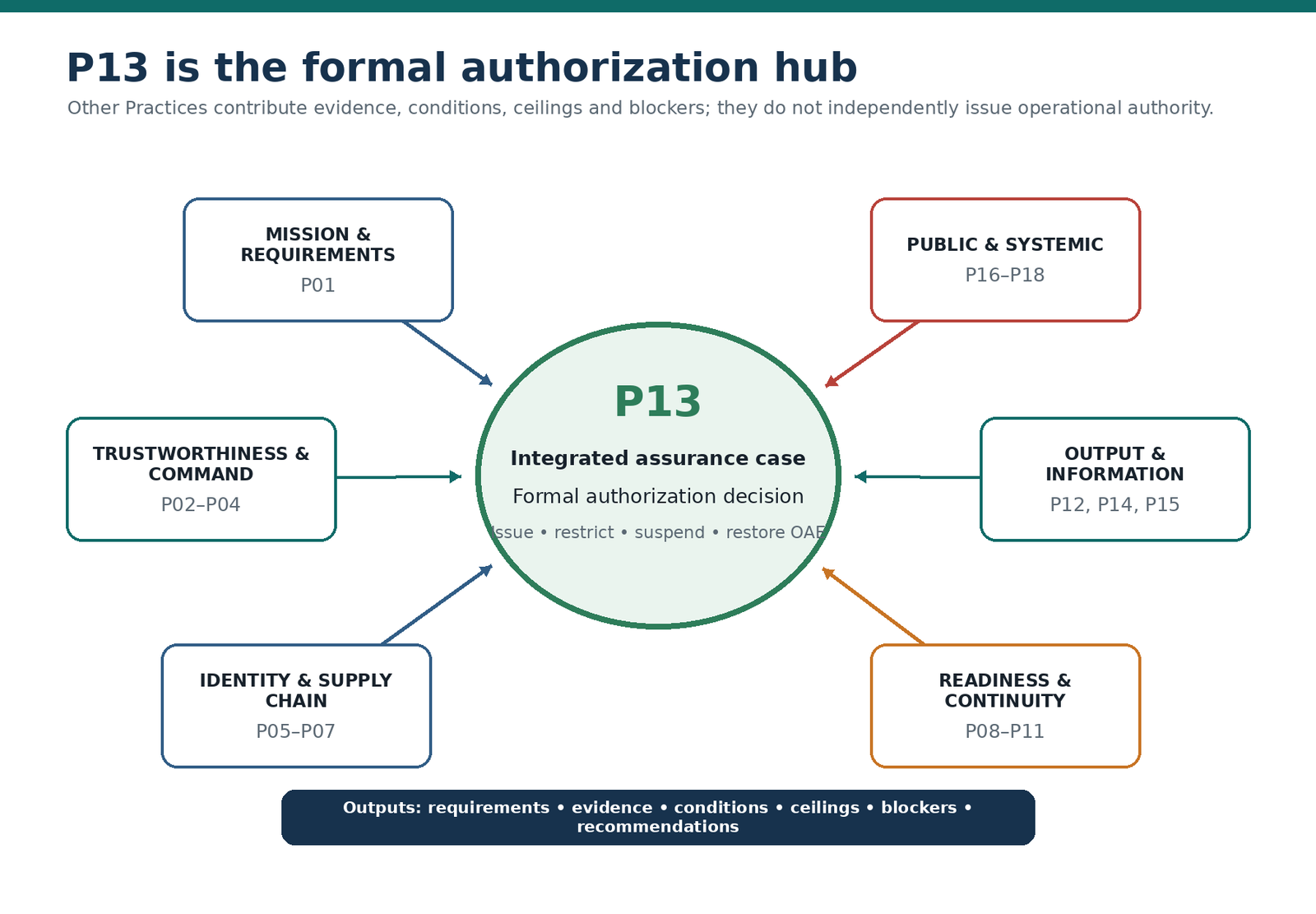
| Seam | Flow | Why it matters |
|---|---|---|
| P03 → P04 → P13 | Machine authority → intervention feasibility → formal authorization | P03 identifies where authority depends on human supervision or machine-speed safeguards. P04 proves intervention feasibility. P13 uses that evidence to bound AVE/OAE. |
| P06 → P11/P18 → P13 | Supplier dependency → continuity/systemic exposure → authorization | External dependency evidence feeds continuity and systemic-risk analysis before residual risk is formally accepted or authority bounded. |
| P11 + P16 → P18 → P13 | Continuity floors + essential-service equity → systemic scarcity governance | Recovery or scarcity choices must not silently transfer unacceptable burden across services or populations. |
| P14 → P17 → P13 | Explanation → contestability/remedy → assurance feedback | Decision transparency supports meaningful challenge; complaint/remedy patterns can become material assurance evidence. |
| P15 + P16 → P17/P13 | Privacy/proxy constraints + distributional outcomes → redress/authorization | Rights and public-interest evidence can constrain purpose, data use and authority even when technical performance remains high. |
| P12 → P07 → P13 | Generated-artifact validation → controlled configuration promotion → authorization | Validated artifacts become operational configuration only through controlled promotion and traceable configuration state. |
| P10 → P08 → P17/P13 | Logs/evidence → incident reconstruction → affected-party and authority response | Reconstructability supports incident learning, disclosure/redress and authority review. |
| P05 → P03 → P13 | Identity/delegation reach → behavioral authority → formal OAE | Technical permissions and delegation ceilings must remain consistent with formally authorized operational authority. |
11. Worked Authorization Examples
The Master Book contains five end-to-end worked cases. The table below summarizes their differing outcomes. The examples are explanatory and non-normative; they demonstrate the framework reasoning under stated facts. No outcome creates a precedent for another system, sector or authority request, which must be decided on its own evidence and operating conditions.
| Case | Scenario | Classification | P13 outcome | Lesson |
|---|---|---|---|---|
| 1 | Telecom NOC fault-triage adviser | A1 / C2 / Class II | Approve A1 with conditions | AI recommends and prioritizes; consequential action remains human-authorized. Runtime drift or use outside the supported incident classes can narrow or suspend use. |
| 2 | AI-generated router configuration with human approval | A1 / C3 / Class III | Conditional generation-only pilot | Human approval does not eliminate the need for deterministic validation, representative testing, provenance and controlled promotion. |
| 3 | Bounded agentic network optimization | A2 / C3 / Class III | Authorize bounded A2 | Autonomous action is constrained by approved action sets, rate/sequence/resource limits, independent enforcement, rollback and continuous assurance. |
| 4 | Machine-speed grid stabilization | A3 / C4 / Class IV | Conditional A3 with independent safeguards | Human oversight cannot be the immediate protection where time-to-harm is shorter than intervention; independent machine-speed safeguards carry the immediate control burden. |
| 5 | Cross-sector telecom-energy-cloud orchestration | A4 requested / C4 / Class IV | Defer A4 | Systemic evidence and scarcity governance are insufficient; some priority/allocation decisions require authoritative human adjudication. |
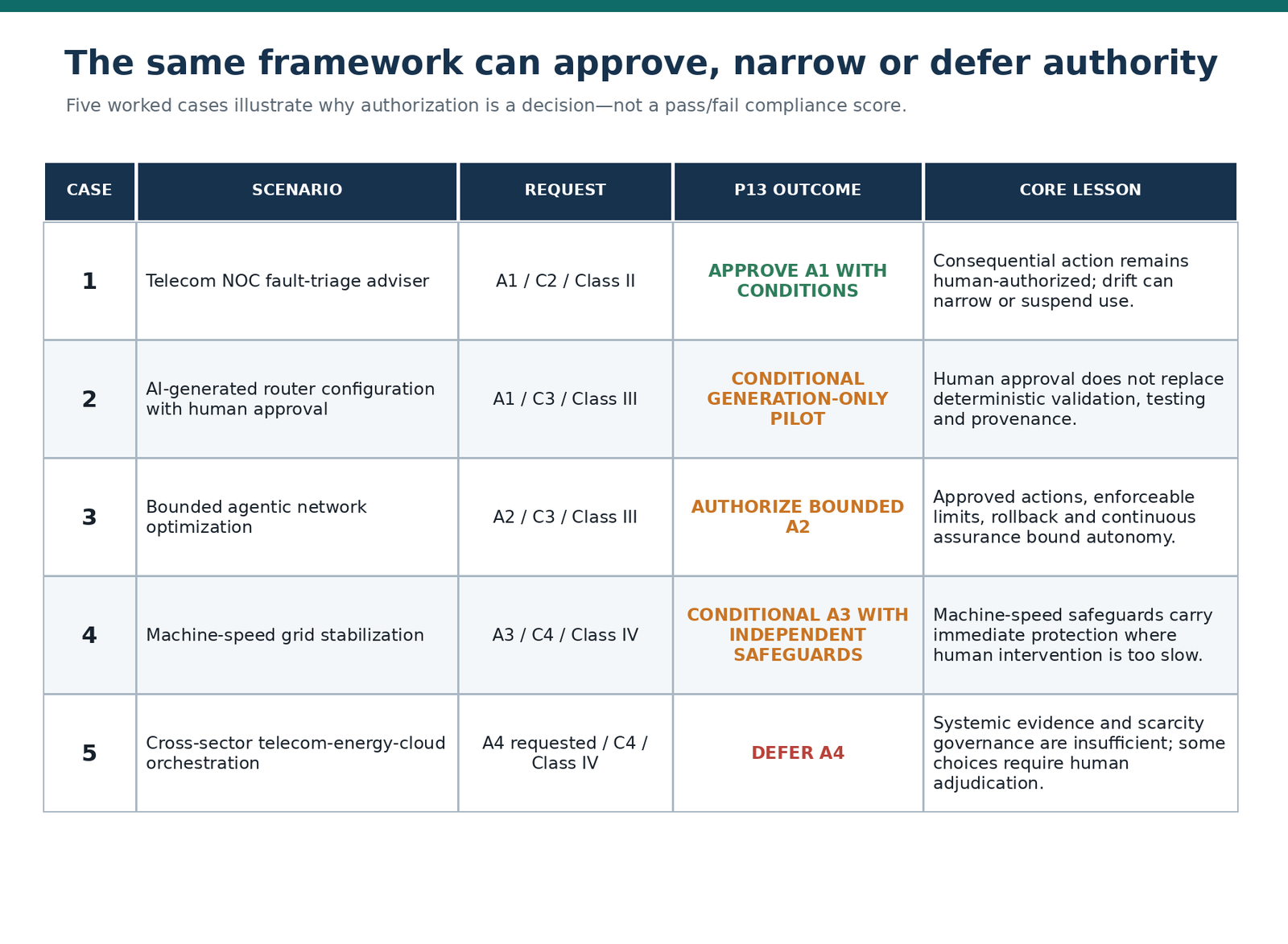
11.1 Condensed example: bounded agentic network optimization
A network-optimization agent is permitted to execute a constrained set of low-level optimization actions across a defined network domain. The use case is not authorized merely because the agent performs well in simulation. The assurance case must establish requirements and protected service floors, representative behavior under congestion and degraded telemetry, identity and tool constraints, non-bypassable action limits, cumulative-action budgets, rollback, operator readiness, logging and incident/continuity capability. P13 then issues an OAE that limits the action set, geography, resources, rate, sequence, duration, delegation and fallback behavior. Runtime signals watch not only model performance but also enforcement health, telemetry quality, cumulative action, human-supervision capacity and dependency state. A material change to topology, tool permissions, model version or fallback availability triggers validity review and can automatically reduce the authority before targeted reassurance and reauthorization.
11.2 Condensed example: machine-speed grid stabilization
A grid-stabilization service requests authority to make bounded corrective adjustments when frequency or voltage conditions can deteriorate faster than an operator can detect, diagnose, authorize and actuate a response. CI-AIGAF does not remove human accountability: people still define the protected operating envelope, approve the authority, review evidence and own recovery. It does, however, reject nominal human oversight as the immediate safeguard where the demonstrated intervention chain is slower than credible time-to-harm. Conditional authority therefore depends on independently enforceable machine-speed protections such as deterministic operating limits, rate and resource bounds, non-bypassable interlocks, rapid isolation, safe-state transitions and continuously tested fallback. The authorization record must identify the timing evidence, safeguard independence, failure assumptions, stop conditions and the human decisions that remain authoritative. If telemetry, interlock health, fallback availability or intervention readiness leaves the validated envelope, runtime controls narrow or suspend the authority and formal restoration returns to P13.
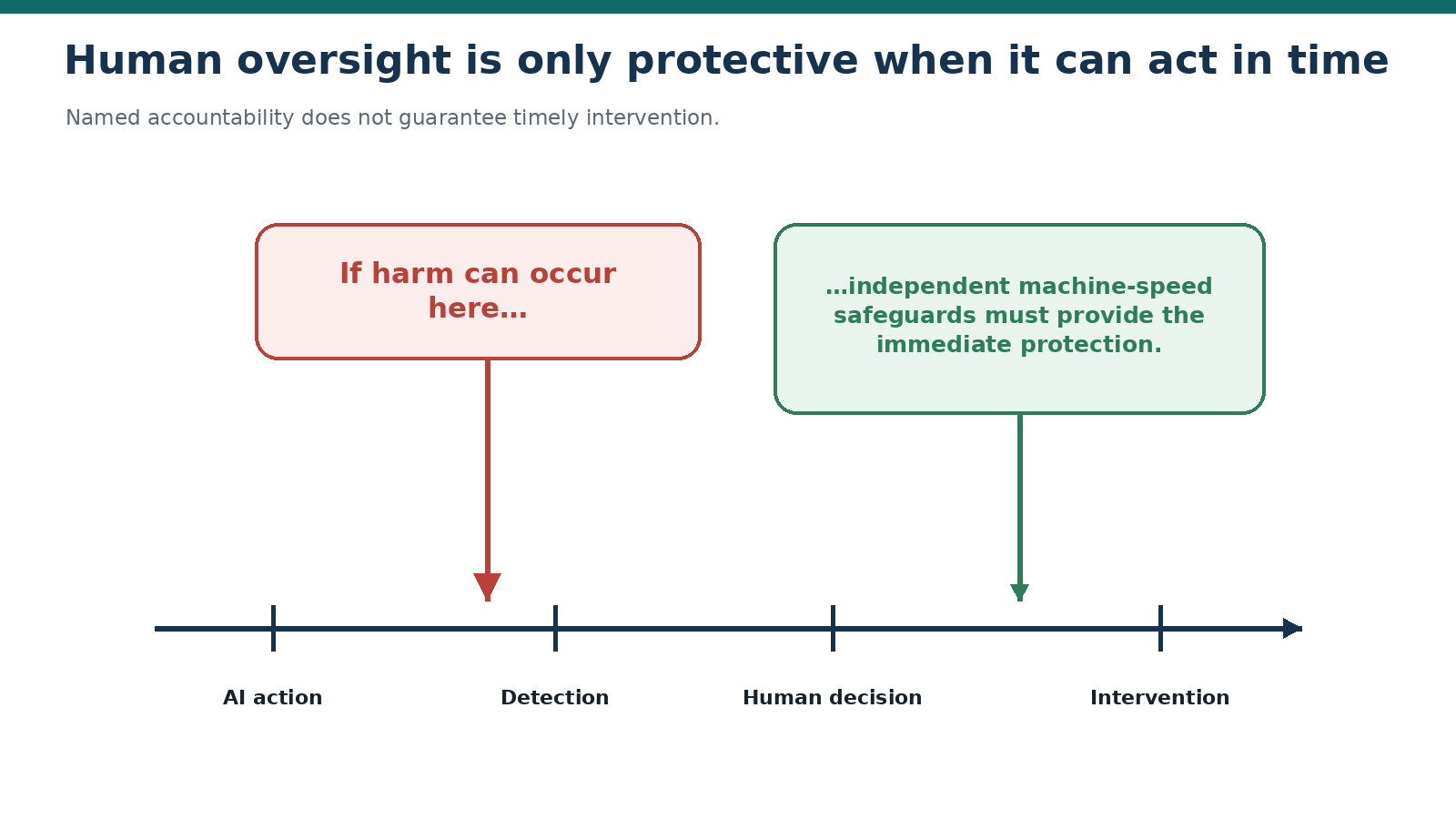
11.3 Condensed example: cross-sector autonomy deferred
A proposed cross-sector orchestration capability seeks authority to coordinate telecom load, energy availability and cloud resource allocation during regional stress. Local optimization can create cross-sector scarcity and cascading effects. P18 therefore requires dependency mapping, shared-concentration analysis, propagation and common-mode scenarios, scarcity governance, coordination triggers and recovery sequencing. Where evidence does not uniquely determine who should bear scarcity, or where multi-party institutional authority is missing, the governance result is not “approve with more monitoring.” P13 can defer A4 authority. The system may remain in a lower authority mode while human institutions retain adjudication of high-consequence scarcity and priority conflicts.
12. Practical Adoption Path
For a first implementation, do not translate the framework into eighteen independent projects. Select one real AI-enabled service, define the authority being requested, identify the consequence context, and build one traceable evidence-to-authority path. Use Appendix D as the minimum authorization evidence-pack anchor, then increase depth, realism and independence according to the requested authority and consequence.
- Run R0: establish intended purpose, organizational role, sector/jurisdiction overlays, affected interests and unresolved legal questions.
- Establish mission and requirements through P01: success criteria, baselines, protected floors, evidence plan and acceptance preconditions.
- Classify requested authority, consequence and assurance posture; identify applicable Practices and accountable owners.
- Build or acquire only where the organization can obtain sufficient identity, provenance, supplier rights, configuration control, fallback and evidence access.
- Generate representative assurance evidence and record counterevidence, uncertainty, evidence-quality limitations and unresolved risk.
- Construct the integrated P13 assurance case; conduct independent challenge; formally decide the AVE and OAE.
- Complete G6 operational readiness: people, logging, monitoring, incident response, continuity, emergency control, communications and rollback.
- Operate under continuous assurance. Treat material change, near-miss, monitoring degradation and control impairment as authority-relevant events.
- Degrade, contain or pause according to pre-authorized response when conditions leave the validated envelope.
- Reassure only what changed; return formal authority restoration or expansion to P13; archive and learn when the capability is retired.
12.1 Illustrative 30/60/90-day adoption sequence
| Period | Focus | Illustrative outputs |
|---|---|---|
| Days 0-30 | Scope and governance | AI use-case boundary; R0 record; accountable owner; requested authority/consequence; applicable Practices; initial requirements; protected outcomes; evidence-gap map. |
| Days 31-60 | Controls and assurance build | Supplier/configuration/identity controls; TEVV plan; logging; incident/continuity readiness; human-control feasibility; initial claims/evidence/defeaters; fallback validation. |
| Days 61-90 | Authorization and controlled operation | Independent challenge; P13 decision; AVE/OAE; operational-readiness gate; runtime signals; material-change triggers; pilot/production restrictions; reauthorization cadence. |
This sequence is an implementation aid, not a fixed certification timetable. High-consequence systems may require longer evidence generation, joint exercises, supplier remediation, legal review or staged authority increases.
12.2 Proportionate adoption profile
A minimum viable implementation is not permission to ignore applicable Practices. It is a staged way to establish the complete authorization spine at proportionate depth, beginning with one consequential service. Depth, independence and evidence realism increase with requested authority, consequence and uncertainty.
| Minimum capability | Executive test | Framework anchor |
|---|---|---|
| 1. Scope and decision | Can the organization name the service, purpose, owner, protected outcomes, requested authority and formal decision route? | R0, P01, classification and P13. |
| 2. Bounded operation | Can the service be constrained through robustness requirements, authority limits, intervention, identity, supplier and configuration controls? | P02-P07, applied to the actual service and dependencies. |
| 3. Evidence and readiness | Can the organization reconstruct behavior, respond to incidents, rely on competent people, recover essential service and validate generated artifacts? | P08-P12, with Appendix D as the minimum evidence-pack anchor. |
| 4. Impact conditions | Are explanation, privacy, equity, contestability and systemic dependencies governed wherever the use case creates those effects? | P14-P18, applied according to the affected interests and operating context. |
| 5. Maintained validity | Can change be detected, authority degraded safely and the case rebuilt before permission is restored or expanded? | Runtime monitoring, material-change assessment, fallback and reauthorization through P13. |
Scaling rule: No profile waives an applicable legal, safety, security, rights or essential-service obligation. Where a Practice is not applicable, record the rationale; where it is applicable, scale its evidence and independence to the decision weight it must carry.
13. External Alignment and Source-Status Discipline
CI-AIGAF is intentionally independent. It uses external law, standards and frameworks as crosswalks and evidence sources while keeping internal Practice and Task identifiers stable. External renumbering or revision should therefore trigger crosswalk maintenance rather than automatic redesign of CI-AIGAF.
13.1 NIST AI RMF
The frozen v1.0 release maps CI-AIGAF outcomes to NIST AI RMF functions/categories/subcategories where aligned. NIST alignment supports interoperability; CI-AIGAF’s evidence-to-authority, AVE/OAE, invalidation and reauthorization architecture remains an Institute for Technology Stewardship design.
13.2 NIST critical-infrastructure profile work
The August 2026 Trustworthy AI in Critical Infrastructure material used during the build is explicitly a Community of Interest discussion draft and is not official guidance. CI-AIGAF treats it as an external alignment input, not as a certification basis or source of authority.
13.3 EU AI Act and complementary EU law
CI-AIGAF v1.0 includes operational-support crosswalks to relevant AI Act obligation families and complementary critical-infrastructure/cyber-resilience law. These mappings are implementation aids, not legal conclusions, and the framework does not create a presumption of conformity. Organizations should verify the current consolidated legal text, role, system classification, sector law and competent-authority interpretation at point of use.
13.4 ISO/IEC, IEC and sector standards
Practice specifications reference management, risk, resilience, security, safety and sector standards where they provide useful implementation or evidence anchors. CI-AIGAF does not reproduce licensed standards and does not claim conformance to them merely by referencing their concepts.
14. Framework Governance, Release and Citation
CI-AIGAF v1.0 is architecture-frozen. Maintenance may correct defects, improve crosswalks, clarify wording, update external references or add implementation resources without silently changing the core authority architecture. Changes to the six-domain/eighteen-Practice structure, P13 authorization ownership, AVE/OAE architecture, evidence-to-authority chain, EQ1-EQ9 or material-change/reauthorization model would require explicit architecture-governance treatment.
14.1 How to cite
Recommended framework citation: Institute for Technology Stewardship (2026), CI-AIGAF v1.0: Critical Infrastructure AI Governance & Assurance Framework: Public Framework Specification, Version 1.0.
When citing a technical requirement or implementation detail, cite the relevant standalone Practice Specification and identifier (for example, CI-AIGAF-P03, P03-T02, or a specific P03-T02-Ixx implementation) rather than relying only on this public summary.
14.2 Feedback and implementation learning
Public use should generate feedback on operational feasibility, evidence burden, cross-sector transferability, ambiguity, missing failure modes, and where authority logic is difficult to implement in legacy or resource-constrained environments. Such feedback is valuable even where it does not immediately change the frozen architecture; it can improve implementation resources, crosswalks, sector overlays and future major versions.
Framework home: technologystewardship.org
Appendix A. Practice Quick-Reference Matrix
| Practice | Title | Task count | Principal interfaces |
|---|---|---|---|
| P01 | Establish Requirements for Success | 6 Tasks | P02, P03, P04, P12, P13 and all Practices that consume requirements or protected floors. |
| P02 | Define Robustness, Resilience, and Quality-of-Service Expectations | 6 Tasks | P01, P03, P04, P11, P13. |
| P03 | Govern Automated and Agentic Operational Authority | 9 Tasks | P04, P05, P10, P12, P13, P18. |
| P04 | Engineer Emergency Avoidance, Override, Recovery, and Situation Awareness | 7 Tasks | P03, P09, P11, P13. |
| P05 | Implement Identity and Access Management for AI Agents, Systems, and Tools | 5 Tasks | P03, P07, P10, P13. |
| P06 | Govern External AI Supply Chain and Third-Party Risk | 7 Tasks | P07, P11, P18, P13. |
| P07 | Manage Internal AI Supply Chain, Configuration, and Provenance | 8 Tasks | P05, P06, P10, P12, P13. |
| P08 | Incorporate AI-Aware Incident Analysis and Response | 8 Tasks | P10, P11, P17, P13. |
| P09 | Provide Calibrated AI Risk Training and Workforce Readiness | 8 Tasks | P03, P04, P08, P11, P13. |
| P10 | Establish Multi-Tiered AI Logging, Evidence, and Audit Capabilities | 8 Tasks | P03, P08, P13, P14, P17. |
| P11 | Maintain AI-Aware Mission Continuity and Disaster Recovery | 8 Tasks | P04, P06, P16, P18, P13. |
| P12 | Validate AI-Generated Operational Logic and Artifacts | 8 Tasks | P03, P07, P10, P13. |
| P13 | Maintain an Integrated AI Assurance Case and Formal Authorization Decision | 9 Tasks | All Practices; sole formal authorization engine. |
| P14 | Establish Explainability, Interpretability, and Operational Decision Transparency | 10 Tasks | P03, P04, P10, P17, P13. |
| P15 | Govern AI Privacy, Sensitive Inference, and Purpose Limitation | 10 Tasks | P07, P10, P16, P17, P13. |
| P16 | Assure Fair, Accessible, and Equitable Delivery of Essential Services | 10 Tasks | P11, P15, P17, P18, P13. |
| P17 | Establish Stakeholder Engagement, Contestability, Notification, and Redress | 12 Tasks | P08, P14, P15, P16, P13. |
| P18 | Manage Cross-Sector Interdependencies, Common-Mode Failure, and Cascading AI Risk | 12 Tasks | P06, P11, P16, P13. |
Appendix B. Evidence Quality Dimensions EQ1-EQ9
| ID | Dimension |
|---|---|
| EQ1 | Relevance |
| EQ2 | Representativeness |
| EQ3 | Operational/environmental fidelity |
| EQ4 | Coverage |
| EQ5 | Independence |
| EQ6 | Reproducibility/reconstructability |
| EQ7 | Currency/recency |
| EQ8 | Provenance/integrity |
| EQ9 | Uncertainty/transfer limits |
Appendix C. Material-Change Catalogue MC-01-MC-12
| ID | Trigger family | Public-use implication |
|---|---|---|
| MC-01 | Model / algorithm / policy | Assess whether existing evidence and authority remain valid; degrade or suspend authority where the change leaves the supported envelope. |
| MC-02 | Data / knowledge / retrieval | Assess whether existing evidence and authority remain valid; degrade or suspend authority where the change leaves the supported envelope. |
| MC-03 | Tool / interface / action | Assess whether existing evidence and authority remain valid; degrade or suspend authority where the change leaves the supported envelope. |
| MC-04 | Identity / permission / delegation | Assess whether existing evidence and authority remain valid; degrade or suspend authority where the change leaves the supported envelope. |
| MC-05 | Dependency / supplier / runtime | Assess whether existing evidence and authority remain valid; degrade or suspend authority where the change leaves the supported envelope. |
| MC-06 | Operating environment / topology / geography | Assess whether existing evidence and authority remain valid; degrade or suspend authority where the change leaves the supported envelope. |
| MC-07 | Authority / autonomy / speed | Assess whether existing evidence and authority remain valid; degrade or suspend authority where the change leaves the supported envelope. |
| MC-08 | Human control / staffing / procedure | Assess whether existing evidence and authority remain valid; degrade or suspend authority where the change leaves the supported envelope. |
| MC-09 | Incident / near miss / unexplained behavior | Assess whether existing evidence and authority remain valid; degrade or suspend authority where the change leaves the supported envelope. |
| MC-10 | Evidence / monitoring degradation | Assess whether existing evidence and authority remain valid; degrade or suspend authority where the change leaves the supported envelope. |
| MC-11 | Rights / population / mission | Assess whether existing evidence and authority remain valid; degrade or suspend authority where the change leaves the supported envelope. |
| MC-12 | Law / regulation / risk tolerance | Assess whether existing evidence and authority remain valid; degrade or suspend authority where the change leaves the supported envelope. |
Appendix D. Minimum Authorization Evidence Pack
The exact evidence pack is risk- and context-dependent. The following public checklist captures the common categories reflected across the frozen Master Framework and Practice set. It is not a substitute for the detailed evidence requirements of applicable Practices.
- R0 applicability, role and obligation record.
- Defined AI-enabled service boundary, intended purpose and accountable owner.
- Requested authority tier, consequence tier and assurance-class rationale.
- Mission/service requirements, protected floors and prohibited outcomes.
- Baseline and TEVV evidence under representative normal, stressed, degraded and fallback conditions.
- Assurance claims, arguments, evidence references and EQ1-EQ9 assessment.
- Counterevidence, defeaters, assumptions, uncertainty and residual risk.
- Identity, access, delegation, configuration and provenance evidence.
- Independent enforcement, fallback, emergency intervention and human-feasibility evidence where relevant.
- Logging, incident response, continuity and recovery readiness.
- Privacy, explanation, equity/accessibility, contestability/remedy and systemic-risk conditions where applicable.
- Independent challenge and dissent record.
- P13 authorization decision, AVE and OAE.
- Runtime signals, thresholds, material-change triggers, degradation responses and reauthorization conditions.
Appendix E. Glossary of Core CI-AIGAF Terms
| Term | Definition |
|---|---|
| AI-enabled service | The governed operational system around AI, including models, data, tools, identities, dependencies, people, controls, fallback and affected service context. |
| Assurance claim | A statement about what must be true for a governance or authority decision to be justified. |
| Argument | The reasoning that connects evidence to an assurance claim. |
| Evidence object | A traceable item used to support or challenge an assurance claim. |
| Defeater | Counterevidence, contradiction, assumption failure, uncertainty or condition that weakens or defeats a claim. |
| Residual risk | Risk remaining after controls and evidence are considered and before/within the formal decision. |
| AVE | Assurance Validity Envelope: P13 case object defining where accepted claims/evidence remain valid. |
| OAE | Operational Authority Envelope: the formally authorized operational boundary for AI-enabled action/influence. |
| PCE | Privacy Conditions Envelope from P15; specialist conditions/evidence, not a parallel authorization engine. |
| ECE | Equity Conditions Envelope from P16; specialist conditions/evidence, not a parallel authorization engine. |
| PRCE | Participation & Remedy Conditions Envelope from P17; specialist conditions/evidence, not a parallel authorization engine. |
| SRCE | Systemic Risk Conditions Envelope from P18; specialist conditions/evidence, not a parallel authorization engine. |
| Protected floor | A minimum safety, service, rights, privacy, equity, accessibility, emergency or resilience outcome that may not be silently traded away by optimization. |
| Material change | A change to system or context that may invalidate evidence, claims or authority and therefore requires validity assessment. |
| Reassurance | Targeted rebuilding or refresh of assurance evidence after change, incident, expiry or degradation. |
| Reauthorization | The formal decision on whether authority should continue, change, restore, reduce, suspend or end after validity review. |
| Independent challenge | Structured review by a sufficiently independent party to test claims, evidence, assumptions, uncertainty and residual risk. |
| Continuous assurance | Ongoing evaluation of whether the conditions supporting assurance and authority remain true in operation, not merely collection of monitoring data. |
End of public framework specification
For implementation depth, use the eighteen final standalone CI-AIGAF Practice Specifications P01-P18 issued in the CI-AIGAF v1.0 Technical Release Package. The Master Book is the separate expanded practitioner and worked-case companion. This public document makes the architecture inspectable without requiring a reader to begin with the full technical corpus.