
- Document
- Public consultation draft, version 1.0
- Published
- 13 November 2026
- Comments close
- 15 January 2027, 23:59 IST
- DOI
- 10.5281/zenodo.24156355
- Respond to
- contact@technologystewardship.org
- Status
- A research proposal for discussion. Not yet tested with practitioners or independently reviewed.
Abstract
Open for comment until 15 January 2027. HJSM has not yet been tested with practitioners or independently reviewed. It is published now so that readers can challenge it before testing begins.
Policy and standards increasingly expect human oversight of automated and AI-driven systems. Yet a person named as overseer may lack the information, the authority, the time or the means to intervene. The Human Judgment Stewardship Model (HJSM) is a draft model for examining, one consequential automated action at a time, whether human intervention is feasible, whether a decision takes effect and what allows operation to resume. It is grounded in telecom network operations. The model has nine elements grouped into five functions: Limit, Decide, Confirm, Resume and Own. It also proposes a set of action states and a decision record. This paper is a public consultation draft. It reports no practitioner findings and does not claim that the model has been validated. It sets out the model, compares it with existing policy and research, describes a planned interview study with practitioners and puts ten questions to readers.
Keywords: human oversight; AI governance; autonomous systems; telecom network operations; critical infrastructure; accountability; human-in-the-loop
Consultation at a glance
| What we ask | Tell us where the model is wrong, incomplete or unworkable in real operations. Section 10 lists ten questions. Please answer any of them. |
| Who should comment | Network and service operations staff, change and incident managers, suppliers and managed-service teams, regulators, safety and risk specialists, and researchers. Practitioners in emerging economies are especially welcome. |
| How and by when | Email contact@technologystewardship.org by 15 January 2027 (23:59 IST). A short response to Q3, Q6 and Q7 alone is welcome. Section 11 explains how comments are handled. |
The model in plain language
A person can be named as the overseer of an automated system and still be unable to oversee it. They may lack the information, the decision rights, the time or the means to intervene. This matters most where automation affects network continuity or other essential services.
HJSM asks five things about a consequential automated action: what its limits are, whether a person can decide in time, whether the decision took effect, what allows operation to start again, and who answers for it at every stage. These are the five functions in Figure 1: Limit, Decide, Confirm, Resume and Own. The nine elements of the model, H1–H9, sit under them.
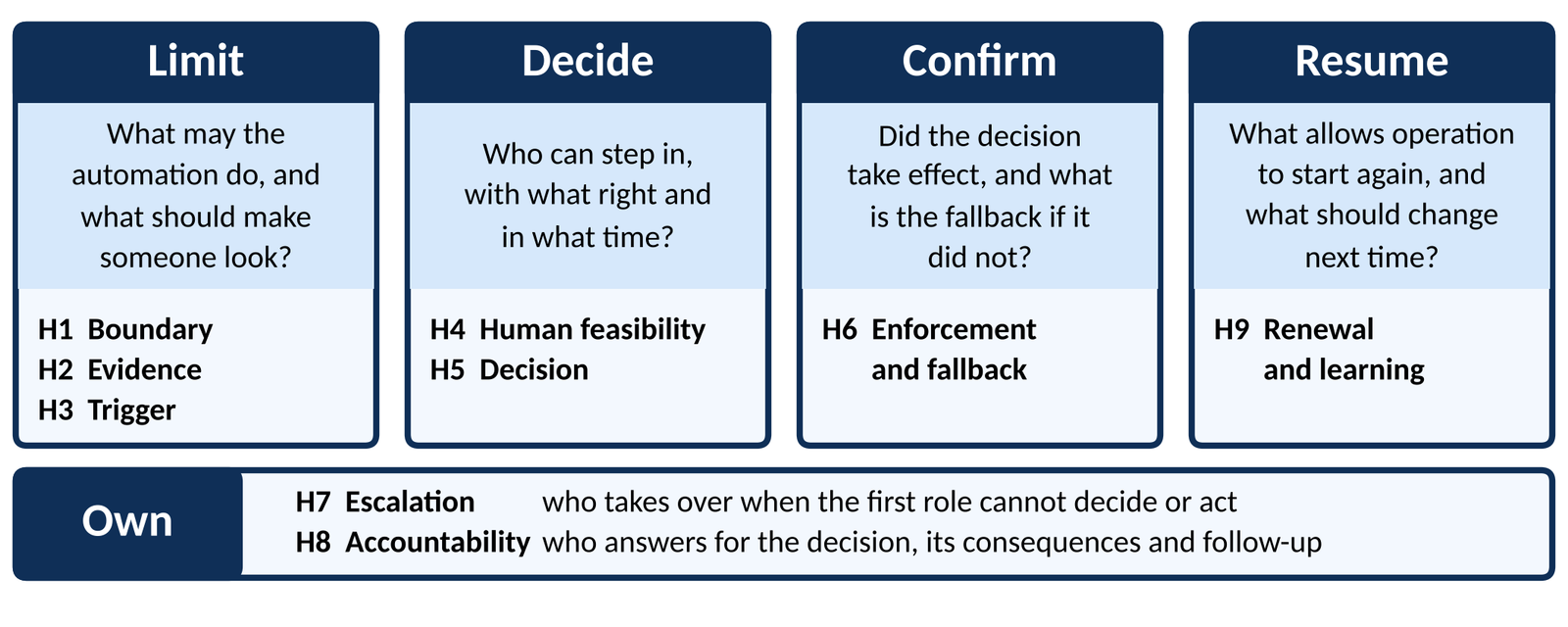
In this draft, human oversight is meaningful when the responsible role has the information, competence, decision rights, time and means to intervene within the response window for the action, and the effect of the intervention is checked. The response window depends on the consequence to be prevented or limited. Where intervention in real time is not feasible, HJSM examines the bounded automation that was approved in advance and who remains accountable for it. Automation is bounded when its limits, its trigger for stopping and its conditions for restarting were set in advance by someone accountable.
The five functions are a way into the model. They are not a complete or validated test of oversight.
The model does not assume that a human decision is always the safer one. Waiting, stopping or intervening wrongly can make things worse. In some cases automation kept within set limits can hold the service steady until a person is available.
Three claims we most want challenged
HJSM rests on five research questions and propositions, set out in section 5. Three claims within them are the most open to dispute, and we most want readers to test them against their own experience.
- A named human is not, by itself, oversight. Intervention is meaningful only where a real role has sufficient information, competence, legitimate decision authority, time and enforceable means to act. (R1)
- Technical recovery is not always permission to resume. Some recoveries can resume under an existing rule, and others need a further decision. Which recoveries fall into each group, and what evidence shows it, is still open. (R3)
- When no qualified person can act in time, bounded automation may be the right response. This holds only if the scope, trigger and termination conditions of the protective action are predefined and auditable. (R4)
These are claims under test and are not findings. One credible counterexample can narrow any of them.
Why this matters now
Human oversight of AI is now a stated expectation in international and national policy. The Co-Chairs’ Summary of the first UN Global Dialogue on AI Governance (Geneva, July 2026) names an identifiable, empowered human decision-maker, able to override or stop a system, among the elements of accountability discussed, and stronger human oversight of agentic AI among the priorities identified. [3] India’s AI Governance Guidelines include human oversight in their People First principle. [4] The European Union’s AI Act requires that high-risk AI systems can be effectively overseen by people while they are in use. [5]
Existing policy and standards already deal with human oversight, the ability to intervene and automated safeguards. India’s Guidelines, for example, recommend safeguards such as circuit breakers where direct human oversight is not effective, and the EU AI Act requires that people assigned to oversight have the competence, training, authority and support they need. [4,5] HJSM does not present these ideas as new. It proposes a way, grounded in telecom practice, to examine how such arrangements work for one consequential action: whether the assigned role can act in the time available, whether the decision takes effect, and what evidence allows operation to continue or resume. This consultation will test whether that adds practical value. Section 6 compares HJSM with existing work. The documents are cited as context. None of them endorses HJSM.
About this draft
This draft is part of the ITS initiative Human Judgment Protocols for Autonomous Systems in Telecom & Critical Infrastructure, which is listed in the AI Dialogue Partnerships Hub of the UN Global Dialogue on AI Governance. The listing does not imply United Nations endorsement, accreditation or funding. [2] About the initiative →
The initiative pays particular attention to emerging economies, including India and Uganda, and to operators without large compliance teams. The first practitioner interviews are planned in India. Interviews in Uganda will follow once the required research permissions are in place. Until then, practitioners there are invited to comment in writing. Research question R5 asks how limited staffing and access change what oversight is feasible, which is why these settings matter to the study. The same questions are proposed for every operator. Their practical answers, limits, response windows and supporting arrangements depend on the operating context and will be examined through R5. This draft makes no finding about either country.
The model starts from how telecom Network Operations Centres (NOCs) work. It draws on common network-operations practice and on one published source on incident organisation. [1] Neither shows that every operator works this way, and neither validates HJSM.
What we are asking for
We are publishing the Human Judgment Stewardship Model (HJSM) so that it can be challenged before it is tested with practitioners. The question behind it is when a consequential autonomous action should give way to the judgment of a qualified person, and what evidence allows the action to continue or resume. This draft contains no practitioner findings.
We ask readers to:
- Point out missing elements, record fields that would not work in practice, and situations where following the model would cause harm.
- Give counterexamples, especially cases where automatic resumption was the right call or where a human intervention was a mistake.
- Suggest changes that would help operators with few staff, limited system access or little governance capacity.
We learn most from real cases: automation that resumed safely without approval, a human intervention that made things worse, or a responsible person who could not act. One case that confirms or breaks a rule helps us more than general agreement.
Practitioners may want to start with the example below, then Figure 2 in section 4 and the questions in section 10. Policy readers will find the essentials in the opening sections, in Figure 2 and in section 9, which sets out what this draft can and cannot claim.
If you may take part in an HJSM interview, please tell us that you have read this draft. The study records prior reading so that interview evidence can be kept separate from reactions to this document.
The nine elements applied to one decision
This example is an illustration. An automated network service proposes to reroute traffic around congestion, and the team must decide whether the action can go ahead within its permitted scope. The example shows how H1–H9 apply. It is not an operating instruction, it does not describe a real event, and it is not one of the cases used in the interviews.
| Element | How it applies to the rerouting decision |
|---|---|
| Limit (H1–H3) | |
| H1 Boundary | Identify the traffic, affected services and changes the automation is permitted to make. A wider reroute may fall outside the existing permission. |
| H2 Evidence | Check the telemetry and service-dependency information relevant to that reroute. Record uncertainty; an unrelated stale inventory field need not block the action. |
| H3 Trigger | Specify what condition requires limits, another decision or a protective response. The trigger must refer to observable conditions for this action. |
| Decide (H4–H5) | |
| H4 Human feasibility | Check whether the duty role has the information, competence, access and time to decide while handling other work. A name on a rota is insufficient. |
| H5 Decision | Identify who can permit, narrow, delay or stop the reroute. Distinguish the role deciding from a supplier who executes the command. |
| Confirm (H6) | |
| H6 Enforcement and fallback | Confirm that the command took effect. Define what can continue if the command fails or no qualified person responds. |
| Own (H7–H8) | |
| H7 Escalation | Use a reachable alternate role when the first person lacks decision rights, competence or access. Record what remains permitted while waiting. |
| H8 Accountability | Name the owner of the decision process, unresolved risk and follow-up, including handover to the next shift. |
| Resume (H9) | |
| H9 Renewal and learning | Check the evidence for resumption. A valid predefined rule can suffice in some circumstances; changed dependencies can require another decision. Review the outcome, including human error. |
The model does not prescribe one answer to the reroute. It makes the basis for action visible and testable. A complete decision record can still describe a wrong decision.
A fuller example, following one decision through enforcement and recovery, will be published separately, at the latest with HJSM v2.0. It is held back for now so that it does not shape the answers of interview participants.
1. Scope and working definitions
HJSM looks at one consequential operational action or decision at a time. It does not assess an AI model in isolation. An action may affect a service, a group of assets, an operating boundary or the response to an incident. For each action, HJSM asks what the automation and the people involved are allowed to do, and what happens when the conditions behind that arrangement change.
The model assumes that an action can be identified and bounded for the purpose of a decision. That may not hold where effects cascade, where several teams share an action or where no single decision-maker can see all of it. In such cases the record should state what could not be bounded or seen. Question Q1 asks about this.
In this draft an action is consequential if it can materially affect a service, is hard to reverse, or affects systems that other services depend on. Routine actions with none of these effects fall outside the model and need no decision record.
The scope for now is telecom and network operations. Whether the model transfers to other critical infrastructure is an open question. Operational technology has its own performance, reliability and safety requirements, and a model built on telecom practice cannot be assumed to meet them.
The action may come from rule-based automation, a machine-learning control loop or an AI agent. This draft treats all three in the same way. Question Q1 asks whether it should.
In this draft, operational authority means the permission and decision rights that an organisation grants, within stated limits. It is not legal permission. HJSM is a research proposal. It is not a certification scheme, and it does not replace an organisation’s own operational and safety arrangements.
| Term | Working meaning |
|---|---|
| Operational authority | Current permission for a system or human role to take a specified consequential action under defined conditions. |
| Action boundary | The action, assets, service scope, operating mode, impact limits and conditions within which action is permitted. |
| Human decision authority | A role’s legitimate ability to approve, stop, restrict, defer, restore or escalate an action; a title alone is insufficient. |
| Intervention | An action that changes, stops, narrows, delays or conditions autonomous activity. Observation by itself is not intervention. |
| Escalation | Transfer to another decision role because the first role lacks the competence, authority, availability or time required. |
| Enforcement | The technical or organisational means that make a decision effective in the operational system. |
| Fallback or protective state | A predefined bounded operating condition used while uncertainty, review or enforcement difficulty remains unresolved. |
| Restoration | Return from restricted or protective operation after the initiating condition changes. Further authorisation may or may not be required. |
| Reauthorisation | An explicit or rule-based decision permitting resumption of a previously restricted action, possibly under changed conditions. |
| Accountability owner | The role responsible for the decision process, its consequences, unresolved risk, record and follow-up. |
These are working definitions. We ask whether the distinctions they draw are useful in practice, particularly where control is shared between an operator, a supplier and a shared service team.
Some similar terms are used with different meanings. Recovery means that the fault or trigger has cleared. Restoration and resumption both mean the return to operation. Reauthorisation is the decision or rule that permits that return. Renewal is the name of element H9, which covers resumption and what is learned afterwards.
Codes used in this draft
| Code | Meaning |
|---|---|
| Limit, Decide, Confirm, Resume, Own | The five functions that group the nine elements (section 2). |
| H1–H9 | The nine elements of the model (section 2). |
| R1–R5 | The research questions and propositions that the study will examine (section 5). |
| N1–N6 | The telecom operating patterns that the model draws on (section 6). |
| HJDR | Human Judgment Decision Record, the proposed record of a decision (section 7). |
| O1, O2, HJ, D1–D3, I1 | The classes of evidence used in the study (section 8). |
2. The nine elements of HJSM
H1–H9 describe the chain of a decision and should be read together. A complete record of a decision does not show that a person could have acted in time. A stop control does not show that the person using it had the right to decide.
The nine elements are grouped into five functions. Limit covers H1–H3: what the automation may do and what should make someone look. Decide covers H4 and H5: whether a qualified person can decide in time and has the right to do so. Confirm covers H6: whether the decision took effect, and what the fallback is if it did not. Resume covers H9: what allows operation to start again and what is learned.
Own is different in kind from Limit, Decide, Confirm and Resume. It is not a stage in the life of an action. It is a layer that applies at every stage. Escalation (H7) says who takes over when the first role cannot decide or act. Accountability (H8) says who answers for the decision, its consequences and its follow-up.
Confirm and Resume each hold one element. They are kept as separate functions because each asks a distinct question that is easy to overlook: whether a decision worked, and how operation restarts. Question Q2 asks whether this grouping is useful. The functions are there to help the reader. They do not set an order.
| ID | Element | Question the model asks |
|---|---|---|
| Limit (H1–H3) | ||
| H1 | Boundary | Which action, assets, service scope, operating mode and impact envelope are under consideration? |
| H2 | Evidence | What information supports continued action or intervention? What is uncertain, missing or contradictory? |
| H3 | Trigger | Which observable condition requires restriction, review, escalation or a change in the current decision arrangement? |
| Decide (H4–H5) | ||
| H4 | Human feasibility | Can a qualified person understand the issue and act within the available time under actual staffing and workload conditions? |
| H5 | Decision | Which choices are available, and which role is authorised to decide continuation, restriction, stopping or resumption? |
| Confirm (H6) | ||
| H6 | Enforcement and fallback | How will the decision take effect, how will success be confirmed, and what remains possible if intervention cannot be completed? |
| Own (H7–H8) | ||
| H7 | Escalation | Which alternate role or decision level can respond when the primary role cannot decide or enforce the action? |
| H8 | Accountability | Who owns the decision process, its consequences, unresolved risk, record and follow-up? |
| Resume (H9) | ||
| H9 | Renewal and learning | What evidence supports resumption, and what later review should change the triggers, thresholds, roles or procedures? |
How the elements relate
H1 and H2 set out the action and the information available. H3 says why the current arrangement needs attention. H4 tests whether a person can realistically respond, and H5 says who may decide and what the choices are. H6 and H7 deal with carrying out the decision and with escalation. H8 keeps ownership clear. H9 links resumption to what is learned from the outcome.
The elements do not have to be followed in the same order every time. A protective action in an emergency may happen before anyone can review the event. A routine operation may continue under a valid predefined rule. The structure is meant to make such arrangements explicit, so that they can be questioned.
Consultation issue. Are any elements missing, overlapping or too broad? In particular, should the model distinguish the role that authorises an action from the role that executes it, the role that accepts residual risk and the role that reviews the outcome? In a small team one person may hold several of these roles. Is it enough for the model to record that?
3. Applying the model to an operational decision
The steps below show how HJSM would be used. They are a proposed method, put forward for review. Triggers, response times and fallback choices depend on the service and on what is at stake, so this draft gives no universal numerical thresholds.
Establish the action and its consequences
Describe the action, the boundary within which it is permitted, and what would happen to the service if it continued, were narrowed, were delayed or were stopped. Identify dependencies that could make an intervention that looks reasonable locally harmful elsewhere. If the boundary changes, a different role may need to decide, or more evidence may be needed.
Check the evidence that matters to that action
Check whether the evidence is relevant to this action, sufficient, fresh and consistent. An item that is out of date or missing may matter for one action and not for another. Record important uncertainty and conflicting information. A general system-health indicator is not enough by itself to support the decision.
Test whether human judgment is feasible
Identify the primary role and the alternate role, what each may decide, what information each can see and how each can make an intervention take effect. Compare the time available with the whole interval from the moment the condition arises to a confirmed response. That interval covers detection, notification, understanding, decision, enforcement and confirmation that the action took effect, and some of these stages overlap. Note which times were observed and which were recalled or estimated, and who set the available response time and on what basis. A quick decision is not enough if detection or enforcement is late. Take account of competing alerts and other duties at the same moment.
Choose and enforce a bounded response
The possible responses include continuing, narrowing, delaying, pausing, taking a predefined protective action, stopping, escalating and restoring operation. The role that decides should be able to explain the choice and how certain it is. Record whether the mechanism used achieved what was intended.
Maintain an operating condition while review is unresolved
A fallback states what may continue and what may not. It can restrict one consequential action while keeping another service function running. Whether a fallback is acceptable depends on its effect on the service, on safety, on whether it can be reversed, on how long it lasts and on how escalation works. Every fallback needs an owner and a condition for ending it.
Assess resumption and review the outcome
Establish whether the conditions for resumption are met, and whether an existing rule permits it or a new decision is needed. Keep the evidence, the reasoning, the result of enforcement and the handover information. Later evidence may show that the person or the automation was wrong, so the original record should be kept separate from later interpretation.
Practical indicators for H4
The indicators are staffing, other demands at the same time, alarm load, competence, information, decision rights, access, delay and the ability to enforce a decision. A name on an escalation chart does not mean that the person is available.
A short form of the test is a set of plain questions. Can the person see the problem? Are they allowed to decide? Can they make the decision take effect? Can they do all of this in time? Some indicators can be checked in advance, such as staffing and access rights. Others, such as alarm load and competing demands, can only be judged at the moment.
4. Action states and resumption
These states give a vocabulary for describing how the status of a consequential action changes over time. They apply to the action and its boundary. They are not a fixed sequence, and one system may have several actions in different states at once.
| State | Working meaning |
|---|---|
| Active | The action is permitted within its defined operating boundary while the relevant evidence and conditions remain within limits. |
| Conditional | Action continues with stated limits while uncertainty, a warning or a deteriorating condition is assessed. |
| Judgment Required | A qualified decision is needed before specified consequential continuation or expansion. The permitted interim behaviour is defined separately. |
| Suspended | Permission for the specified consequential action is withdrawn and the action is expected to stop. Whether it has stopped is confirmed and recorded separately. Other bounded service functions may remain active. |
| Recovered Pending Review | Technical conditions have recovered, while any unresolved restart conditions are assessed. This state is provisional and applies only where review is actually needed. |
| Resumption Authorised | Resumption is permitted, by a role or by a valid predefined rule, within stated limits. Whether the restart succeeded is recorded separately as pending, succeeded, partial, failed or unconfirmed. |
| Closed | No further restart is expected for the action, for example after retirement or cancellation. |
What the states describe
The states describe what an action is permitted to do. They do not, by themselves, show what the system is doing. Withdrawing permission does not prove that the action has stopped, and a new authorisation does not prove that the restart succeeded. For each significant restriction or restart, the record therefore states the decision or rule, the intended effect, the observed result and any enforcement that failed, was partial or could not be confirmed.
Closing an incident is recorded separately from the status of the action. An action that returns to normal operation is Active again, even if the incident that involved it has been closed. Closed applies to an action that has been retired or cancelled.
The recovery question remains open
Research question R3 asks when technical recovery is enough for operation to resume, and when further authorisation by a person or the organisation is needed. The research design allows for both answers. HJSM does not assume that every recovery needs manual approval.
An action may resume under an existing predefined rule if the rule still applies and its conditions are met. In other cases a changed boundary, an unresolved dependency or an earlier decision may call for further judgment. Practitioners are asked to challenge where that line falls and what evidence should support it.
The Recovered Pending Review state should be narrowed, replaced or removed if evidence shows that it causes unnecessary delay or misdescribes a type of recovery. Technical recovery, permission to operate and organisational review are related. They remain three separate questions.
Selected transitions between action states
Figure 2 shows how an action can move between the seven states. It shows selected transitions only and is not a required workflow.
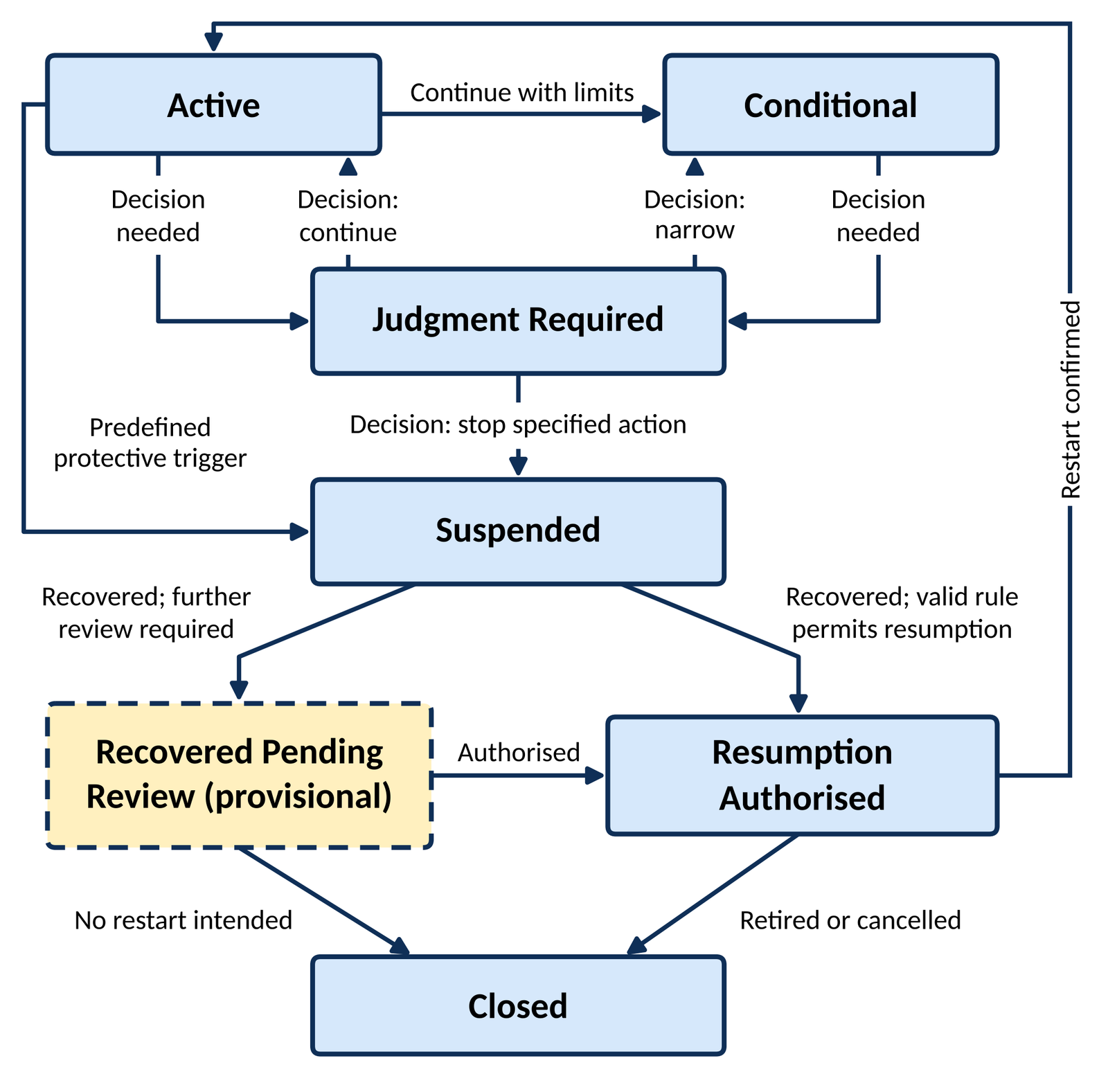
How to read Figure 2:
- In normal operation the action is Active. If a warning appears or conditions worsen, it becomes Conditional and continues within stated limits.
- From either state the action can move to Judgment Required. A qualified person then decides whether it continues, continues within narrower limits or stops.
- A predefined protective trigger can also suspend the action directly, without waiting for a decision. This can happen from Active or Conditional. The figure shows the path from Active only.
- When the fault has cleared, a suspended action can take one of two routes. If a valid rule permits it, resumption is authorised directly. If further review is needed, the action waits in Recovered Pending Review until it is authorised.
- Once the restart is confirmed, the action is Active again. If the restart fails or cannot be confirmed, that is recorded and the action is not treated as Active. An action that is retired or cancelled is Closed.
The figure can also be read as the life of a delegated authority. It is granted (Active), limited (Conditional), withdrawn (Suspended) and restored (Resumption Authorised).
The amber box with the dashed border marks the provisional state. Whether that state is needed is part of research question R3. The figure shows permission. The result of enforcement is recorded alongside it. In every state, the limits that apply in the meantime are stated explicitly.
When enforcement fails or no one can decide
Three situations have no state of their own in this draft: a suspension that fails or cannot be confirmed, a restart that fails or cannot be confirmed, and a Judgment Required state in which no qualified person can decide in time. In each case the action keeps its permission state and the record carries the failure. The enforcement result is recorded as failed, partial or unconfirmed. Escalation (H7) applies, and the predefined fallback (H6) states what may continue in the meantime. An action whose restart has not been confirmed is not treated as Active. Whether these situations need states of their own is an open question. Question Q4 asks about it.
Transition information
For each significant transition, the proposed record states the trigger, the evidence, the role or rule involved, what is permitted in the meantime, the result of enforcement and the basis for the next state. Fieldwork will test which transitions need an explicit record and how much information is reasonable to ask for.
5. Research questions and propositions
R1–R5 are what the practitioner study will examine. They are not findings. R4 is a proposition with a competing view that evidence can test. R3 is an open question with two possible answers. R1, R2 and R5 are research questions, each with a working assumption and a set of cases that the study will compare. Any of the five may be supported within a context, narrowed, challenged or left unresolved.
R1 Meaningful human intervention
Working assumption: human intervention in a consequential action is meaningful only where a real role has sufficient information, competence, legitimate decision authority, time and enforceable means to act. Research question: which combinations of these conditions make intervention effective, and how do teams compensate when one is missing? The study will compare interventions that succeeded, failed, were delayed or were properly delegated. It will keep human intervention separate from protection that was achieved without it.
R2 Evidence relevant to continuing action
Working assumption: whether an autonomous action should continue depends on whether the evidence for that action and boundary is relevant, sufficient, fresh and consistent. Research question: which gaps in evidence change a defensible decision to continue, and why? The study will compare a gap that changed the decision with one that did not, and will record why each mattered for the consequences of the action.
R3 Recovery and resumption
When is technical recovery enough for operation to resume, and when is further authorisation by a person or the organisation required? The study must be open to evidence of routine automatic resumption that was appropriate, as well as evidence that a further decision was needed. The useful result may be a classification of recovery conditions and not a single restart rule.
R4 Time-critical protective action
Where the time a person needs to detect a condition, decide and make the decision take effect is longer than the safe response window, a bounded protective or fallback action may be justified, provided its scope, trigger and termination conditions are predefined and auditable. The competing view is that a qualified person can be reached and can act effectively within the safe interval. The research must examine how that interval is set, who approved the protective rule and what the protective action would lead to. A rule that is predefined and auditable is not thereby shown to be safe. Who is accountable when a protective action approved in advance causes harm is an open question that the study will examine. Interviews can inform these questions. They cannot by themselves establish a safe interval.
R5 Feasibility in the operating context
Working assumption: whether human-judgment controls work depends on staffing, other demands at the same time, the authority of the role, connectivity, access rights, escalation delay and the operating model. Research question: how do these conditions affect intervention, and which compensating arrangements help or fail? The study will compare similar tasks under different operating arrangements, including lean teams that cope well and well-resourced responses that did not. Where the human response that the model assumes cannot be delivered in a given environment, the model should be revised.
How evidence can change the model
One credible counterexample from operations can require a change of substance or a narrower rule, even if most participants agree with the rule as drafted. If readers repeatedly misunderstand a point, the wording needs to be clearer. Where the evidence is too thin, the question stays open. Agreement or disagreement among participants does not settle whether a rule is legally or morally right.
6. The telecom basis and its evidence gaps
HJSM draws on six patterns of telecom operations, N1–N6. The grouping is ITS’s own synthesis of common network-operations practice. Only the incident-handling patterns are tied to a published source in this draft. [1] Fieldwork must establish what people do in practice and what can carry over to the governance of autonomous systems. The patterns are put forward for telecom only. Applying HJSM in another sector would start from that sector’s own practices and evidence.
| Pattern | Basis | What remains to establish |
|---|---|---|
| N1 Classify and route | Incident-organisation guidance [1] and common alarm-management practice. | How events are classified, routed and reprioritised under real operating load. |
| N2 Escalate to a qualified role | Incident structures [1] and common role and permission practice. | Whether the escalated role has current information and independent means to stop or narrow the action. |
| N3 Govern change and approval | Common change-request and approval practice. | Who holds decision rights for normal and emergency changes; what evidence and rollback arrangements apply. |
| N4 Correlate operational evidence | Common alarm and performance-management practice. | How practitioners assess material staleness, inconsistent telemetry and service dependencies. |
| N5 Maintain trace and ownership | Common trouble-ticket practice: creating, tracking and managing records. | How ownership, disagreement and unresolved risk survive real handovers. |
| N6 Recover with conditions | Common change-management practice informs the question, without establishing a universal restart rule. | Which recovery classes permit predefined resumption, which need another decision, and why. |
What the basis establishes
ITU-T E.409 deals with how telecommunication organisations organise the handling of security incidents. It is relevant to incident roles and handling. It does not validate HJSM, and it does not cover all network-operations practice. [1] The other patterns are not tied to a published source in this draft. They are ITS’s synthesis of common practice, and fieldwork must test them.
We do not claim that existing automation work lacks governance. HJSM asks whether its account of human feasibility, decision rights and resumption adds something useful for operations.
Priority evidence gaps
The main gaps are how long a response really takes, how control is divided between operator and supplier, when automatic resumption is safe, what happens when several decisions are needed at once, how operators keep their skills, how often intervention fails or is mistaken, and whether any of this transfers beyond telecom. The practitioner study focuses on these gaps. Published sources do not close them.
How HJSM relates to existing work
Several existing sources already cover parts of what HJSM addresses. The table sets out what each covers, where HJSM connects with it and what remains to be tested.
| Existing work | What it already covers | Related part of HJSM | What remains to be tested |
|---|---|---|---|
| India AI Governance Guidelines [4] | Human-in-the-loop controls at critical decision points, and automated safeguards such as circuit breakers where direct human oversight is not effective. | R4 | Under what conditions, and on what evidence, such safeguards are appropriate in telecom operations. |
| EU AI Act, Articles 14 and 26(2) [5] | Systems that people can oversee, override and stop. Oversight assigned to people with the competence, training, authority and support they need. | H4, H5 | Whether the assigned role can act in the time available, alongside its other duties. |
| Human-factors research [6] | Automating routine work can leave operators less able to take over when they are needed. | H4 | How operators keep the skills to intervene as automation takes over routine cases. |
This is a first comparison and does not amount to a full mapping. It does not yet cover standards for network automation. HJSM has not yet been shown to add to these sources. Its possible contribution is a compact record, at the level of a single action, that helps practitioners see where intervention is not feasible and tell recovery conditions apart. A later test is to compare the HJSM record with an organisation’s existing incident or change record, and to note what it adds and what extra work it creates. We welcome pointers to other work that the model should take into account.
7. The Human Judgment Decision Record
The Human Judgment Decision Record (HJDR) is the proposed record of what was decided, or applied by rule, at a decision point in a consequential action. It links the trigger, the information available, the decision rights, the choice made, its enforcement and the conditions for resumption. The record makes a decision traceable. A completed record does not show that the decision was correct or that intervention was feasible.
| Field | Minimum information proposed | When captured |
|---|---|---|
| Record identity | A unique identifier and timestamps sufficient to reconstruct the sequence. | At the decision |
| Operational context | Service, system or action; affected boundary and consequence or criticality context. | At the decision |
| Trigger | The condition that made judgment, restriction or escalation relevant. | At the decision |
| Evidence snapshot | Information available at decision time, including material uncertainty, freshness and contradictions. | At the decision |
| Action and boundary | The proposed or ongoing autonomous action and its permitted limits. | At the decision |
| Human roles | Primary decision role, alternate/escalation role and actual decision rights. | At the decision |
| Feasibility | Relevant information, competence, time, access rights, workload and means of enforcement. | At the decision, completed afterwards |
| Decision | The choice made, including continuation, restriction, pause, fallback, stop, escalation or resumption. | At the decision |
| Rationale | Reasoning, material uncertainty, disagreement and any unresolved concern. | At the decision, completed afterwards |
| Enforcement | Mechanism used and the observed status of the intended change: succeeded, partial, failed, pending or unconfirmed. | At enforcement, then updated |
| Fallback | Permitted operating condition if review or enforcement cannot be completed. | At the decision |
| Accountability | The operational owner of the decision process, its consequences, unresolved risk, record and follow-up. | At the decision |
| Restoration | Evidence, conditions and role or rule applicable to resumption. | At resumption |
| Outcome | Known immediate result, later findings and any continuing uncertainty about correctness. | Afterwards |
| Handover and audit | Related tickets, records, shift information and unresolved actions. | At handover |
Keep the detail in proportion and link to existing records where possible. The record should not require confidential runbooks, customer data, credentials or details of vulnerabilities. A restricted record held by the operator can support a de-identified research account without being published.
Later corrections and interpretations should be kept separate from the original record. Failed enforcement, and evidence that a human decision was wrong, belong in the record. We ask which fields are essential, which can be combined and which would add needless work for operations staff.
Not every field has to be completed during an event. The last column of the table shows when each is captured. At the decision point, capture or link the action and boundary, the trigger, the deciding role or rule, the essential evidence and any material uncertainty, the decision, the interim limits and the current owner. Record the enforcement attempt and its observed status, including a failed, partial, pending or unconfirmed result, and update it as evidence arrives. The rule or role that permits resumption, the conditions checked and the observed result are added at resumption. Later reasoning and corrections are dated separately, so that a later reconstruction is not mistaken for a record made at the time.
These timings concern recording. They do not postpone the feasibility assessment or the checks required before resumption. Feasibility is assessed when human intervention is relied on, and the essential constraints are captured or linked then. Urgent protective action must not wait for a form to be completed.
Capture can use existing logs and records. Where possible, fields should be filled automatically or linked from the existing incident or change record, so that the HJDR does not become a second set of paperwork. The trial interview will give a first indication of how much work the record involves. It cannot show the burden during a live incident.
A deliberate decision not to intervene is a human decision and is recorded as one. Continuation, protective action or resumption under a rule approved in advance may involve no new human decision. In those cases the record states the rule that applied and its owner. It should not invent a human decision that did not take place.
8. Planned practitioner study and analysis
The study combines the published sources with a trial interview and interviews with 5–10 practitioners, chosen for their operational roles (a purposive sample). The first phase aims for 5–6 interviews in India. The final report will state the roles and jurisdictions of those who took part, how they took part and the limits of the evidence. A sample of this size can reveal operating conditions and exceptions. It cannot show how common they are across the sector.
With a sample of this size, the interviews give most time to the three claims set out at the start of this paper, which correspond to R1, R3 and R4. Other elements are covered as time allows, and the report will say what was not examined.
Review and pilot before main fieldwork
Before the trial interview, one reviewer from telecom network operations and one specialist in qualitative research methods will examine the interview materials. Decisions on jurisdiction, consent, privacy, eligibility and administration will be documented, and the interview materials will then be fixed. The 75-minute trial interview tests whether the questions are understood and neutral, whether the interview is too demanding and whether the evidence is captured properly. If the trial shows that the interview does not fit the time, it will be shortened to its priority topics or split into two sessions. The trial is reported separately and does not count towards the main sample.
Before the main interviews, ITS will finalise the eligibility and sampling rationale, the method of analysis, the procedure for second review and the participant arrangements. It will also define what counts as a distinct operational case and as an operating context. Findings from the trial and the changes they lead to will be documented, and the interview materials will then be fixed. Any later deviation will be recorded.
Independent response and subsequent critique
Each interview combines the participant’s own account of a real operational event with neutral hypothetical cases. Participants give their own answers, including answers to neutral follow-up questions, before the HJSM concepts are introduced. Their comments on HJSM afterwards are recorded as a separate stream of evidence. This draft does not reproduce the interview cases, their variants or the interviewer’s materials.
Publishing this draft means that some participants may already know the model. Screening will record whether a participant has read the draft, taken part in its review or been exposed to it in another way. The analysis will check whether any conclusion depends on those participants, and the report will say so if no evidence is available from participants who had not read the draft. An answer given before HJSM is introduced in the interview cannot be assumed to be free of that influence.
Evidence distinctions
| Evidence | Use in the study |
|---|---|
| O1 Firsthand account | Evidence of an operational event or practice, assessed for relevance and specificity. |
| O2 Permissible artefact | Corroborating operational material where provenance and permission allow review. |
| HJ Hypothetical judgment | Content and feasibility critique; not evidence that the described practice occurred. |
| D1 to D3 Desk material | Standards, industry specifications and reported cases, with their status distinguished. |
| I1 ITS inference | Researcher interpretation, explicitly identified rather than counted as independent evidence. |
| Comments after the model is shown | Challenge, usability and content feedback; not independent support for a proposition. |
Evidence is weighed against the specific question. Hypothetical judgments, and comments made after HJSM is shown, can show whether the model is understood and seems workable. They do not show that a practice occurred or that the model is effective.
Analysis and checking
The analysis uses H1–H9, R1–R5 and N1–N6 as its framework and remains open to themes that do not fit them. After each interview the answers are coded, and the researcher writes a short note on how his own assumptions may have affected the interview. The method calls for a qualified second reviewer to code two interviews independently and to reconcile any differences. That reviewer has not yet been appointed. If independent second coding does not take place, the final report will say so and treat it as a limitation. Participants are asked to check the facts and quotations in their account. They are not asked to endorse the final interpretation.
9. Limits on findings and use
What this draft can claim now
HJSM is a model grounded in telecom practice and prepared for testing with practitioners. The underlying research package has been through an AI-assisted desk review and internal revision. Independent review of the method by human experts and validation with practitioners are still to come. This draft was revised after several rounds of desk review. Those reviews did not cover the interview materials and do not replace the independent reviews described in section 8. This draft reports no operational trial and no safety-performance result, and it makes no claim that the model works everywhere.
How later findings will be classified
| Finding status | Proposed analytical basis |
|---|---|
| Supported for this sample | At least two distinct operational cases from more than one stated operating context, each supported by relevant O1 or O2 evidence, with no unresolved credible counterexample that contradicts the claim within its stated scope. |
| Conditionally supported | As above, where the support holds in some of the contexts examined and not in others. The condition that separates them is stated. |
| Challenged | A credible operational counterexample, or repeated independent accounts, materially contradict the rule as drafted or narrow it. |
| Insufficient | Available evidence is too sparse, hypothetical, contradictory or limited in context to support a defensible conclusion. |
Independence is judged at the level of the case. Several accounts of the same event, or an account and a document about that event, count as one case. Firsthand accounts that count as support are collected before HJSM is introduced, and prior exposure to this draft is recorded separately. Hypothetical judgments and reactions to the model are analysed separately, for content, understanding and perceived feasibility. They do not establish that something happened in operations or that the model is effective.
Where contrary evidence narrows a claim, the original claim is recorded as challenged. The revised claim is assessed separately within its stated conditions, and both versions stay linked in the revision record.
The two-case rule is a convention for this study. It is not a validated threshold. Each finding names the feature that distinguishes the contexts, and states its sources, contrary cases, the conditions under which it holds and the uncertainty that remains.
These categories describe the evidence studied. They are not a certification. A contrary case is not outvoted by a larger number of favourable responses. Where numbers are reported, they will say how many participants discussed an issue. They are not estimates of how common it is.
Important limitations
- A small, deliberately chosen sample can identify conditions and counterexamples. It cannot show agreement across the industry or represent it. We do not claim that a sample of this size captures every relevant theme.
- Accounts of past events may be incomplete, and answers to hypothetical cases may differ from what people do under operational pressure. Documents and fact-checking help but do not remove these limits.
- An interview can examine what participants report about decision rights and limits on enforcement. It cannot verify that a stop mechanism works technically or show that an arrangement is safe on a live network.
- A well-documented human intervention may still be late, mistaken or harmful. Whether the decision was good and whether the person could act are separate questions.
- Evidence from telecom does not show that the model applies in energy, transport or other control rooms. Those uses need evidence from the sector concerned and further testing.
- This study will not be used to claim that the model is validated for any sector or region.
Anyone applying the model should therefore do so in proportion to the risk and subject to local engineering and operational review. This draft offers a structure to examine and challenge. It does not supply a universal safe response time, staffing ratio or restart condition.
10. Questions for public and expert review
Please answer the questions that match your experience. We welcome corrections, competing explanations and examples that would narrow the model. You do not need to agree with it, and a comment is not treated as an endorsement of ITS or HJSM.
You do not need to answer all ten. A short response to Q3, Q6 and Q7 alone is welcome. Those are the questions where operational experience matters most.
Q1 Scope and definitions
Is the consequential action an appropriate unit of analysis? Which definitions are unclear or fail to distinguish operationally different situations? Should the model treat AI-driven or agentic action differently from rule-based automation? Can a consequential action always be bounded for a decision, for example where effects cascade or several systems interact?
Q2 Completeness of the model
Which H1–H9 element is missing, redundant or too broad? What concrete decision would the proposed structure fail to explain? What would make the model unusable in practice? Are Limit, Decide, Confirm, Resume and Own the right five words?
Q3 Human feasibility
Which conditions determine whether a person can intervene effectively? Where do staffing, competing demand, competence, access rights or escalation arrangements change the answer?
Q4 Divided authority
How should the model account for operator, supplier and shared-service roles where the person reviewing an issue cannot independently enforce the decision? Who holds the means to stop or restrict the action? How should the model record a decision that was made but did not take effect? Should a suspension or restart that fails, or a required judgment that no qualified person can give in time, be a state of its own or a flag in the record?
Q5 Evidence materiality
What distinguishes a material gap in evidence from an immaterial one? What would make continued action reasonable despite some stale, missing or conflicting information?
Q6 Recovery and resumption
Which classes of recovery can appropriately resume under existing rules, and which need a further decision? What facts or evidence distinguish the classes?
Q7 Protective action and delay
When can predefined protective automation preserve an appropriate operating condition? When could waiting for review, suspending action or using the proposed fallback increase harm? What makes a predefined rule valid: who approves it, what limits it, and when should it be reviewed or expire? Who is accountable if a protective action approved in advance causes harm?
Q8 Human error and learning
How should the model examine mistaken intervention, rubber-stamping, delayed decisions and skill loss? What evidence should change the future role of the human?
Q9 Proportionate decision records
Which HJDR fields are essential for accountability and learning? Which could be omitted, combined or linked to existing records without losing important evidence?
Q10 Evidence and transfer
Which sources, operational accounts or counterexamples challenge the proposed telecom patterns? What additional evidence would be necessary before applying them in another critical-infrastructure sector?
11. How to comment and what happens next
Deadline and route
Comments are open until 15 January 2027 at 23:59 IST.
Email: contact@technologystewardship.org
Please use the subject line “HJSM consultation”. State the section or question, the issue, the change you propose and your reasons or source. It helps to give your role and sector. Naming your organisation is optional.
Please send only non-confidential professional feedback. Do not send customer data, credentials, details of vulnerabilities or operational material that your employer restricts.
How comments are handled
ITS reads all comments and does not publish them individually. A summary of the comments, by theme and by type of respondent, will be published with the next version of the model. No one will be named or quoted without their permission, and the summary will not report combinations of role and country small enough to identify a respondent. Contact details are used only to acknowledge a comment or to ask for clarification. ITS does not pass them to third parties, apart from the service provider that hosts its email. Questions about comments and privacy, including how long comments are kept and how to have a comment or contact details removed, can be sent to Gaurav Arora at the email address above.
Public comments and study interviews serve different purposes and are recorded separately. Anyone interested in taking part in an interview will receive separate information on eligibility and participation. We will record whether an interview participant has read this draft.
We welcome written comments from practitioners in Uganda and other emerging economies, including those who work without a large compliance team. Comments received through this consultation are not counted as fieldwork in any country. Taking part in the research itself depends on the permissions and participant process that apply.
How comments will affect the model
For each issue raised, the revision record will state the issue, the evidence for it, the decision taken and any change made. A comment may lead to a change of substance, a narrower rule, clearer wording or a question left open for further research. We will explain significant changes. Findings that contradict the model will be kept in the record and not removed to give an appearance of agreement.
What happens next
Practitioner interviews are planned to run alongside this consultation, once the interview method has been reviewed and piloted. ITS plans to publish HJSM v2.0 in early 2027, with a summary of comments and a report on the practitioner evidence, ahead of the second Global Dialogue on AI Governance in New York on 3–4 May 2027. [3] That timing depends on the study being complete. If it is not, ITS will issue a revised consultation draft and will not present the model as version 2.0.
Suggested citation
Arora, G. (2026). Human Judgment Stewardship Model (HJSM). Making human oversight workable: a draft model from telecom network operations. Public consultation draft, version 1.0. Institute for Technology Stewardship. DOI: 10.5281/zenodo.24156355
12. Selected references
The sources below support the limited claims this draft makes about telecom practice and policy context. They do not endorse HJSM. Links and source status were checked on 29 October 2026 for [1] and [2] and on 11 November 2026 for [3] and [4].
[1] ITU-T. Recommendation E.409 (2004). Incident organization and security incident handling: Guidelines for telecommunication organizations.
ITU recommendation record. Used for telecommunications security-incident organisation. The current record lists the 2004 component as in force.
[2] Institute for Technology Stewardship. Human Judgment Protocols for Autonomous Systems in Telecom & Critical Infrastructure. Initiative page.
ITS initiative record. Source for the parent initiative, its reported Partnerships Hub listing and emerging-economy focus; not independent evidence of HJSM effectiveness.
[3] United Nations. Global Dialogue on Artificial Intelligence Governance: Co-Chairs’ Summary (September 2026).
UN Co-Chairs’ Summary. Used for policy context on human oversight (section VI, thematic cluster 4) and for the dates of the second Dialogue. It is a summary issued by the Co-Chairs, not a negotiated or adopted text.
[4] Ministry of Electronics and Information Technology, Government of India. India AI Governance Guidelines: Enabling Safe and Trusted AI Innovation (November 2025).
Official PDF. Used for the People First principle and the section “Mitigating Loss of Control”. No alignment or endorsement is claimed.
[5] European Union. Regulation (EU) 2024/1689 (Artificial Intelligence Act), Article 14, Human oversight, and Article 26(2).
EUR-Lex record. Cited as policy context. Regulation (EU) 2026/1744 amended the Regulation in July 2026; the description of Articles 14 and 26(2) in this draft follows the consolidated text of 27 July 2026. This draft makes no claim about whether any telecom system falls within the Regulation’s high-risk categories.
[6] Bainbridge, L. (1983). Ironies of automation. Automatica, 19(6), 775–779.
Publisher record. DOI 10.1016/0005-1098(83)90046-8. Used for the general point about operator skills. A full comparison with HJSM has not been made.
About ITS and this draft
The Institute for Technology Stewardship (ITS) is an independent research initiative based in India. It develops practical approaches to the governance of autonomous and emerging technology, drawing on operational experience and on challenge from practitioners. Telecom is the first operational setting for this study. [2]
Author and independence
Gaurav Arora is the founder of ITS. This document sets out the author’s own analysis. It does not represent the views of any former employer, operator, regulator, standards body or United Nations entity.
Research status and use
This is a research proposal that has not yet been validated. Independent review of the interview method, decisions on jurisdiction and privacy, the trial interview and the main practitioner study are all still to come. The draft provides no certification, no legal advice and no assurance that any particular implementation is safe. An organisation that adopts the model needs its own engineering and organisational review.
Rights and licence
© 2026 Institute for Technology Stewardship. Licensed under Creative Commons Attribution-NonCommercial 4.0 International (CC BY-NC 4.0). Third-party sources retain their own rights.